Copper Strands Across The Pacific
p. 45 · Read in the full issue
By Morwell Hodges
IN 1879 —the same year that General Roberts occupied Kandahar and Kabul, and Prince Louis Napoleon was killed in Zululand —there was a man in Canada who conceived the bold idea of linking the Antipodes with the Mother Country by means of a British submarine cable spanning the Pacific Ocean.
At first his scheme was treated with derision. The British Government turned a deaf ear to the proposal. They were much too busy, they said, with the crucial state of affairs in Egypt and South Africa to bother about one man’s fantastic dream of crossing the world’s greatest ocean with strands of copper wire. Anyway, whv be so concerned about linking Aus tralia and New Zealand with England or anywhere else? Nothing of consequence ever happened in these remote and half forgotten segments of the Empire.
But the man with the plan—or with the wild dream, as authorities in Eng land were apt to call it —was a determined man. He was an Empire-builder, influen tial, and not accustomed to having his suggestions pigeon-holed. He held an important position in Canada. He was Chief Engineer to the Canadian Govern ment Railways. His name was Sir Sand ford Fleming. More was to be heard of him.
At this time Sir Sandford Fleming was viewing with justifiable pride, the day-to day approach of the Canadian Pacific Railway nearer to the Pacific Coast. This railway crossed Canada from the Atlantic Ocean, and was running a neck-and-neck race to the west with the telegraph system of Canada.
ONE day, as Sir Sandford sat in his snowbound office in Alberta, thinking that, largely under his direction, one of the greatest feats of railway construc tion work in the history of man was near ing completion, the thought suddenly struck him: “Whv stop with a railway in Canada? Why link England only with her dominion across the Atlantic? Whv not link her by cable with her Pacific Ocean dominions as well?” He obtained a map of the Pacific Ocean and from point to noint drew up a plan of how this could be done—and done in British territory.
Thereupon he took pen and paper and petitioned the British Government as fol lows: — “If these connections are made we shall have a complete overland tele graph from the Atlantic to the Pacific coast. It appears to me to follow that, as a question of Imperial im portance, the British possessions to the west of the Pacific Ocean should be connected by submarine cable with the Canadian Line. Great Britain will thus be brought into direct com munication with all the greater colonies and dependencies without passing through foreign countries.”
AT the Colonial Conference in 1887, and at postal and telegraph conferences in Australia and New Zealand, there was a strong opinion in favour of Sir Sandford Fleming’s proposal. At length the British Government was compelled to sit up and take notice. No longer could the matter be shelved. The antipodean dominions were not so docile after all.
They clamoured to be heard. And heard by means of a cable spanning the Pacific.
Canada joined forces with Australia and New Zealand in advocating the scheme, and the Home Government promised to take action. This promise came to nothing for some time, but was repeatedly renewed. Again the Colonies grew restive. There was a hint too that foreign powers were interested. Germany, for instance, had vast interests in the Pacific.
At length Canada detemined to take the bit in her teeth, and at a Colonial Conference held at Ottawa in 1894, the Canadian Government made a practical move by calling for tenders for the con struction of a trans-Pacific cable line.
When the tenders came in, they were so much below the anticipated figures that Canada was then and there prepared to go on with the scheme alone.
News of this reached England like a bolt from the blue, and caused numerous heated debates in Parliament, and an in fluential body known as the Association of Chambers of Commerce of the United Kingdom was spurred into action.
IN May, 1895, the Association waited on the Prime Minister (Lord Rosebery) and urged immediate action. In 1896 a Pacific Cable Committee was appointed with the then Under Secretary of State for the Colonies, Lord Selborne, as chair man, and representatives of Canada, New South Wales and Victoria as well as the British Government. No time was lost in furthering the project. A satisfactory agreement was reached between the governments as to ownership and conduct of the proposed cable, and in 1901 the Imperial Government passed what was known as the Pacific Cable Act “to pro vide for the construction and working of a submarine cable from the Island of Vancouver to New Zealand and to Queensland.”
Construction work was completed in October. 1902, and the line was opened for public traffic on December 7 of that year. It became known as the “all-red route,” and new sections were added as time went by.
Eventually the tentacles of the Pacific cable were spread as follows; From Barn field to Fanning Island (3,458 nautical miles, the longest continuous stretch of cable in the world, and lying at great depths, the soundings for much of the route being from 2,800 to 3,400 fathoms); Fanning Island to Suva (2.043 n.m.); Suva to Auckland, laid in 1923 (1,253 n.m.); Suva to Norfolk Island (982 n.m.); Norfolk Island to Southport, Queensland (837 n.m.); Southport to Sydney, laid in 1923 (510 n.m.); Norfolk Island to Doubtless Bay, New Zealand (519 n.m.): Doubtless Bay to Auckland, laid in 1912 (199 n.m.); Auckland to Syd ney, laid in 1912 (1,251 n.m.); Bamfield to Victoria, Vancouver Island, laid in 1914 to provide an alternative route to the landline across Vancouver Island (106 n.m.).
The cable was a payable proposition from the start, but its value to the Em nire was not fully realised until the out break of the First World War in 1914, when it carried expeditiously, accurately, and with the utmost secrecy, correspond ence of vital importance to the British Government and the governments of the overseas Dominions.
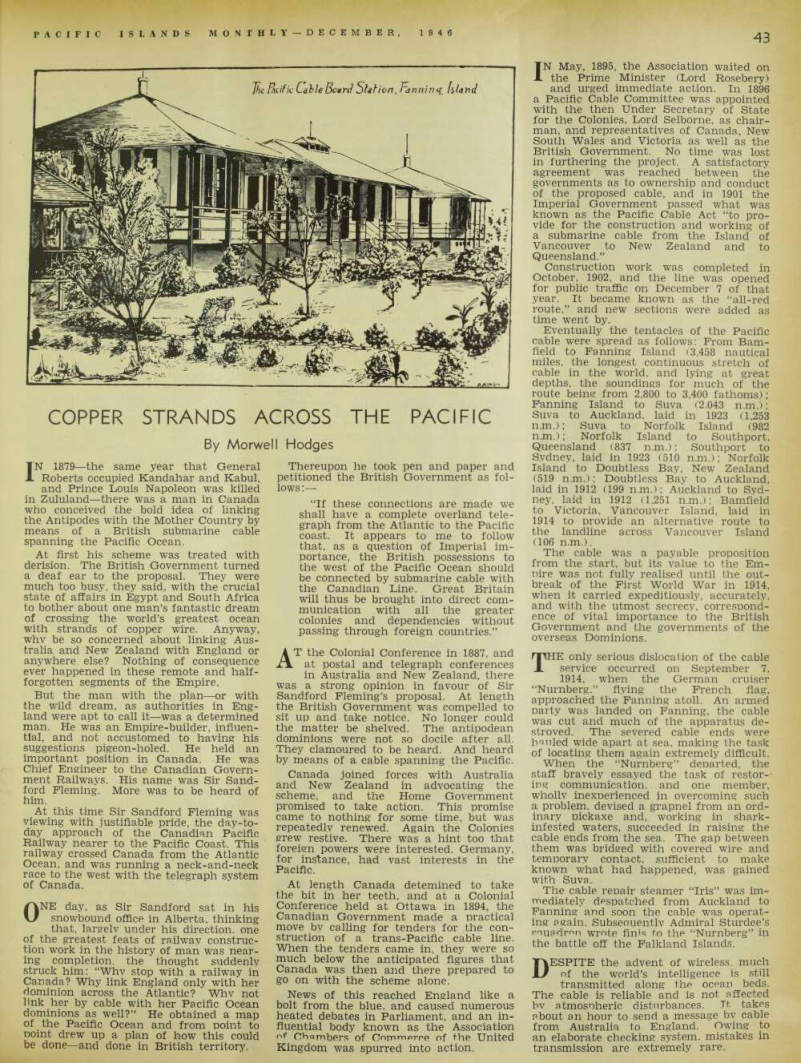
THE only serious dislocation of the cable service occurred on September 7. 1914, when the German cruiser “Nurnberg.” flying the French flag, approached the Fanning atoll. An armed party was landed on Fanning, the cable was cut and much of the apparatus de stroved. The severed cable ends were hauled wide apart at sea, making the task of locating them again extremely difficult.
When the “Nurnberg” denarted, the staff bravely essayed the task of restor ing communication, and one member, wholly inexnerienced in overcoming such a problem, devised a grapnel from an ord inary pickaxe and, working in shark infested waters, succeeded in raising the cable ends from the sea. The gap between them was bridged with covered wire and temporary contact, sufficient to make known what had happened, was gained with Suva.
The cable repair steamer “Iris” was im mediately despatched from Auckland to Fanning and soon the cable was operat ing again. Subseouentlv Admiral Sturdee’s wrote finis to the “Nurnberg” in the battle off the Falkland Islands.
DESPITE the advent of wireless, much of the world’s intelligence is still transmitted along the ocean beds.
The cable is reliable and is not affected bv atmospheric disturbances. It takes about an hour to send a message bv cable from Australia to England. Owing to an elaborate checking system, mistakes in transmission are extremely rare.