The New New Guinea
pp. 11-12 · Read in the full issue
Its Depressing Present and Its Curiously Uncertain Future A Survey by Judy Tudor
WHEN I returned to New Guinea after several years’ absence, at the begin ning of September, I went with what I believed was an open mind.
Because I felt that I knew my Tern torians, I was prepared to discount some of their grievances; because I believed that the New Order could not be wholly wrong, I was prepared to see good in its aims. Somewhere, I hoped, there was a middle road.
When I had been in Port Moresby two hours, a man whose opinion I value said “I don’t know what it all adds up to. I don’t 'know where we are going; or where the Administration is going. I’ve been here months and I’ve got no answer. But perhaps you, with feminine intuition, may see something I can’t.”
Intuition failed to fill that bill; and there were times when I wished mightily for a crystal ball—nothing less seemed likely to provide an answer to some of the frustrations and disorganisation which I encountered in the complicated business of living in that country.
However, I still feel that, with perse verance, we can find a middle road.
Articles dealing with certain angles of Territory’s life to-day will appear in this and subsequent issues of the journal.
This present article is meant as a gen eral survey, and an honest attempt to see the light.
IN Port Moresby, the administration centre is at Konedobu, formerly ANGAU headquarters and situated just below Government House. It is sep arated from the township by about two miles of road and an ocean of doubt, distrust and plain misunderstanding.
Generally I found that the people in Port Moresby were more discontented, knew less and therefore worried more about the Administration’s intentions than Territorians further afield, who had much of their time taken up with the stern business of building a house, gett ing, food and fighting a personal battle with transport difficulties.
In the outports much —as always de pends upon the good commonsense of the District Officer.
There appears in Moresby to be no contact —social, mental or otherwise —between the inner ring of the Administra tion and the ordinary citizen. One high official told me that there actually was no one in the township for the Adminis trator and Mrs. Murray to know. I find that hard to believe.
I found the Administrator and his wife charming, but I met many o her charm ing people in Moresby whose IQ rating is sufficiently high to warrant their in clusion in even the most rarified circles.
In a communistic state, of course, it may be an ideal arrangement for the inner circle to plan and the mob to fol low without question. In a place like New Guinea it is not desirable —particularly now, when it is obvious that it is going to take the best efforts of all sec tions of the community to pull the place out of the slough of despond into which it has sunk.
If the Administration knows its plans —which some openly doubt —then there is ho harm in explaining them to the people. Even if they are distasteful, it is better that than to be in a perpetual state of doubt.
Most people to-day, even in the Ad
ministration itself, instinctively are an tagonistic to the Administration Policy although they often do not know what they are being antagonistic about. A good public relations officer might help close that breach. At present, the place thrives on rumours, most of them with no basis in truth.
The time for the re-establishment of the Legislative Council is long overdue, too. There should be representatives on it of all sections of the community -in cluding native if possible. It is essential that New Guinea people should be allowed some expression of thought.
I HAD every assistance from the Ad ministrator and Administration offi cials, and I talked with various of the departmental heads, particularly those connected with native health, agriculture and education.
Briefly, all are proceeding with plans based on the supposition that large Gov ernment grants will be forthcoming from Australia. One departmental chief is of the opinion that if Australia will not make the grants indefinitely, then the United Nations will. Perhaps he has more insight into the workings of UNO than I; but, personally, I should not like to depend much' on finance from that quarter.
As for the plans themselves: they are good plans, in tune with similar practices in other native countries overseas and are, in fact, only putting into effect what was promised as long ago as the time of the annexation of Papua.
But they are plans of the future—of 20, 30 and 50 years hence depending upon how long it takes the New Guinea native to adapt himself to civilisation.
Little is actually being done by any of these departments. In native health, for example, I doubt very much whether the service is up to 1939 standard. The Department is carrying on the 44 hos pitals established by ANGAU; but there is a shortage of European staff and few facilities for training native practitioners at present.
The same can be said of education which must be an even slower process— and of agriculture.
The plans of the Agricultural Depart ments are extraordinarily detailed and far-reaching. They will be in full oper ation in about 50 years, I should judge; but in the meantime —what?
IT needs no crystal ball to see that, as far as Europeans are concerned, the writing is on the wall in the Pacific anyhow, and their days there are num bered. That is plain in Samoa, Tonga and Fiji to-day, and what is happening there is inevitable in New Guinea. Time and progress are going to take care of that. But, in the interval, would it not have been better to quickly re-establish those industries that were already well rooted in the Territory, even though they were run by Europeans?
Mr. W. Cottrell-Dormer, Director of Agriculture, told me that the present agricultural policy is not to get rid of Europeans. On the contrary, he said, the Australian Government is all in fav our of encouraging the planters, already established, as in this way the native will learn by example. He says that he has discussed the matter with the Min ister, and that the Minister, too, is sym
pathetic towards European planting. The Europeans, however, would like to hear Mr. Ward’s assurance of that from Can berra; and I think, too, that it would clear the air considerably if Mr. Cottrell- Dormer, on behalf of the Administration, made a speech to that effect over the Moresby radio network.
Planters perhaps strangely in view of this assurance are still labouring under the impression that their efforts to produce, or even to re-establish them selves, are of no particular interest to the Administration or the Australian Government. If it is otherwise, then they should be told. A little encourage ment hurts no one.
Briefly, the Government’s economic plan (when the native has been edu cated and made reasonably fit) will be based on native, and not European, agri culture. It is, for example, hoped to establish large tea estates on Mt. Hagen, which ultimately will be run for and by the natives: but even the most optim istic estimates put the full-flowering of this project at 30 years from now.
In the interval, and until such time as the native is ready to take over, the country’s economy must be based on Euro pean enterprise, or on grants made by the Australian Government—in other words, must be paid for by the Austra lian taxpayer. The taxpayer is at pre sent footing the bill, and judging by the results of the recent election, is prepared to go on doing so for the next three years at least.
It seems, however, an illogical way of running a country which could very easily be self-supporting. Prices for copra, rubber, cocoa, coffee and gold are high, and most other Pacific territories are enjoying boom times.
AWAY from Moresby, there is another picture. No permanent building can be erected in the townships until the Town Planners permit it —and the Town Planners have been in the Territory for months now without producing any plans. While they wait, everyone, includ ing Administration officials, goes on living in converted army barracks, grass huts, old stores and anything else that provides a roof.
Lae is possibly the most depressing
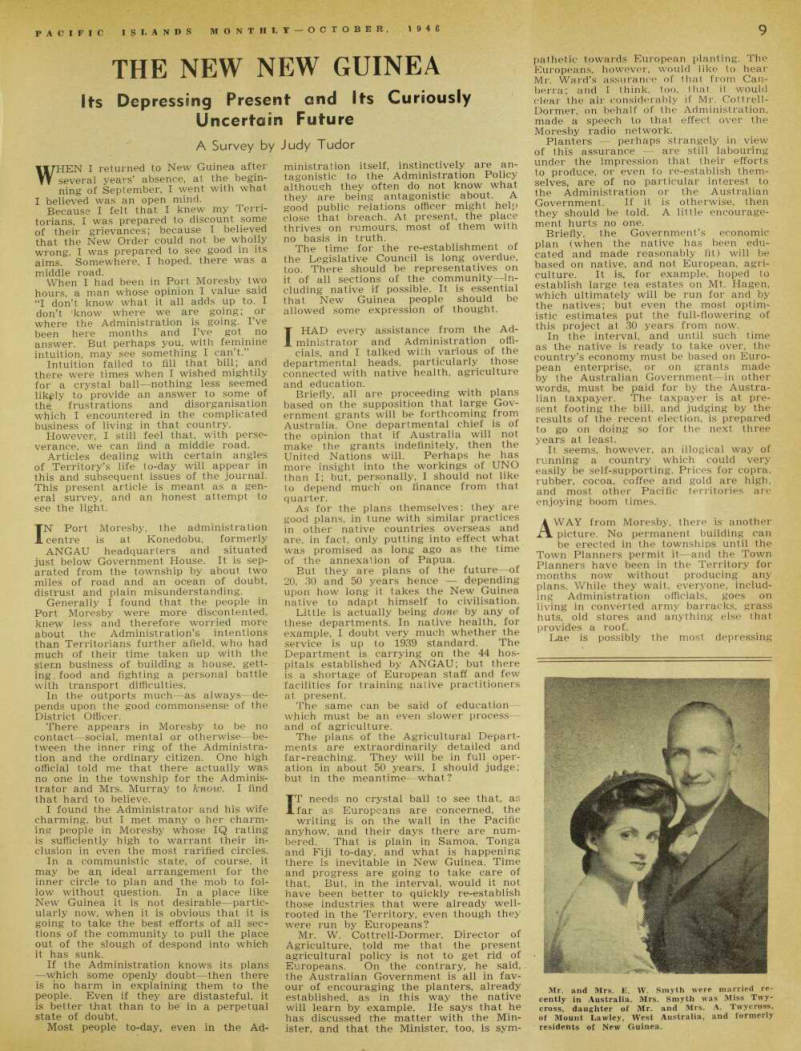
Mr. and Mrs. E. W. Smyth were married re cently in Australia. Mrs. Smyth was Miss Twy cross, daughter of Mr. and Mrs. A. Twycross, of Mount Lawley, West Australia, and formerly residents of New Guinea.
part of the Territory, both because of its climate, which is foul, and the scat tered nature of the naturally unattrac tive township. Lae, without gold exports, seems to have no reason for existence.
Madang is battered, but still beautiful.
Local plantation labour has only re cently been paid off, but some copra is still being cut.
At least one plantation owner there is working out his labour difficulties by going in for a sort of share-farming busi ness with the local villages. The success of this depends, ultimately, of course, upon what the natives can buy with their money. Money of itself is and never was much use to a native but he will work so long as he has some specific purpose in view.
Here, too, in Madang, W. R. Carpenter & Co. Ltd., are going ahead with a pro ject that should bring prosperity to the township.
ON the goldfields, only Bulolo Gold Dredging are making any notable pro gress. They have gone into the busi ness of re-establishment in a systematic manner, and are getting results.
New Guinea Goldfields .Ltd. are also busy, but their results are so far not perceptible to the naked eye.
The smaller shows are still at a stand still, most of them waiting for equipment and machinery and most of them exist ing on war damage insurance payments.
Equipment for sluicing, and labour to build the water races, are still unpro curable.
No gold is being produced at all in the goldfields area (although it should be a national asset at this time of dollars shortages) except, perhaps, by a few alluvial miners in a small way.
Mining ordinances are still suspended in New Guinea and it is impossible, to date, to sell gold even when or if it is won. Except on the two largest com panies' properties, the greatest activity in the Wau-Bulolo district is the plant ing of kau-kau and other vegetables, against the day perhaps when it might be practical and economic to hire a, line of boys for mining operations.
AND, now, what of the Territorians themselves? In spite of all their dif ficulties, the continual frustration which they meet at every turn, the ex tremely bad living conditions, the fact that they have to start all over again, and the deep disillusion that anyone but a clod must feel on returning to the Ter ritory, they manage to be more cheerful than one would suppose.
Most of them derive contentment from the mere fact that they are back again in their own country. It will take a mighty lot to dislodge them, no matter what obstacles, natural and otherwise, rear up in their path.
Characteristically, they are tackling their problems each in his own individual fashion.' All give a helping hand to the other fellow, but there is no suggestion of banding together for the common cause —although there are causes enough to start half a dozen small revo lutions.
The Pacific Territories Association, which did a good job in Australia while the Territorians were isolated there as “evacuees,” has died a natural death.
From the moment its affairs were wound up in Sydney, it disappeared from human ken and no one has suggested resurrect ing it.
In any other community, union might be strength. In New Guinea, I doubt it; the people are not built that way.
Many who have gone back with their old iron-clad ideas intact are finding the going tough. Most, however, have been able to adjust their minds to changing
times, and I would back these latter against any New Order. If they can weather the next 12 months, then I irhagine they will have carved another niche for themselves. But New Guinea will not be for their children, or their children’s children.
IN conclusion, here are some outstand ing impressions of a four weeks’ visit: GENERAL: Frustration.
Most Respected Official: Mr.
K. McMullen, formerly of District Ser vices, TNG, and now seconded to PCB.
BIGGEST MYSTERY: The functions and purpose of H. lan Hogbin and Miss Camilla Wedgwood, anthropologists. The general opinion is that if it is experts the Administrator needs, then he has them in his own departments.
Biggest Disappointment: Com
monwealth Disposals Commission.
GREATEST NEED: Shipping; and someone to stop planning long enough to fill in the holes in the roads, keep the power stations functioning, the water services running, transport on the roads and the temporary houses and quarters from entirely disintegrating.
BIGGEST MOAN (in outports): No beer.
These and other matters will be dis cussed in subsequent articles.