Moresby's Housing Shortage Causes
pp. 10-76 · Read in the full issue
Trouble
MUCH of the discontent which exists in the Public Service in Port Moresby (and other parts of the pro visional territory of Papua-New Guinea to a lesser degree) is caused by housing shortages and lack of other reasonable amenities.
As was reported in September “PIM.”
Moresby public servants held a protest meeting in August, to discuss, among other things, the extraordinary length of time apparently necessary to complete the 40-odd Government houses that had, at that date, been under construction for eight months. John Stubbs and Sons, of Sydney, are the contractors who are building the houses.
The protest meeting, however, was somewhat of a damp squib—the fact that it made the Sydney Sunday papers’ headlines notwithstanding.
The meeting was called by the presi dents of the Papuan and New Guinea Public Service Associations and was for members of the Provisional Administra tion. The meeting was well attended by public servants (90 per cent, of whom remained, as usual, inarticulate); by the Administrator; and by the heads of vari ous departments.
At the commencement of the meeting, Mr. L. Odgers (NG Public Servants’ As sociation) rose and suggested that, as the Administrator was a busy man, the meeting be adjourned while he addressed those present; later he (the Administra tor) could leave and the business of the meeting could proceed.
The Administrator, however, was not so lightly disposed of; he said that as a member of the Provisional Administra tion he insisted on being permitted to remain, and the chairman, probably out of his depth, consented. Technically, the Administrator is divorced from the public service in that the Administration has a special function and he is not a member of the public service of the Pro visional or any administration.
However, the meeting was then thrown open to discussion, during which there was, as already reported, some plain speaking by the articulate min ority.
OPINION is divided in the Territory on the appearance of the Adminis trator at a meeting called for the plain purpose of discussing and dissect ing him and his administration. But whether it was or was not etiquette his presence certainly cut the ground from under the feet of the rank and file, although he in turn was forced to listen to some frank criticism.
This discussion should perhaps have cleared the air. Indications are, how ever, that it left the important issues very much as they were. Public service grievances remained unmet, apart from the announcement that a Common wealth Public Service inspector would visit the Territory at the end of Septem ber to inquire into wages, conditions, etc.
The next move is again up to the public servants, but it is highly unlikely that they will actually strike, as has been suggested in sections of the Aus tralian press.
As a class, public servants (possibly because they are good citizens) are re luctant to take direct action, and although there is undeniable unrest in New Guinea and much off-stage mutter ing, it probably will remain at that.
ONE outcome of the meeting was a statement by the Director of Public Works that if it were quickly built homes that they needed, he could pro duce one in a fortnight. The challenge was accepted, and the Public Works De partment made good its promise.
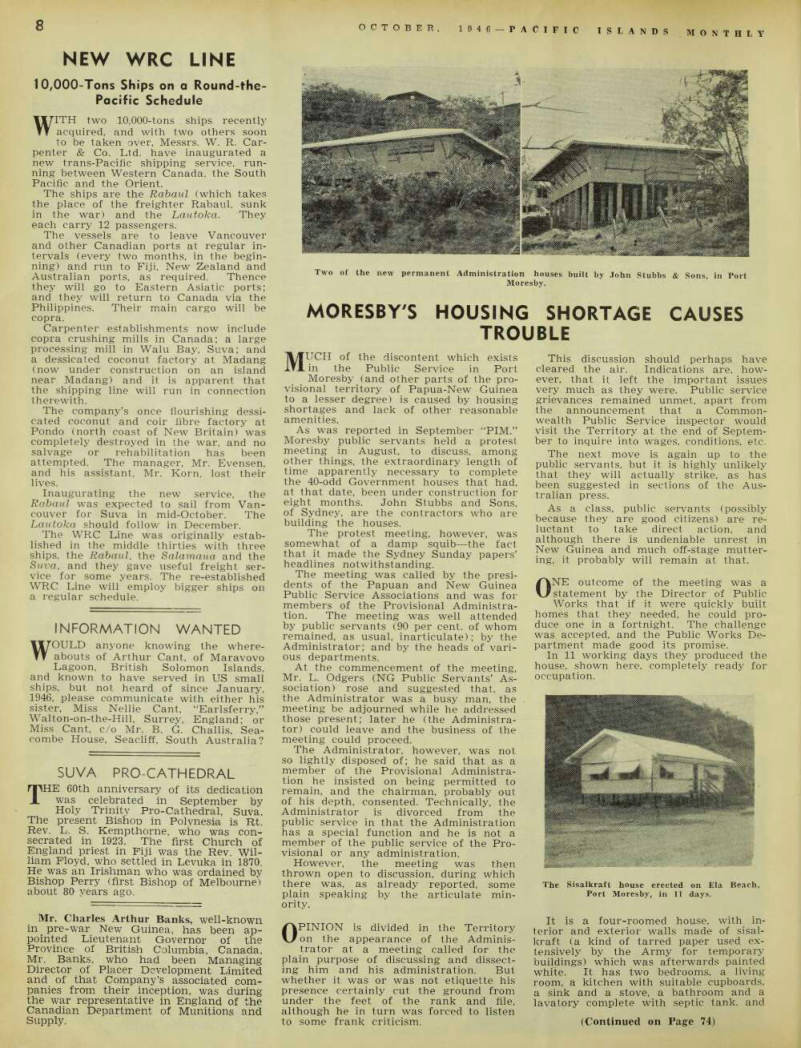
In 11 working days they produced the house, shown here, completely ready for occupation.
It is a four-roomed house, with in terior and exterior walls made of sisal kraft (a kind of tarred paper used ex tensively by the Army for temporary buildings) which was afterwards painted white. It has two bedrooms, a living room, a kitchen with suitable cupboards, a sink and a stove, a bathroom and a lavatory complete with septic tank, and
(Continued on Page 74)
Two of the new permanent Administration houses built by John Stubbs & Sons, in Port Moresby.
The Sisalkraft house erected on Ela Beach, Port Moresby, in 11 days.
is connected to light and power mains.
The house is erected on Ela Beach, near the native hospital, and presumably will be used by someone connected with that establishment.
Price for the “paper”-house was not divulged, but it can be assumed that it cost many times less than the £2OOO - Stubbs’ houses, which are only slightly more livable. The Public Works Department is not, however, to go on building these temporary dwellings. It is believed that local native builders will be asked to put in a tender for their construction if it is decided to build more of them.
Although “temporary,” they are built on a good timber frame, with excellent
flooring and roofing. The sisalkraft will last at least two years; but cement sheets, when available, can easily be ap plied over the paper walls which would then provide insulation.
THE permanent houses (shown on page 8), are of fibro-cement sheets. Shut ters also are of flbro—which effect ively excludes all light and most of the air.
They come in two or three-bedroom types, with lounge, kitchen and bath room, all under one roof. Pre-war cost in the territory would probably be about £4OO.
The location of these dwellings can only be described as quaint.
The house designed for Dr. John Gun ther, for example, is supported by long piles in front, while the rear nestles snugly into the good earth. Dr. Gun ther, however, may be an enthusiastic rock gardener, in which case he will have fine scope for building a diminish ing series of terraces down the perpen dicular drop from his front door.
Contractor Stubbs, too, is no doubt having headaches in procuring supplies; it is stated that Australia will export to New Guinea only four stoves per month; and timber also is difficult to obtain. On the other hand, it should be pointed out that in recent months at least two special ships were employed carrying sawn timber from Cairns (Queensland) to Alexishafen, in New Guinea, for the Catholic Mission there. What the Cath olic Mission can manage, John Stubbs and Sons, with the help of the Adminis tration, surely can do.
More And More People
IT is hard to decide whether Port Moresby, in relation to housing, is worse off in comparison with the rest of the territory, or better off.
In Moresby, it is seemingly impossible to build oneself a grass hut or repair a disintegrating Army building. In the rest of the Territory, it is not only pos sible to have a grass hut or an Army shed, but it is the only way in which to get a roof over one’s head. One thing is certain, however; there are more
wails in Moresby, in regard to housing, than in the rest of Papua-New Guinea combined. We repeat; perhaps this is because in the outposts a man who is at all handy, can make a habitable dwelling for himself; but in more civilised Moresby he has to put further strain on the already overcrowded accommodation.
Every ship and plane brings more people. As a solution to the problem of where they all will go, someone has sug gested that they crawl into the holes in the woodwork.
Port Moresby Hotels
THE Hotel Moresby is catering well for the travelling public and is also sup plying hundreds of extra meals for those who have sleeping accommodation, but no means of cooking food. The “Top Hotel,” which also belongs to Burns Philp & Co. and which was ready for occupation when the balloon went up in 1942, is now an empty shell —all its ex pensive fittings and furniture disap peared during the occupation as com pletely as though they had never been.
During the war, this fine building ap pears to have been an officers’ club, and the Australians and/or Americans who occupied it converted it to their own peculiar uses. Where an extra entrance to a room was deemed necessary, a hole was roughly hacked there; when electric fittings were to be removed, they were torn out by their roots; toilets were re moved from their external fittings and filled with indescribable rubbish.
To-day, therefore, the hotel that was to give Papua a touch of civilized luxury is a great, empty, echoing barn, serving no purpose. The contract has been signed for repairs and it will eventually be furnished again and put into commis sion; but that will be many, many moons hence, at the present rate of progress in the Territory.
When it is habitable, it will be capable of housing New Guinea’s travelling public and will probably house perman ent residents as well. At present, the Moresby Hotel caters only for the trav elling public and no permanent guests are taken.