Assignment In Mid-Pacific
pp. 41-43 · Read in the full issue
Sir Albert Ellis Has a Story to Tell
AFTER the Jap surrender in August, 1945, arrangements were made for Australian forces to go north from Torokina (Bougainville) and re-occupy the phosphate islands of Nauru (former Anglo-Australian Mandate) and Ocean (chief island of the Gilbert and Ellice Colony). An invitation immediately was sent to principal men of the British Phosphate Commission, and Sir Albert Ellis, of Auckland (one of the Commis sioners), Mr. J. A. Bissett (the Com mission’s New Zealand manager), and Mr. Bott (the Commission’s chief en gineer) were flown to the rendezvous, and took part in all the subsequent pro ceedings.
It was a good thing for the Commis sion, for these experts were able to make a survey of the damage to the phosphate installations immediately after the sur render; but it also was a good thing for the world. Sir Albert Ellis, pioneer of the Central Pacific, discoverer of the great phosphate deposits on Nauru and Ocean, author of two books on Central Pacific history and conditions, was thereby given material for his third book, “Mid Pacific Outposts,” a copy of which has just reached us from the publishers (Brown & Stewart, Ltd., Auckland— -17/6).
Thus, there has been filled what threatened to be a very ugly blank in the recorded history of the war in the Pacific.
We have had some connected stories of what happened in most Pacific areas be tween Pearl Harbour and August, 1945; but no intelligible account of war events in the equatorial region wherein lie Ocean Island and Nauru.
Sir Albert has not only filled this blank place in war Pacific war history; he also has produced a highly interesting, colour
lul and readable book. It sketches in the necessary background, and it is filled with facts, names and documents, in their correct order. It is indispensable in any Pacific library.
When Japan struck, the following ap proximately was the population on the two “outposts” (phosphate islands)
Most of the Europeans and some Chinese were got away, but many of the Chinese and all the natives were left to the tender mercies of the Japs. Large numbers were shipped away to the other islands (Carolines, Marshalls. Gilberts), and large numbers were murdered. This new book gives many terrible details.
SIR Albert tells how the Europeans and Chinese were rescued. The Allies, in February, 1942, sent north a very fast Fighting French cruiser-destroyer, Le Triom'phant, and the British Phosphate Commission vessel Trienza. The French cruiser dashed in at night to Nauru, loaded Europeans and Chinese, and raced back to a mid-ocean rendezvous with the Trienza. She unloaded on to the Trienza; and, again in darkness, she went into Ocean Island. Thus, without accident, despite prowling Jap ships and planes, they landed safely in Brisbane, 226 Euro peans and 597 Chinese, on March 8, 1942.
Of the Europeans, there voluntarily re mained behind to guard natives and property, the following men:—
The men who remained on Nauru were murdered. Those who stayed on Ocean Island were virtually murdered —they apparently died from disease, induced by starvation, ill-treatment and lack of medical care.
The Japs turned both islands into the strongest fortresses they had created anywhere in the Pacific, evidently in the belief that we should try to take them by frontal assault. MacArthur took them by strategy. He by-passed them, and struck at the head of the octopus, in Japan; he cut off all their supplies for a year; and the Japs ignominiously surrendered both phosphate island fortresses without firing a shot.
SIR ALBERT was a keenly observant member of the force which landed on both islands to receive the Jap surrender and re-occupy the places, and his description of what they found —immense fortifications, and skinny exhausted garrisons, trying to live on a diet of pumpkins and coconut toddy, with oc casional fish —is alone worth the price of the book.
One note runs riglrt through this book.
It is one long story of torture and
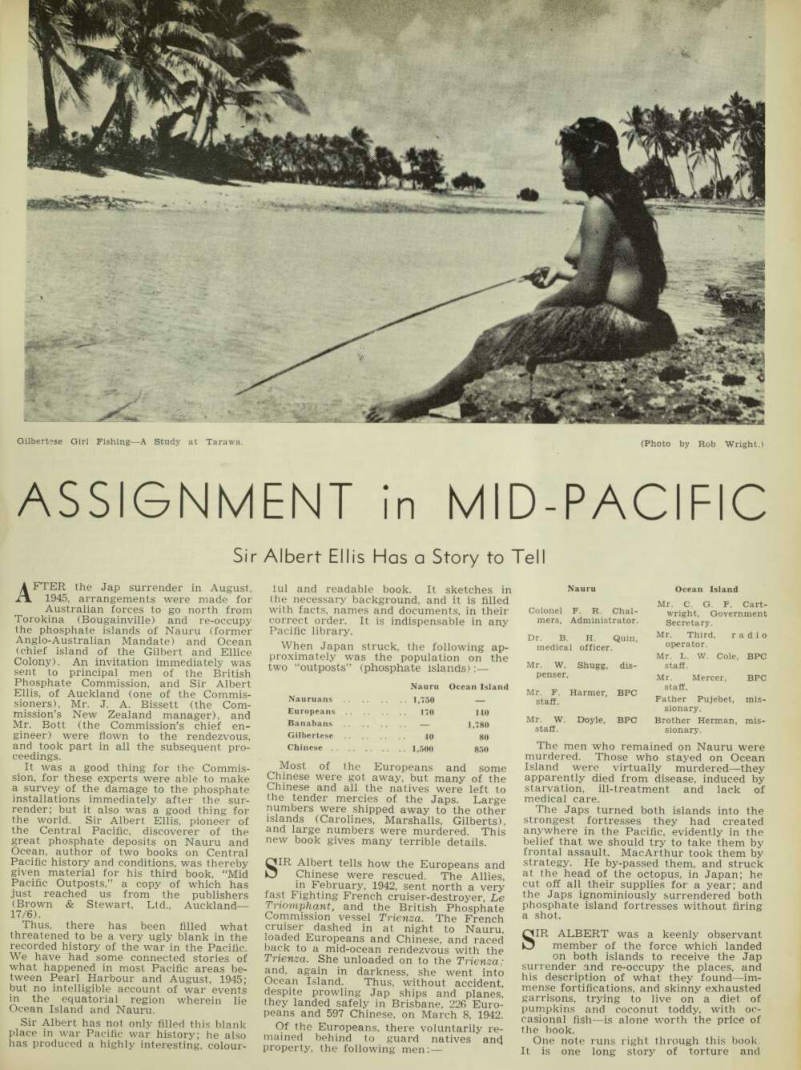
Gilbertese Girl Fishing—A Study at Tarawa.
(Photo by Rob Wright.)
Nauru Ocean Island Nauruans 1,750 — Europeans 170 140 Banabans — 1 780 Gilbertese 40 80 Chinese 1,500 850
Nauru Ocean Island
Mr. C. G. F.
Cart- Colonel F. R.
Chalwright. Government mers, Administrator.
Secretary.
Dr. B H.
Quin.
Mr. Third. radio medical officer. operator.
Mr. L. W. Cole,
Bpc
Mr. W.
Shugg, disstaff. penser.
Mr. Mercer,
Bpc
Mr. F.
Harmer,
Bpc
staff. staff.
Father Pujebet, missionary.
Mr. W.
Doyle,
Bpc
Brother Herman, misstaff. sionary.
murder, robbery and starvation. No where is there anything at all to suggest that these men of Nippon are even human in their treatment of fellow mortals. All the evidence of the South Pacific is that they are sub-human beasts.
Sir Albert went from one horror to an other: From the scene of the murder of the Nauru officials, to the place where they massacred the last Banabans on Ocean Island; from the desecrated ceme tery on Ocean Island to the spot on Tarawa, where the Americans erected a monument; “In memory of 22 British subjects murdered by the Japanese on Betio . . . Standing unarmed to their posts, they matched brutality with gal lantry and met death with fortitude.” All these were familiar places —many of the murdered people were his personal friends. \\TE quote now from ‘'Mid Pacific Out
▼V posts”:—
Of the people’s welcome to the returning Europeans : With gratification that was quite natural, Mr. Bott said that when they entered the boat harbour at Nauru, Lieut.-Colonel Kelly had courteously stepped aside and invited him to be the first European to land on the island since the Japanese invasion three years pre viously. It was a very appropriate honour, for he had been island manager on Nauru for the Commission at the time of the evacuation, with all its worries and responsibilities.
Mr. Bott stated that he had received a very pathetic welcome from the large crowd of natives near the landing steps, and was much touched by the experience, saying that many of the natives and Chinese had tears streaming down their faces. One can well imagine this, as they recognised the man so well-known to them stepping out of the barge. His return, in itself, was sufficient guarantee that their troubles were over.
Of the damage done on Nauru : We went down to the low-lying country again, and along to the air-strip, com mencing at the site of the Administration settlement; but there was not a sign of it, and I was unable to locate the area.
The air-strip was much larger than I had anticipated, and must have entailed an enormous amount of work in construction.
The Nauruans’ much-prized coconut trees had been cut down by the thousand, many of the trunks being used in roofing over the gun pits and bomb-proof shelters.
Dotted about the vicinity were a large number of wrecked Japanese planes, the result of the Americans’ overwhelming attacks.
The only places where we could see any of this material (the phosphate works’ rubber-belt conveyors) was on the floors of the Japanese “apartments” in the tunnels, where it was cut into lengths and did duty as floor covering.
As the Residency, the manager’s and assistant manager’s houses on Ocean Island had suffered more than the other buildings at the hands of the Japanese, it appeared as being part of their studied policy to belittle the Europeans in the eyes of the natives.
Of how the Japs fed themselves and the natives : Wherever one went about the island — between the machine-gun posts and the pill-boxes, the gun emplacements and the air-raid shelters, the tank traps and the trenches —there were pumpkins; one could not possibly get away from them. Nauru was the world’s record pumpkin-patch, and until the present crop is gathered or destroyed it will continue to hold the record! There were heaps of them ready
for use; huts stacked full of them. I’ve never seen so many in my life.
Sweet toddy has a high nutritive value, being rich in vitamin B. when touring the island it was evident to us that the coconut palms had been tapped on a large scale —thousands of them, in fact!
To do this, deep notches were cut in the trunks of the trees, so that the natives or Japanese (for they learned to do it) could readily climb to the top of the highest palms.
The process of tapping is to bind up about half of the spathe before it opens out into flower, with coconut twine, and then sever the outer end. This produces a regular flow of sap, and a bottle or a coconut shell is suspended underneath to catch this. Each morning and evening the full receptacle is removed and re placed by an empty one. Only a small proportion of the palms should, however, be treated in this way, as the tapped trees do not bear coconuts, and therefore the normal crop was being destroyed. When the tapping ceases, the palm usually comes into bearing again.
Of the disappearance of the stone which commemorated Sir Albert’s original discovery of Ocean Island phosphate ; At first sight, there was no sign of the historical object, which had consisted of a large square concrete base, supporting a block of limestone, with a bronze tablet cemented to it reading: “This stone marks the camp site of A. F. Ellis when first prospecting this island in May, 1900. Here the British flag was first flown.”
Looking closely, however, I found the remains of the concrete base, also a large piece of coral rock on which I used to sit when talking to the Ocean Islanders.
One could not but feel rather dejected at the destruction of this memento. It had been installed at the suggestion of an old member of the staff, who was associated with the Historical Evidence Society of Sydney.
While surveying the surroundings, so altered since I had last seen them, some thing unusual caught my eye—and there, among the rocks and rubbish, was the bronze tablet, a good deal bent, but quite useable. (It since has been replaced.) Of native communities scattered or massacy'ed : The most noticeable feature from the human aspect on Ocean Island was the absence of any native population. Right from the beginning of our operations in 1900, there had always been plenty of Ocean Islanders about, and many of our native labourers. These brown people had seemed to be part and parcel of the establishment, so to say, and a very ap propriate one. It was a marked contrast to the crowds of enthusiastic and excited natives who had greeted our arrival at Nauru.
Of how Jap plans went astray.
An interesting feature which came to light during the investigations of the survey party was the discovery of cer tain arrangements made by the Japa nese at the boat harbours and the phos phate bins, in anticipation of shipping the phosphate stored there. The plan they had worked on was somewhat similar to the temporary method which we now will use at Ocean Island. But it appears that when they were ready to begin shipping, the American bombing attacks became so intense that the Japanese decided not to risk their vessels. (No phosphate was shipped from either island by the Japs.) Of the damage to the phosphate-working installations : The investigations of the survey party
fully confirmed that the damage at Nauru was very heavy—in fact, worse than had been anticipated.
Apart from the destruction done by the Commission’s personnel prior to the evacuation, in order that the Japanese should not be able to ship phosphate, the island has the remarkable record of hav ing been attacked by three Powers during World War No. 2. The German raider (in 1940) shelled it for two hours, causing much damage; Japanese planes bombed it the day following Pearl Harbour, and on subsequent occasions; and, finally, the American attacks by sea and air com pleted the work of destruction. It is little wonder that the island was des cribed as being a “shambles.”
It will be realised that with feelings of profound relief we saw that Ocean Island was not so badly damaged—in fact, more of the buildings and plant had survived the ravages of war than we had dared to hope. True, a great deal of the rail way material had been shipped away, or was installed in jagged patterns across the reef as obstacles in the event of a landing attack, and many houses had been wrecked internally, removed, or bomb damaged, including the large machine shop. All would require recon ditioning or rebuilding, and that must necessarily take a long time.
Of the blasted battlefield on Tarawa Atoll : We never ceased to marvel that on this little islet of Betio, less than a square mile in area, over 5,000 dead had been buried; it seemed incredible.
There can be no doubt that the Japa nese considered the place impregnable.
Following their usual practice of be littling the white men in the eyes of the natives they boasted to them that they could never be defeated there. But they did not realise the prowess of the American Marines. Tarawa will ever be classed among the bloodiest battles of the war, an epic fight, one in which the gallantry, resource and determination of the Marines carried the issue to victory.
Most of Betio now is perfectly flat, bare and blazing hot in the tropical sun shine; certainly most historical, but not in the least degree scenic. The long, wide landing-strip for aircraft dominates the picture, occupying a large portion of the island.
Of good relations between British and Americans in these seas : It may be thought by anyone reading these pages that the Union Jack is the only flag that counts in the affections and respect of the white people and natives in these Central Pacific Islands. That is certainly not the case, for the Stars and Stripes also holds an honoured place with them —as well it should.
One does not like to contemplate what the position would have been had the Americans not extended their activities to these latitudes when they did. At Tarawa, therefore, it was pleasing to see the Union Jack flying out bravely from the Resident Commissioner’s trim and ship-shape flagstaff; while only about a hundred yards away was the Star Spangled Banner, similarly fluttering in the breeze.
They seemed to me both fit and proper, a token of mutual respect, and an in dication of hope for the future. With the tragic war just ended, surely the foremost thought with us all must be that the two great English-speaking nations, Britain and America, should go forward together with similarity of pur pose, the same ideals of justice and liberty, and like religious beliefs. If they do this, and keep a due sense of responsi bility, there will be hope for this war-'-
stricken world.'
R.W.R.
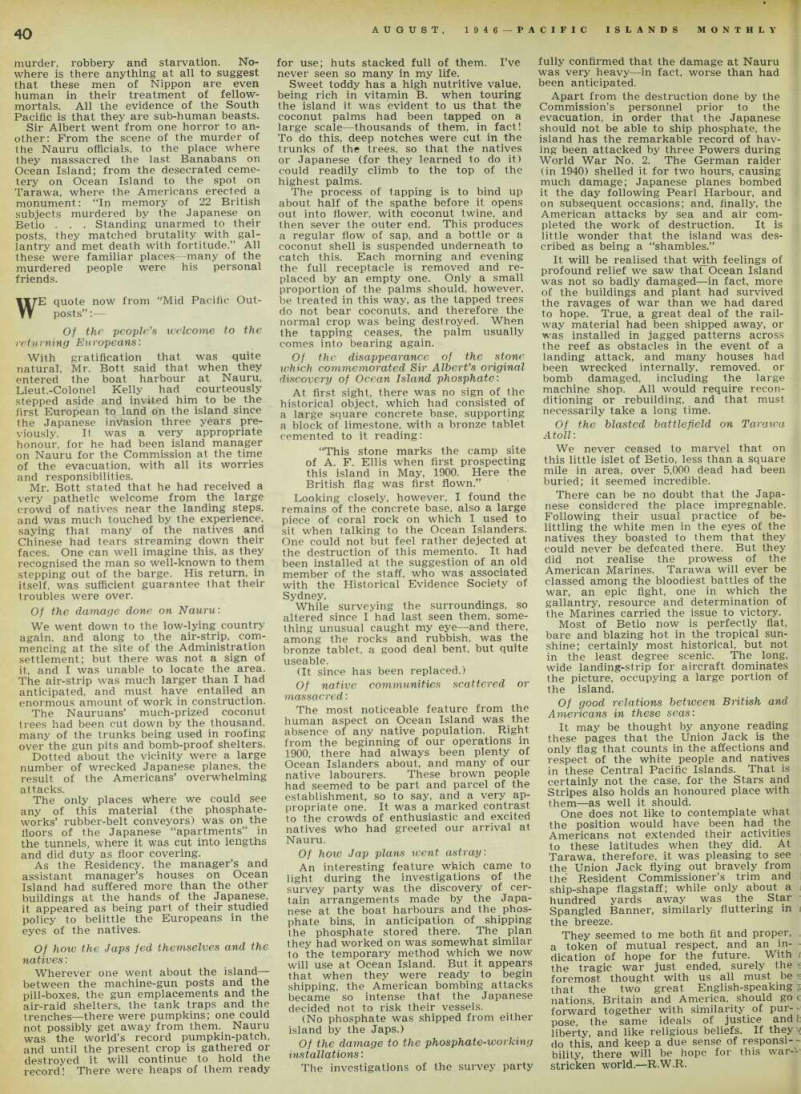
Drawing of a Trobriand Islander by Sheila Farquharson.