Tropicalities
p. 40 · Read in the full issue
WITH a friend, who is a RNZAF. tech nician travelling round the islands servicing the radio equipment on the airmail route, we were discussing the “borrowing” habits of our brown brothers.
On his latest visit to W. Samoa he was investigating a plant that had gone “dead.” The power supply was carried by a heavy, expensive cable which for the greater part of its length, was buried, but one section of which crossed very hard ground, where it had merely been covered with rubbish and weeds. Over hauling the power line, our friend dis covered that the unburied section had been cut out and borrowed by persons unknown.
Visiting another station, he was sur prised to find that there was no aerial.
But by looking in the bush, it was revealed that the aerial masts had been felled and the galvanised stay wires “borrowed” —for making fish-spears.—W.B. ♦ ♦ * THE Ellice Islanders of Vaitupu, who have purchased Kioa, in the Fiji Group, and are also laying claim to Niulakita, the most southern of the Ellice Islands (July “PIM”) base their claims on an event of 80 years ago.
According to the Islanders, a party left Vaitupu in canoes for the island of Nuku laelae (Ellice Group also) about the year 1866, but failed to reach their destination, and landed at Niulakita, which was then uninhabited. Here they stayed long enough to plant gardens and coconut groves, and to construct new canoes, before they sailed back to Vaitupu.
The connection between the two islands continued, however, until about 1884 when the people were apparently induced by the German firm of Ruge & Company to turn over their rights on Niulakita, in return for the cancellation of certain debts the Islanders were supposed to have incurred with the firm. Five years later the German firm went into liquid ation and the island was sold to a well known Apia merchant, Mr. H. J. Moors (father-in-law of the late O. F. Nelson and friend of Robert Louis Stevenson).
It changed hands again between then and 1926. when Burns Philp (SS) Co. Ltd., acquired it. As already stated in the “PIM,” the G & E Islands Colony bought it from BP in 1944.
Three other Ellice Islands (Nukufetau, Nui and Nukulaelae> have also recorded claims to the island. The G & E Govern ment intends to hold an inquiry into the respective claims at an early date and then sell the island, at cost price, to the successful claimant. —MAC. ♦ * * IS the ban off Bird-of-Paradise feathers? Seen at a Sydney “do” recently was a lady with a hatful of golden Paradise plumes which leapt to the notice of anyone with an eye for beauty or the unusual.
Or is it that because these feathers have been off the market for so long, neither police nor Customs officials recognise them any more? Once seen Paradise plumes should be hard to for get.
Another prohibited export from New Guinea was the crest of the Goura pigeon—yet one Sydney “beauty salon” has had a crest in one of its windows
for months. These Air Force grey feathers with the white eyes, although lacking the softness of the Paradise plumes, are sufficiently beautiful to make them popular hat ornaments—if they were procurable.—“NG-ite.” * * * HAS anyone noticed that not only do one’s gramophone records last longer even under frequent playing in the islands, but when worn, and put aside as “dud,” they suddenly gain a new lease of life?
It’s island air that works the seeming miracle! The damp and salt-laden at mosphere affects the record surfaces in such a way that they exude a crystalline substance, that partly fills worn grooves, causing the needle to “track” almost as freely as when the disc was new. So. a scratchy disc just needs a rest, for this crystalline material to develop. With “canned” music still scarce this is worth knowing.—“ETl.” * * ♦ TWO Territorians who have decided not to return to New Guinea are Mr. and Mrs. H. C. Hill. They have built a caravan and mobile workshop instead, and intend to earn their living by tour ing outback Australia, mending anything from ploughs to tractors.
A gold musical clock forms part of the caravan’s equipment. This was the only household treasure saved by Mrs. Hill when she was hurriedly evacuated from New Guinea in 1942.
Before the war, Mr. Hill was for 11 years dredging-master with Bulolo Gold Dredging. He served in the NGVR be fore joining the AIF.—J.M.H. * * * NO mention was made in your story of Sir Peter Buck (July PIM) that the Maori Knight was also an Anzac. He served as a medical officer in the Maori Battalion which took part in the Gallipoli campaign, and he later went to France, not returning to New Zealand until 1919.
At the time that his knighthood was conferred upon him, the Melbourne “Her ald” ran a short article about Te Rangi Hiroa, written by A. R. McElwain, who in it told the following amusing story of the genesis of Buck’s parliamentary career: “This is how he first, quite accidentally and, I think, a little unwillingly, became a member of the NZ House of Representa tives for a Maori electorate.
“At the routine elections another Maori, after a strenuous campaign, had been elected. But before the House assembled, he died and the seat remained vacant.
“Whereupon the mother of the dead member called the tribe together and had present that celebrated Maori, Sir James Carroll, MP, named for his magnificent oratory, ‘The Silver Tongued.’
“Her son had died, the mother told the assembly. He had left a widow. It was their duty to see that that widow was nrovided for. A husband must be found for her. She (the mother) had taken counsel of Sir James as to who was the most acceptable bridegroom. He had re commended Te Rangi Hiroa. Therefore, she declared, Te Rangi Hiroa must be appointed her son’s widow’s husband. The tribe agreed.
“That was how Peter Buck landed, with out a single election speech, into the New
Zealand Parliament. The ‘widow,’ you see, in the mythical way the Maoris have, was the deceased Maori’s seat in Parlia ment.”—“Kiwi.” * * * NOW that air travel between Pacific islands is available it will be interest ing to see how the authorities cope with the ancient tradition of travellers being garlanded with flowers and berries.
Anybody who has travelled by air around the Cook Group and Samoa, where native chiefs and bright young things of the hula-type have also been on the aircraft, knows just what a trial it can be to be shut in a stuffy cabin with the smell of frangipanni and other sweet-smelling tropical flowers. Some of the berries worn as a necklace have an odour which may be nectar to the native wearer, but are just the source of a plain “iffy” whiff to a white person—and there is no way of getting to leeward.—White’s Aviation Ltd.
1 THINK I’ll give up planting and get me a lugger for pearl-shell fishing. My women-folk tell me that mother-of pearl buttons are on sale in Australian cities again—at a price. Prices range from 1/1 to 2/9 per button; and sizes of said buttons range from the size of threepence to approximately the size of a shilling.
Judging by those rates there must be more profit in pearl-shell than there is in copra at the PCB fixed price of £22/10 - per ton.—Planter Pete. * * rpHE whole history of the New Guinea X Women’s Club of Sydney, as well as that of the war years in the Terri tories of Papua and New Guinea, is con tained in the Club’s scrap-book which was kept from May, 1941, until recently by Mrs. C. H. Maclean.
Clippings from the newspapers of all the eastern States of Australia record Territories’ triumphs as well as disasters during these last dramatic years. It is to be hoped that the book will be continued and that, ultimately, it will find a per manent home in New Guinea, where it will be of great interest and historic value in the years ahead. —A.C.
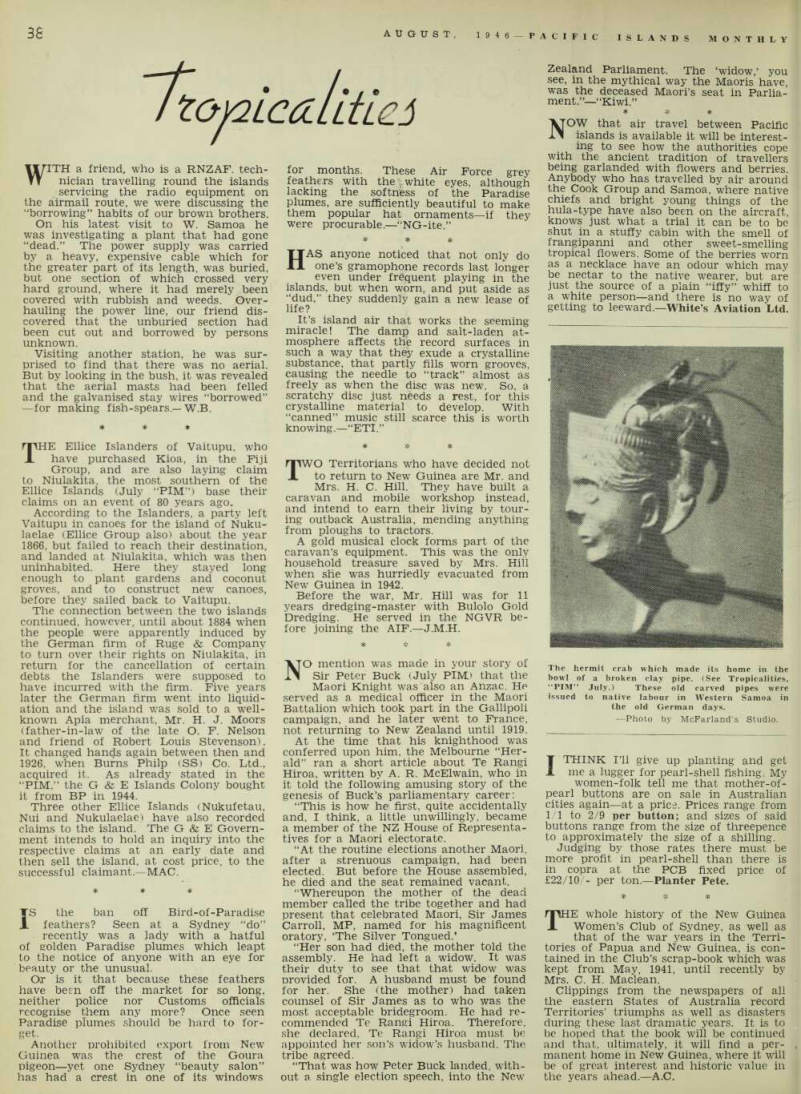
The hermit crab which made its home in the bowl of a broken clay pipe. (See Tropicalities, “PIM” July.) These old carved pipes were issued to native labour in Western Samoa in the old German days. —Photo by McFarland’s Studio.