Knight
pp. 38-39 · Read in the full issue
From Clerk, to Millionaire Knight
OVER 60 years ago, in Suva, two boys entered the service of Walter Horne, clothier and merchant, at the wage of 10/- per week.
To-day. one is well-known “Tommy”
Horne, retired managing director of Wal ter Horne and Co. Ltd., of Suva. He is now a resident of Sydney and the friend of every Old Fijian who nasses through the South Seas metropolis.
The other is Sir John Maynard Hed strom, regarded as anything from semi- to full millionaire, who next March will re tire from the post of managing director of Morris Hedstrom Ltd., one of the most powerful firms of merchants in the Pacific “Tommy” Horne and Mavnard Hedstrom have been lifelong friends.
Some argue that, in this world of mass production and international cartels, there is no room left for business romances of the Dick Whittington tvue. Well, here is one right at hand—the story of John Maynard Hedstrom. of Fiii.
His father was a Swedish shipmaster, Captain N. S. Hedstrom, who held two harbour-master posts in Fiji. Young Hedstrom was born in Levuka in 1872, and was educated at Wesley College, Mel bourne. He matriculated and returned to Fiji, and commerce, about 1888.
But no junior clerk job, or any other job tied to routine and schedule, could hold the energetic, restless youth. Within a very few years, he had tried two or three different posts, and then he found himself back in his birthplace, old Levuka, in charge of the office of A. N. T. Duncan, agent of the Union SS Co. He still was reaching out. He established a commis sion business and then he joined up with Percy Atherton Morris, and together they established Morris Hedstrom & Co., and took over the merchandising firm of Miller Hedey. One R. Bentlev had established the business many years before; Miller Hedey took it over; and then it was pur chased by the two young men (Morris was only four years older than Hedstrom).
That was the foundation in 1902 of a con cern that to-dav counts its assets in mil lions. , . ... , The new firm went along steadily and soundly, in those early years of the cen tury before World War I. Mr. Morris remained at the helm in Levuka; while the ever-restless Mr. Hedstrom. who had begun to take an active interest in public affairs, turned his thoughts towards Suva, now displacing Levuka as the chief town
of the Colony. They bought out the in terests of Arthur Joske, in Suva, and opened a branch of Morris Hedstrom and Co. there, and Suva became Mr. Hed strom’s particular charge. He was elected
to the Legislative Council, and he held a seat there con tinuously from 1908 until he retired in 1937.
WORLD War I did not stop the firm’s progress. Caut ious trading was de manded. but the venturesome spirit of Maynard Hedstrom was attended by shrewd vision: wartime copra made several South Seas fortunes, and MH & Co. saw the writ ing on the wall as soon as anyone. When the war was over, the now strongly-en trenched firm started away on two decades of phenomenal advancement.
Mr. Morris retired from Le vuka, and went to live in Sydney 25 years ago. He is still there, and is still a mem ber of the Board of Directors.
Maynard Hedstrom and Hen ry Marks (head of Henry Marks and Co. Ltd., 30-years old powerful rival of MH & Co. Ltd., in the same field) sat down together for a quiet chat: as a result of which there took place in 1920 an important amalgamation. The younger absorbed the older.
Henry Marks & Co., Ltd., dis appeared; and Henry Marks joined the Board of Morris Hedstrom Ltd.
MH went on growing and growing; its branches appear ed in Samoa and Tonga; its trade stores were seen in every village in the three South Pacific Territories of Fiji, Samoa and Tonga. They bought out Marlow & Co. (afterwards Millers Ltd.), sawmillers and timber mer chants, etc., and that firm controlled by MH, but oper ated separately, also has branches all over Fiji.
Both Maynard Hedstrom and Henry Marks gave distinguished public service to Fiji. Maynard Hedstrom was knighted
early in the twenties—the first Fiji citi zen to achieve that distinction —and Henry Marks got an early CBE. In 1933, he too was knighted. He died a few years later.
Morris Hedstrom Ltd. now has a sub scribed capital of nearly three-quarters of a million, and reserves of over half a million. In these difficult post-war days, when it is so difficult to find suitable em ployment for money, it regularly carries over a quarter of a million in its current
bank account, and something approaching three-quarters of a million in Govern ment and municipal stocks and shares.
There is little “paper” about MH figures: it is one of the most remarkable balance sheets published in the South Seas. rUHE statement that this is the achieve ment of Maynard Hedstrom would be resented by no man more than Maynard Hedstrom himself. Yet none can deny that he has been the presiding genius of this phenomenal growth. Few men of his high commercial status dis play, in the same degree, his character istics of kindliness, courtesy, and con sideration for others. These qualities, and his flair for happiness and hospitality tend to conceal the sharp vision, quick mind and inflexible purpose which made the Pacific Islands clerk a near-million aire and a knight within the span of 40 yon One of his associates recently said of him- “One secret of his success is his human touch in business. All through his career, his employees, from the highest to the humblest, would do any thing for him. The personnel of his
Morris And Hedstrom In The Beginning
These two photographs were taken about 40 years ago. They show the founders of Morris Hedstrom, Ltd., as young men. On the left:
Percy Atherton Morris. On
the right: JOHN MAYNARD
Hedstrom.
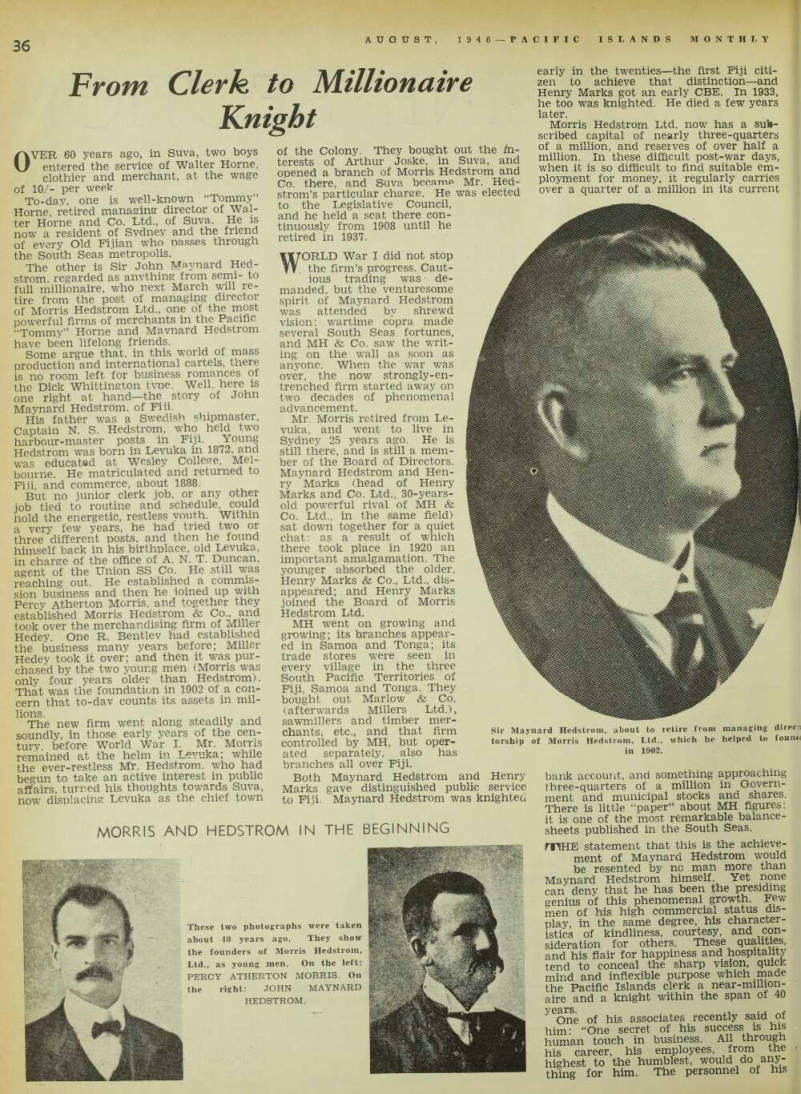
Sir Maynard Hedstrom, about to retire from managing directorship of Morris Hedstrom, Ltd., which he helped to found in 1902.
company, like the personnel of his Board, is rarely changed except by death. He can count on complete loyalty every where.”
The ideas of Sir Maynard Hedstrom are reflected in a 20-years-old Pension Fund, built up by the Co., and carrying £125,000 of assets; and in a healthy and growing Morris Hedstrom Scholarship Fund, simi larly built by the Company, which sends selected Fijian boys to the University in New Zealand.
Sir Maynard was twice married. In 1895, he married Miss Grace Eastgate, and they had three sons and two daught ers. One son is the well-known J. M.
Hedstrom, a Director of the Company.
Two others are residents of Fiji. One daughter married Mr. Robert Crompton, junr. Another, Mrs. Chapman, lives in New Zealand. Their mother died some 15 years ago, and Sir Maynard, in the thirties, married Miss Joyce Beauchamp, of Sydney. Lady Hedstrom’s charm and hospitality have made the Hedstrom home in Suva famous in three contin ents.
The present MH Board consists of Sir Maynard Hedstrom, who will continue as chairman; Mr. R. Crompton, CBE, KC;* Mr. P. A. Morris; Mr. H. E. Snell (who will become managing director next March); and Messrs. B. H. Marks, R. A.
Crompton, J. Dowling, J. M. Hedstrom. junr., and C. S. Israel. Mr. Dowling re cently retired from the post of Sydney manager, which was assumed by Mr.
C. S. Israel, who is a nephew of the late Sir Henry Marks.
Mr. J. L. Mac Duff, who was attached to the Legal Department in Fiji last year as a temporary officer has returned to the Colony to take up a position as District Magistrate.
Mr. and Mrs. L. H. Pope left Fiji at the end of June for Sydney en route to Northern Rhodesia, where Mr. Pope has been appointed Government Auditor. He has been Auditor in Fiji since August, 1938.
Fisherman's Dream!
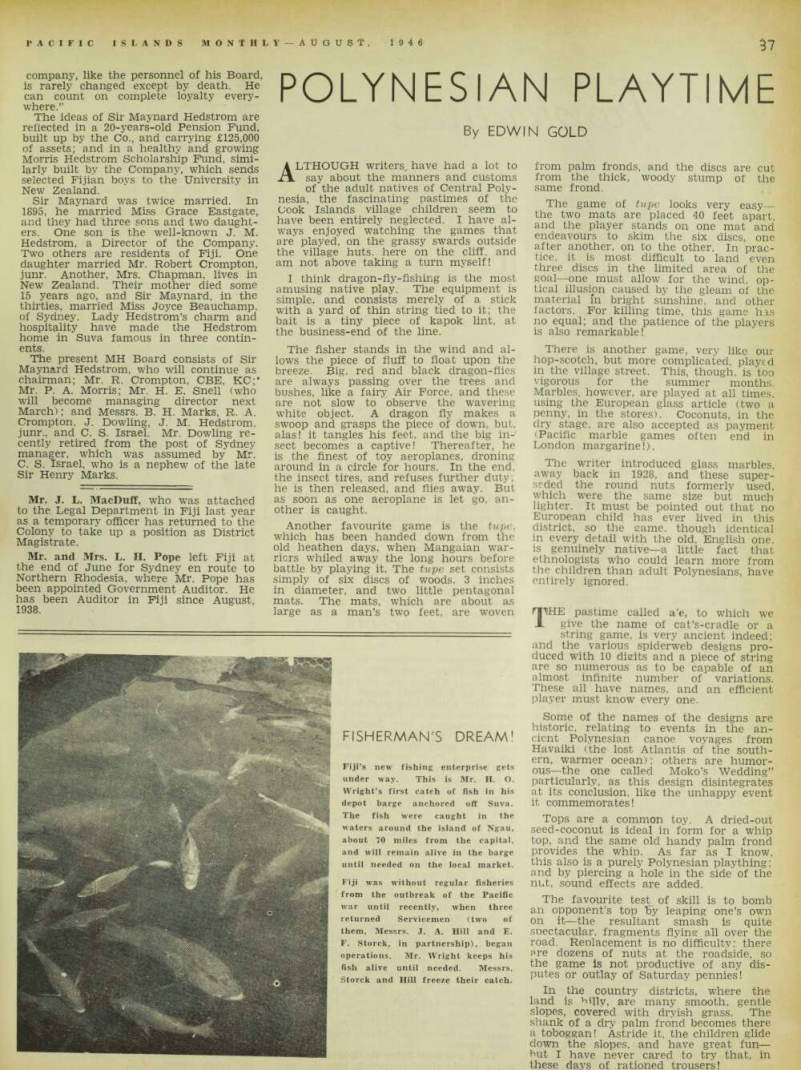
Fiji’s new fishing enterprise gets under way. This is Mr. H. O.
Wright’s first cateh of fish in his depot barge anchored off Suva.
The fish were caught in the waters around the island of Ngau, about 70 miles from the capital, and will remain alive in the barge until needed on the local market.
Fiji was without regular fisheries from the outbreak of the Pacific war until recently, when three returned Servicemen (two of them, Messrs. J, A. Hill and E.
F. Storck, in partnership), began operations. Mr. Wright keeps his fish alive until needed. Messrs.
Storck and Hill freeze their catch.