Magazine Section
p. 37 · Read in the full issue
Territories' Talk-Talk
By "Tolala"
Rehabilitation is as great a prob lem as ever both in Papua and NG: • A couple of thousand surplus Army axes were recently sold for 2/- each, then retailed locally for 22/6 each. • 1,800 motor trucks went for 30/each, and some resold for £5O. • Native ration prices, according to one correspondent, run at: Rice, 4d. per lb.; tobacco, 10/6 per lb., and meat 2/a tin. As for issue blankets, they are unobtainable. But then, that doesn’t make so much difference, he writes.
There ain’t no boys to use them. ♦ * * SOME of the old-timers around the Rabaul district have formed a United Producers and Citizens’ As sociation, with the idea of safeguarding their interests and speeding up rehabili tation. Already functioning are the Returned Soldiers’ League and the Paci fic Territories’ Association. Territorians should concentrate more on unity than a variety of organisations to air their opinions. Pre-war experience demon strated that a multiplicity of associations did not always make for successful action.
A united front on the rehabilitation question is what is required, and one or two live organisations are ample to meet any situation. That old adage that in unity there is strength still holds good. ♦ ♦ ♦ SOMEWHAT reminiscent of the old plantation store was a sign recently seen in a Sydney suburban shop window: “Choice Cigarette Paper 7d. a roll.” Beneath was a roll of paper, around which was a wrapper bearing the legend:
“Strong, Soft and Soluble. Hygienic . . .”
Necessity is still the mother of resource fulness. * * * DESPITE internal trouble in the NEI, reaching at times major magnitude, the Batavia Central Statistical Office is able to publish the fact that from November, ’45, to the middle of ’46 over 9,000 tons of rubber, 8,400 tons of copra and nearly 4,000 tons of tin ore have been exported from that country. ’Twould be interesting to know what our own Territorial exports have been for the same period. We don’t hear much about that sort of thing these days. ♦ * * HOME-BREW in native villages is a question which is going to cause a few headaches to others besides those who imbibe the plonk. The ob servant native did not miss much while watching the Japs and Formosans fer menting bananas, pineapples, rice and so on to obtain a potent-plus line of liquor to offset their bomb-happy condition dur ing the last couple of years of Allied strafing. Plonk parties amongst natives are already prevalent and will require strong measures to eliminate—and con stant policing thereafter. * * ♦ A CORRESPONDENT writes, support ing the suggestion (April “Talk- Talk”) for a Territorial stamp issue, or overprinting, giving an individuality to stamps used in the Territories. Thev would go over in a big way, he says, and would create a nice little revenue for a Provisional Administration overloaded with expenditure but almost minus revenue. * ♦ ♦ LEWIS LETT has given us another fine book from his experienced pen, dip ped in the ink of Papuan mythology
and fact. “Savage Tales” (published by F. W. Cheshire, Melbourne) is a collec tion of short stories in the true Lett style, maintaining the usual high stan dard which has placed Lewis Lett at the top of the literary ladder where Island writing is concerned. * * * LATEST Rabaul pre-war commercial ventures which are in process of be ing voluntarily wound up are Rabaul Electricity, Ltd., and Rabaul Recreations, Ltd., two concerns which did yeoman work in the good old days. ♦ ♦ ♦ LESLIE GILL complains of the raw deal planters and settlers are re ceiving in the British Solomons, as compared with Territorian opposites who have the Australian War Damage Com mission to consider their claims. That’s the difference between the Australian and the British set-up. Mr. Gill should take a leaf out of Mark Streeter’s book.
He hails from Utah (USA) and has filed a claim for some £300,000-odd damages against the Jap Government for loss of equipment and wages when taken prisoner on Wake Island in December, ’4l. There are still such things as reparations— when the Peace Conferences gets around to them. ♦ * ♦ A SYDNEY Sunday paper features a gift of ten guineas for the Food for Britain Appeal, sent by 160 native students of a Papuan training school, to Minister Ward “from their small finan cial resources.” This works out at less than 1/3 each which, considering the monies held by natives around Moresby and other centres, would not require such a great amount of self-sacrifice after all. * ♦ ♦ IjWE WALKER, whom I mentioned re j cently as arriving back in Australia on a job of work for the BOAC, and well-known in Territorial circles, was married in Suva on July 23 to Clive Brew ster. OBE, MC. head of the WRC set-up in Fiji . . . Max Babbage, of Bougainville, was married on July 25 at St. Stephens’, Macquarie Street. His bride was Miss Marian Fleming, who had served with the AAMWS for over 4i years . . . Anthro pologist Chinnery, who for some years has been on loan from New Guinea to the Northern Territorv Administration, is back in Papua again where, no doubt, he will find that a good many changes have occurred during his absence . . . Raphael Cilento, Knight, medico and lawyer, is hitting the head-lines as a result of his recent appointment as Director of Re fugees in UNO. He is well-known in NG, where he was a most efficient Director of Public Health for many years. ♦ * * A CONVIVIAL evening was spent re cently at the Town Hall Hotel, Mel bourne. where many old Territorians were able to “send off,” in true New Guinea fashion, John Murphy and several other Territorians who are returning North. Among those present were: Roy Barnett, Bill Cameron, Jack Devany, Joe Brennan, Jeff Archer, John Milligan, John Murphy. C. O’Loghlen. Major Doug.
Umphelby, Bill Fox, Gerry Monk, Tommy Thompson, F. Cutler, D. H. Vertigan, George Townsend, J. V. Stanley.
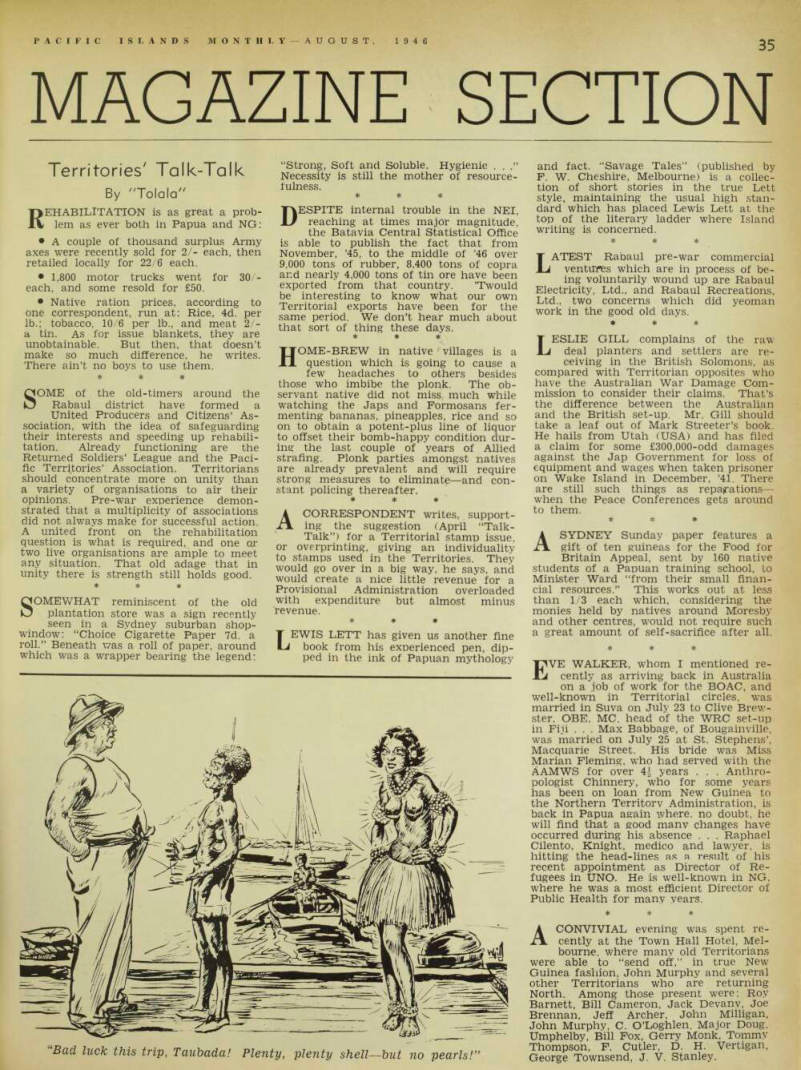
“Bad luck this trip, Taubada! Plenty, plenty shell-but no pearls!"