Trans
pp. 38-40 · Read in the full issue
Pacific
How the Air Sers are to be run
RESIDENTS of Territories of the South-west Pacific are to have three varieties of modern magic carpet in the near future. The air-age, of which lyrical journalists have sung for four years past, is practically with us.
Not. only will it be possible to board a ’plane in Fiji for San Francisco, Honolulu, Canton Island, Noumea, Auckland or Sydney, but you will be able to choose the airline company you hap pen to fancy. You will be able to pat-; ronise private enterprise or Government control: and to deliberate between going American, Canadian or British-Austra lasian.
Or you will, ultimately. Judging by the number of frustrated travellers who have been panting for six war-years to get on the move again, you will be glad enough, in the initial stages, to take the first ’plane that comes along!
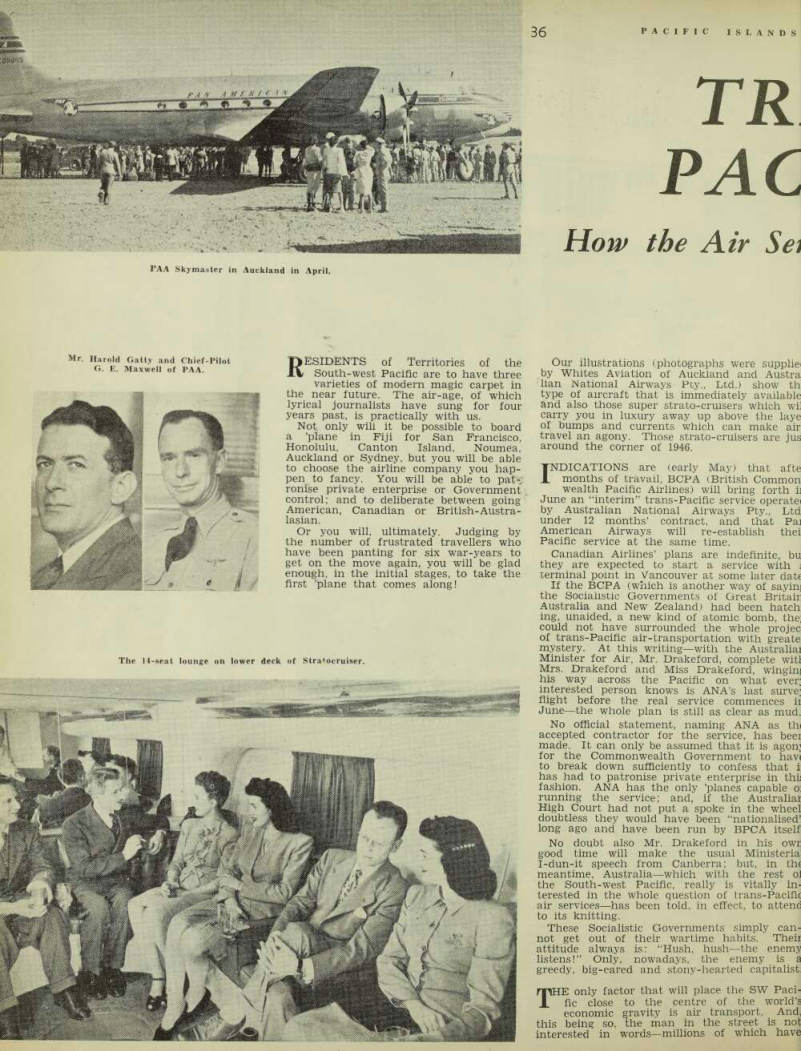
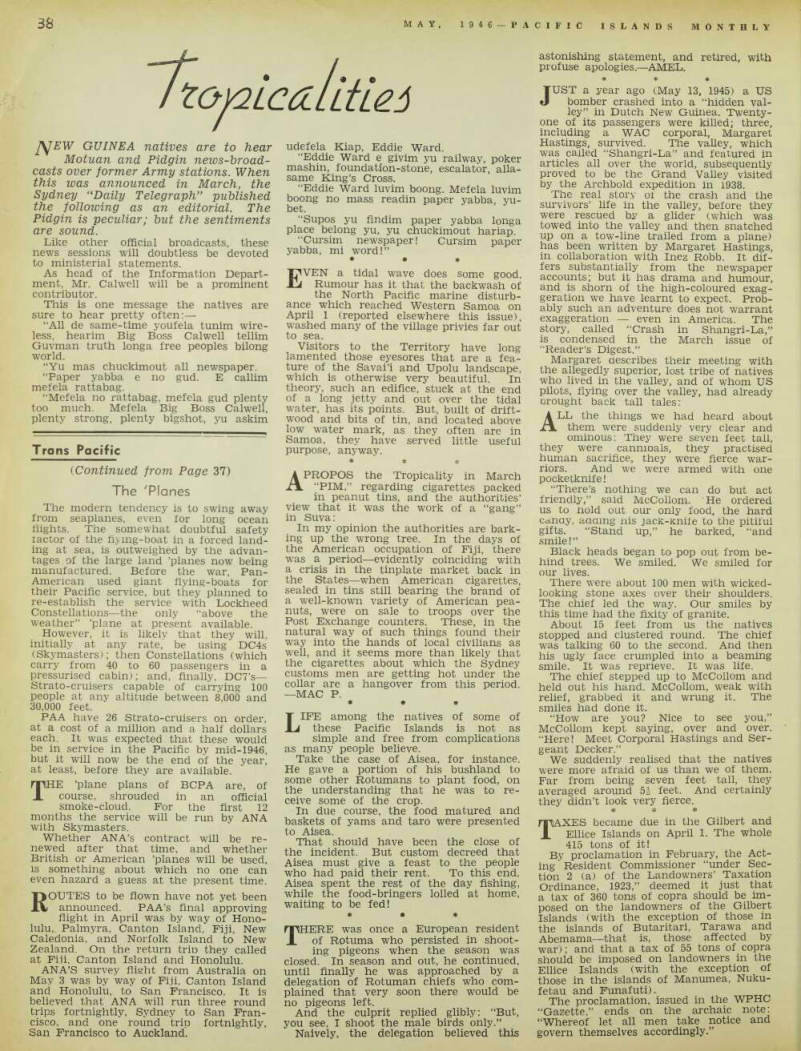
Our illustrations (photographs were supplie by Whites Aviation of Auckland and Austra lian National Airways Pty., Ltd.) show th type of aircraft that is immediately available and also those super strato-cruisers which wl carry you in luxury away up above the laye of bumps and currents which can make air travel an agony. Those strato-cruisers are jus around the corner of 1946.
INDICATIONS are (early May) that afte months of travail, BCPA (British Common wealth Pacific Airlines) will bring forth i] June an “interim” trans-Pacific service operate by Australian National Airways Pty., Ltd under 12 months’ contract, and that Pa: American Airways will re-establish thei Pacific service at the same time.
Canadian Airlines’ plans are indefinite, bu they are expected to start a service with ; terminal point in Vancouver at some later date If the BCPA (which is another way of sayini the Socialistic Governments of Great Britair Australia and New Zealand) had been hatch ing, unaided, a new kind of atomic bomb, the; could not have surrounded the whole projec of trans-Pacific air-transportation with greate mystery. At this writing—with the Australia] Minister for Air, Mr. Drakeford, complete witl Mrs. Drakeford and Miss Drakeford, wingini his way across the Pacific on what ever; interested person knows is ANA’s last surve; flight before the real service commences ii June—the whole plan is still as clear as mud.
No official statement, naming ANA as thi accepted contractor for the service, has beei made. It can only be assumed that it is agon; for the Commonwealth Government to havi to break down sufficiently to confess that 1 has had to patronise private enterprise in thi fashion. ANA has the only ’planes capable o: running the service; and, if the Australiai High Court had not put a spoke in the wheel doubtless they would have been “nationalised’ long ago and have been run by BPCA itself No doubt also Mr. Drakeford in his owr good time will make the usual Ministeria I-dun-it speech from Canberra; but, in the meantime, Australia —which with the rest oJ the South-west Pacific, really is vitally in terested in the whole question of trans-Pacific air services—has been told, in effect, to attend to its knitting.
These Socialistic Governments simply can not get out of their wartime habits. Theii attitude always is: “Hush, hush —the enemy listens!” Only, nowadays, the enemy is a greedy, big-eared and stony-hearted capitalist rE only factor that will place the SW Paci fic close to the centre of the world’s economic gravity is air transport. And, this being so, the man in the street is not interested in words —millions of which have
PAA Skymaster in Auckland in April.
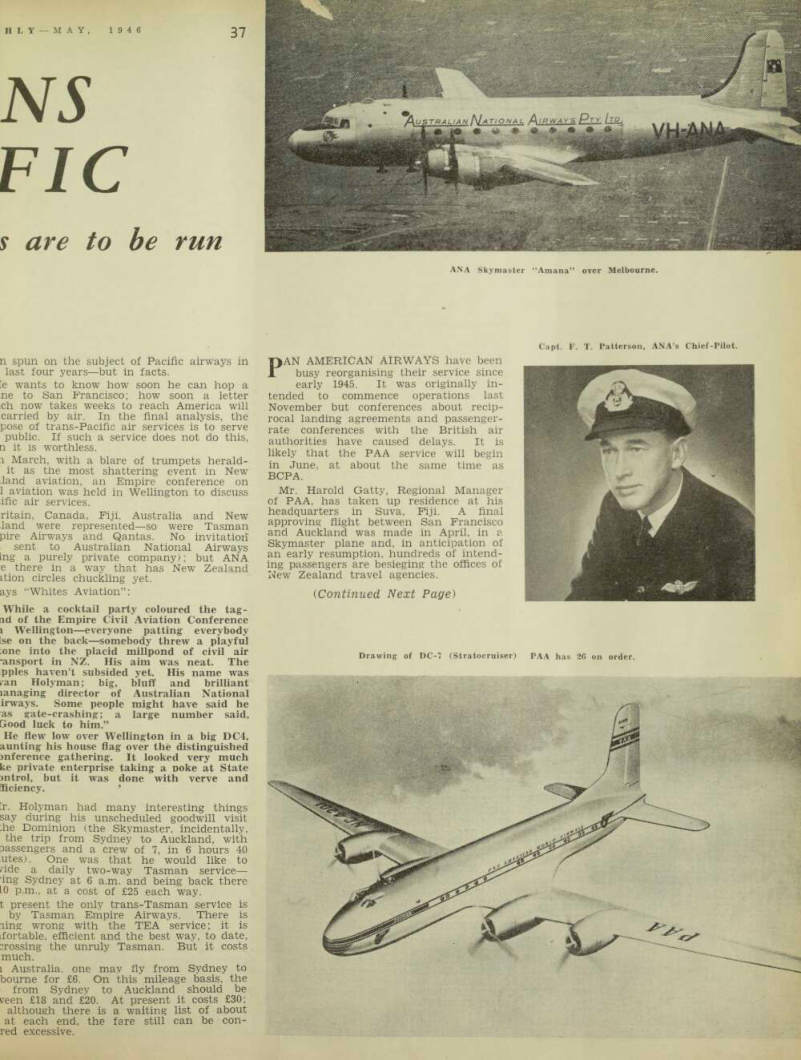
Mr. Harold Gatty and Chief-Pilot G. E. Maxwell of PAA.
The 14-seat lounge on lower deck of Strat ocruiser.
n spun on the subject of Pacific airways in last four years—but in facts.
'.e wants to know how soon he can hop a ne to San Francisco; how soon a letter ch now takes weeks to reach America will carried by air. In the final analysis, the pose of trans-Pacific air services is to serve public. If such a service does not do this, n it is worthless. i March, with a blare of trumpets herald it as the most shattering event in New land aviation, an Empire conference on 1 aviation was held in Wellington to discuss ific air services. ritain, Canada, Fiji, Australia and New land were represented—so were Tasman pire Airways and Qantas. No invitation sent to Australian National Airways ing a purely private company); but ANA e there in a way that has New Zealand ition circles chuckling yet. ays “Whites Aviation”: While a cocktail party coloured the tag id of the Empire Civil Aviation Conference i Wellington—everyone patting everybody Ise on the back—somebody threw a playful ;one into the placid millpond of civil air •ansport in NZ. His aim was neat. The pples haven’t subsided yet. His name was fan Holyman; big, bluff and brilliant janaging director of Australian National irways. Some people might have said he as gate-crashing; a large number said, Good luck to him.”
He flew low over Wellington in a big DC4, aunting his house flag over the distinguished inference gathering. It looked very much ke private enterprise taking a poke at State mtrol, but it was done with verve and [ficiency. * 'r. Holyman had many interesting things say during his unscheduled goodwill visit ;he Dominion (the Skymaster, incidentally, the trip from Sydney to Auckland, with passengers and a crew of 7, in 6 hours 40 utes). One was that he would like to fide a daily two-way Tasman service— ring Sydney at 6 a.m. and being back there L 0 p.m., at a cost of £25 each way. t present the only trans-Tasman service is by Tasman Empire Airways. There is ling wrong with the TEA service; it is Portable, efficient and the best way, to date, crossing the unruly Tasman. But it costs much. i Australia, one may fly from Sydney to bourne for £6. On this mileage basis, the from Sydney to Auckland should be veen £lB and £2O. At present it costs £3O; although there is a waiting list of about at each end, the fare still can be con red excessive.
PAN AMERICAN AIRWAYS have been busy reorganising their service since early 1945. It was originally in tended to commence operations last November but conferences about recip rocal landing agreements and passenger rate conferences with the British air authorities have caused delays. It is likely that the PAA service will begin in June, at about the same time as
Bcpa.
Mr. Harold Gatty, Regional Manager of PAA, has taken up residence at his headquarters in Suva, Fiji. A final approving flight between San Francisco and Auckland was made in April, in a Skymaster plane and, in anticipation of an early resumption, hundreds of intend ing passengers are besieging the offices of New Zealand travel agencies. (Continued Next Page )
ANA Skymaster “Amana” over Melbourne.
(Japt. F. T. Patterson, ANA's Chief-Pilot.
Drawing of DC-7 (Stratocruiser) PAA has 2G on order.
The "Planes
The modern tendency is to swing away from seaplanes, even for long ocean flights. The somewhat doubtful safety lactor of the flying-boat in a forced land ing at sea, is outweighed by the advan tages of the large land ’planes now being manufactured. Before the war, Pan- American used giant flying-boats for their Pacific service, but they planned to re-establish the service with Lockheed Constellations—the only “above the weather” ’plane at present available.
However, it is likely that they will, initially at any rate, be using DC4s (Skymasters); then Constellations (which carry from 40 to 60 passengers in a pressurised cabin); and, finally, DC7’s— Strato-cruisers capable of carrying 100 people at any altitude between 8,000 and 30,000 feet.
PAA have 26 Strato-cruisers on order, at a cost of a million and a half dollars each. It was expected that these would be in service in the Pacific by mid-1946, but it will now be the end of the year, at least, before they are available.
THE ’plane plans of BCPA are, of course, shrouded in an official smoke-cloud. For the first 12 months the service will be run by ANA with Skymasters.
Whether ANA’s contract will be re newed after that time, and whether British or American ’planes will be used, is something about which no one can even hazard a guess at the present time.
ROUTES to be flown have not yet been announced. PAA’s final approving flight in April was by way of Hono lulu,. Palmyra, Canton Island, Fiji, New Caledonia, and Norfolk Island to New Zealand. On the return trio they called at Fiji, Canton Island and Honolulu.
ANA’S survey flight from Australia on May 3 was by way of Fiji, Canton Island and Honolulu, to San Francisco. It is believed that ANA will run three round trips fortnightly, Sydney to San Fran cisco. and one round trio fortnightly, San Francisco to Auckland.