Pacific Queen
p. 36 · Read in the full issue
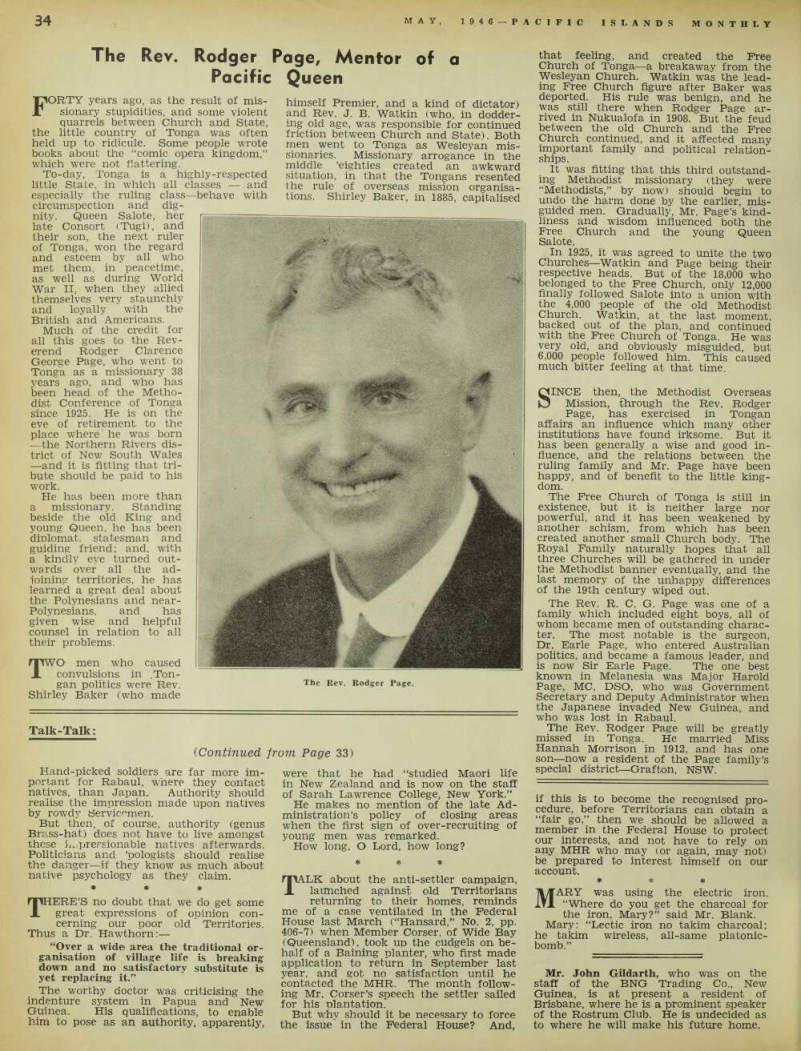
The Rev. Rodger Page, Mentor of a Pacific Queen
FORTY years ago, as the result of mis sionary stupidities, and some violent quarrels between Church and State, the little country of Tonga was often held up to ridicule. Some people wrote books about the “comic opera kingdom,” which were not flattering.
To-day, Tonga is a highly-respected little State, in which all classes and especially the ruling class —behave with
circumspection and dig nity. Queen Salote, her late Consort (Tugi), and their son, the next ruler of Tonga, won the regard and esteem by all who met them, in peacetime, as well as during World War 11, when they allied themselves very staunchly and loyally with the British and Americans.
Much of the credit for all this goes to the Rev erend Rodger Clarence George Page, who went to Tonga as a missionary 38 years ago, and who has been head of the Metho dist Conference of Tonga since 1925. He is on the eve of retirement to the place where he was born —the Northern Rivers dis trict of New South Wales —and it is fitting that tri bute should be paid to his work.
He has been more than a missionary. Standing beside the old King and young Queen, he has been diplomat, statesman and guiding friend: and, with a kindly eye turned out wards over all the ad joining territories, he has learned a great deal about the Polynesians and near- Polynesians, and has given wise and helpful counsel in relation to all their problems. rjTWO men who caused X convulsions in .Ton gan politics were Rev.
Shirley Baker (who made
himself Premier, and a kind of dictator) and Rev. J. B. Watkin (who in dodder ing old age, was responsible for continued friction between Church and State) Both men went to Tonga as Wesleyan mis sionaries. Missionary arrogance in the middle ’eighties created an awkward situation, in that the Tongans resented the rule of overseas mission organisa tions. Shirley Baker, in 1885, capitalised
that feeling, and created the Free Church of Tonga—a breakaway from the Wesleyan Church. Watkin was the lead ing Free Church figure after Baker was deported. His rule was benign, and he was still there when Rodger Page ar rived in Nukualofa in 1908. But the feud between the old Church and the Free Church continued, and it affected many important family and political relation ships.
It was fitting that this third outstand ing Methodist missionary (they were “Methodists,” by now) should begin to undo the harm done by the earlier, mis guided men. Gradually, Mr. Page’s kind liness and wisdom influenced both the Free Church and the young Queen Salote.
In 1925, it was agreed to unite the two Churches—Watkin and Page being their respective heads. But of the 18,000 who belonged to the Free Church, only 12,000 finally followed Salote into a union with the 4,000 people of the old Methodist Church. Watkin, at. the last moment, backed out of the plan, and continued with the Free Church of Tonga. He was very old, and obviously misguided, but 6,000 people followed him. This caused much bitter feeling at that time.
SINCE then,_ the Methodist Overseas Mission, through the Rev. Rodger Page, has exercised in Tongan affairs an influence which many other institutions have found irksome. But it has been generally a wise and good in fluence, and the relations between the ruling family and Mr. Page have been happy, and of benefit to the little king dom.
The Free Church of Tonga is still in existence, but it is neither large nor powerful, and it has been weakened by another schism, from which has been created another small Church body. The Royal Family naturally hopes that all three Churches will be gathered in under the Methodist banner eventually, and the last memory of the unhappy differences of the 19th century wiped out.
The Rev. R. C. G. Page was one of a family which included eight boys, all of whom became men of outstanding charac ter. The most notable is the surgeon, Dr. Earle Page, who entered Australian politics, and became a famous leader, and is now Sir Earle Page. The one best known in Melanesia was Major Harold Page, MC, DSO, who was Government Secretary and Deputy Administrator when the Japanese invaded New Guinea, and who was lost in Rabaul.
The Rev. Rodger Page will be greatly missed in Tonga. He married Miss Hannah Morrison in 1912, and has one son—now a resident of the Page family’s special district—Grafton, NSW.
The Rev. Rodger Page.