New Guinea
pp. 41-42 · Read in the full issue
Indonesia and New Guinea
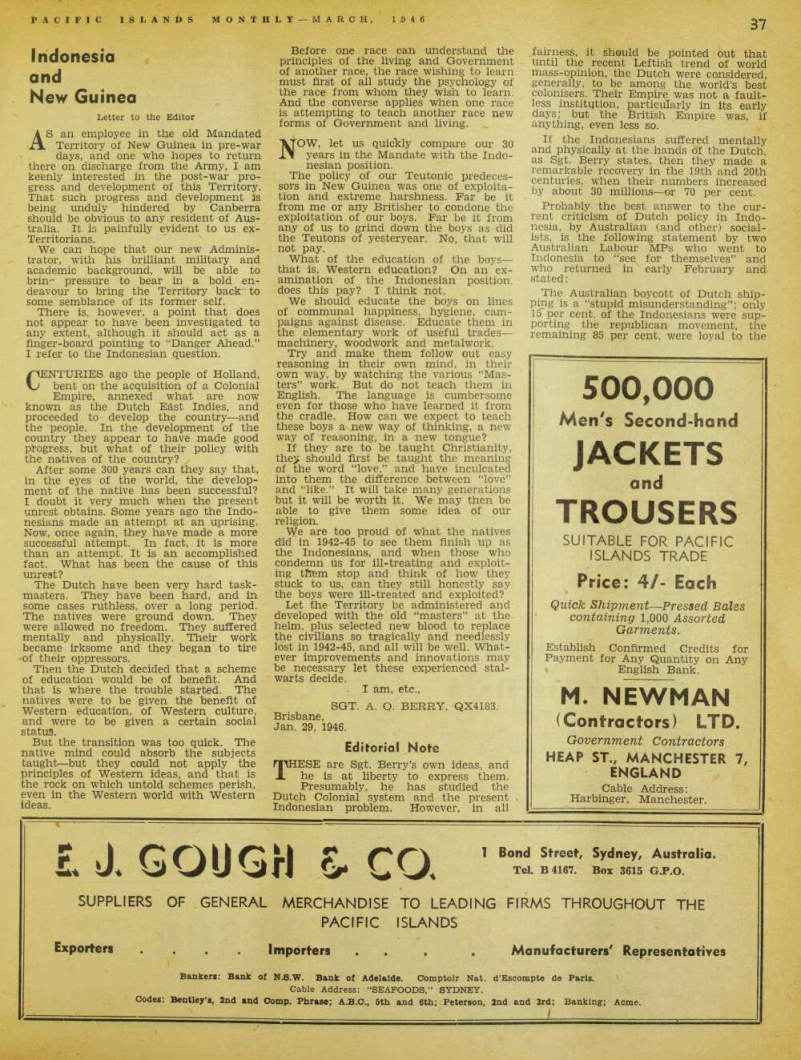
Letter to the Editor AS an employee in the old Mandated Territory of New Guinea in pre-war days, and one who hopes to return there on discharge from the Army, I am keenly interested in the post-war pro gress and development of this Territory.
That such progress and development is being unduly hindered by Canberra should be obvious to any resident of Aus tralia. It is painfully evident to us ex- Territorians.
We can hope that our new Adminis trator, with his brilliant military and academic background, will be able to brin~ pressure to bear in a bold en deavour to bring the Territory back to some semblance of its former self.
There is, however, a point that does not appear to have been investigated to any extent, although it should act as a finger-board pointing to “Danger Ahead.”
I refer to the Indonesian question.
CENTURIES ago the people of Holland, bent on the acquisition of a Colonial Empire, annexed what are now known as the Dutch East Indies, and proceeded to develop the country—and the people. In the development of the country they appear to have made good progress, but what of their policy with the natives of the country?
After some 300 years can they say that, in the eyes of the world, the develop ment of the native has been successful?
I doubt it very much when the present unrest obtains. Some years ago the Indo nesians made an attempt at an uprising.
Now, once again, they have made a more successful attempt. In fact, it is more than an attempt. It is an accomplished fact. What has been the cause of this unrest?
The Dutch have been very hard task masters. They have been hard, and in some cases ruthless, over a long period.
The natives were ground down. They were allowed no freedom. They suffered mentally and physically. Their work became irksome and they began to tire -of their oppressors.
Then the Dutch decided that a scheme of education would be of benefit. And that is where the trouble started. The natives were to be given the benefit of Western education, of Western culture, and were to be given a certain social status.
But the transition was too quick. The native mind could absorb the subjects taught—but they could not apply the principles of Western ideas, and that is the rock on which untold schemes perish, even in the Western world with Western Ideas.
Before one race can understand the principles of the living and Government of another race, the race wishing to learn must first of all study the psychology of the race from whom they wish to learn.
And the converse applies when one race is attempting to teach another race new forms of Government and living.
NOW, let us quickly compare our 30 years in the Mandate with the Indo nesian position.
The policy of our Teutonic predeces sors in New Guinea was one of exploita tion and extreme harshness. Far be it from me or any Britisher to condone the exploitation of our boys. Far be it from any of us to grind down the boys as did the Teutons of yesteryear. No, that will not pay.
What of the education of the boys— that is, Western education? On an ex amination of the Indonesian position, does this pay? I think not.
We should educate the boys on lines of communal happiness, hygiene, cam paigns against disease. Educate them in the elementary work of useful trades— machinery, woodwork and metalwork.
Try and make them follow out easy reasoning in their own mind, in their own way, by watching the various “Mas ters” work. But do not teach them in English. The language is cumbersome even for those who have learned it from the cradle. How can we expect to teach these boys a new way of thinking, a new way of reasoning, in a new tongue?
If they are to be taught Christianity, the> should first be taught the meaning of the word “love,” and have inculcated into them the difference between “love” and “like.” It will take many generations but it will be worth it. We may then be able to give them some idea of our religion.
We are too proud of what the natives did in 1942-45 to see them finish up as the Indonesians, and when those who condemn us for ill-treating and exploit ing them stop and think of how they stuck to us, can they still honestly say the boys were ill-treated and exploited?
Let the Territory be administered and developed with the old “masters” at the helm, plus selected new blood to replace the civilians so tragically and needlessly lost in 1942-45, and all will be well. What ever improvements and innovations may be necessary let these experienced stal warts decide.
I am, etc.,
Sgt. A. O. Berry, Qx4183.
Brisbane, Jan. 29, 1946.
Editorial Note THESE are Sgt. Berry’s own ideas, and he is at liberty to express them.
Presumably, he has studied the Dutch Colonial system and the present Indonesian problem. However, in all
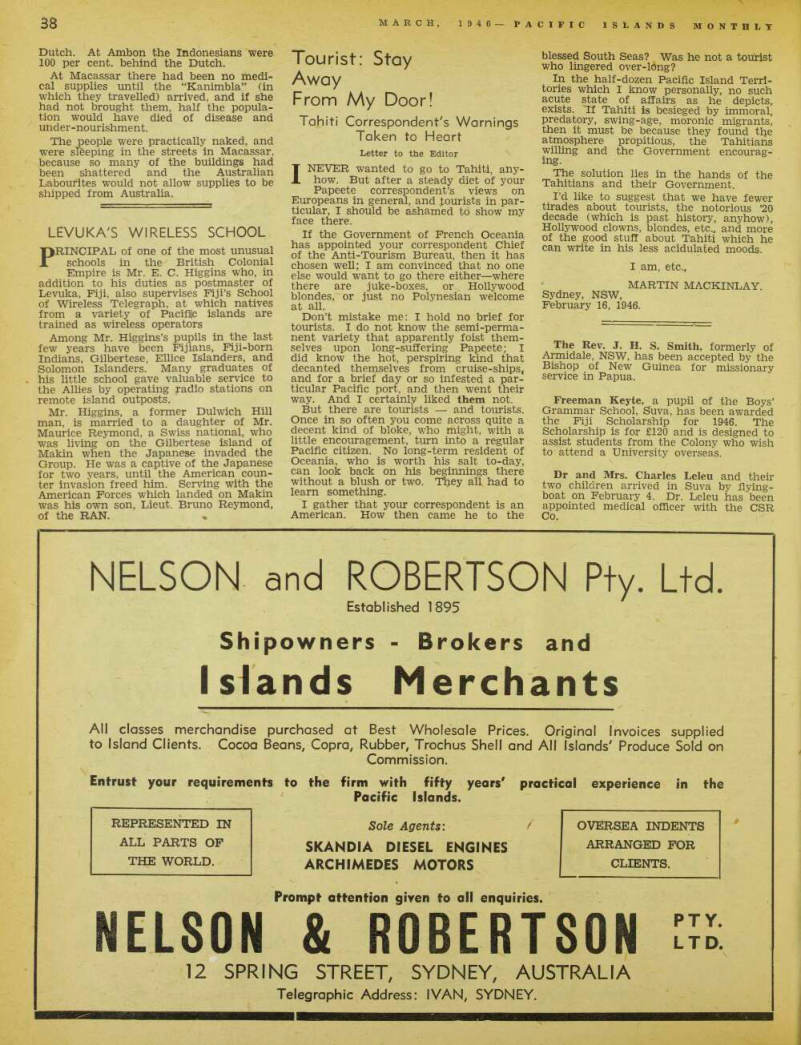
fairness, it should be pointed out that until the recent Leftish trend of world mass-opinion, the Dutch were considered, generally, to be among the world’s best colonisers. Their Empire was not a fault less institution, particularly in its early days; but the British Empire was, if anything, even less so.
If the Indonesians suffered mentally and physically at the hands of the Dutch, as Sgt. Berry states, then they made a remarkable recovery in the 19th and 20th centuries, when their numbers increased by about 30 millions—or 70 per cent.
Probably the best answer to the cur rent criticism of Dutch policy in Indo nesia, by Australian (and other) social ists, is the following statement by two Australian Labour MPs who went to Indonesia to "see for themselves” and who returned in early February and stated: The Australian boycott of Dutch ship ping is a “stupid misunderstanding”; only 15 per cent, of the Indonesians were sup porting the republican movement, the remaining 85 per cent, were loyal to the
Dutch. At Ambon the Indonesians were 100 per cent, behind the Dutch.
At Macassar there had been no medi cal supplies until the “Kanimbla” (in which they travelled) arrived, and if she had not brought them, half the popula tion would have died of disease and under-nourishment.
The people were practically naked, and were steeping in the streets in Macassar, because so many of the buildings had been shattered and the Australian Labourites would not allow supplies to be shipped from Australia.