Extraordinary Episode Near Rabaul in 1942
p. 40 · Read in the full issue
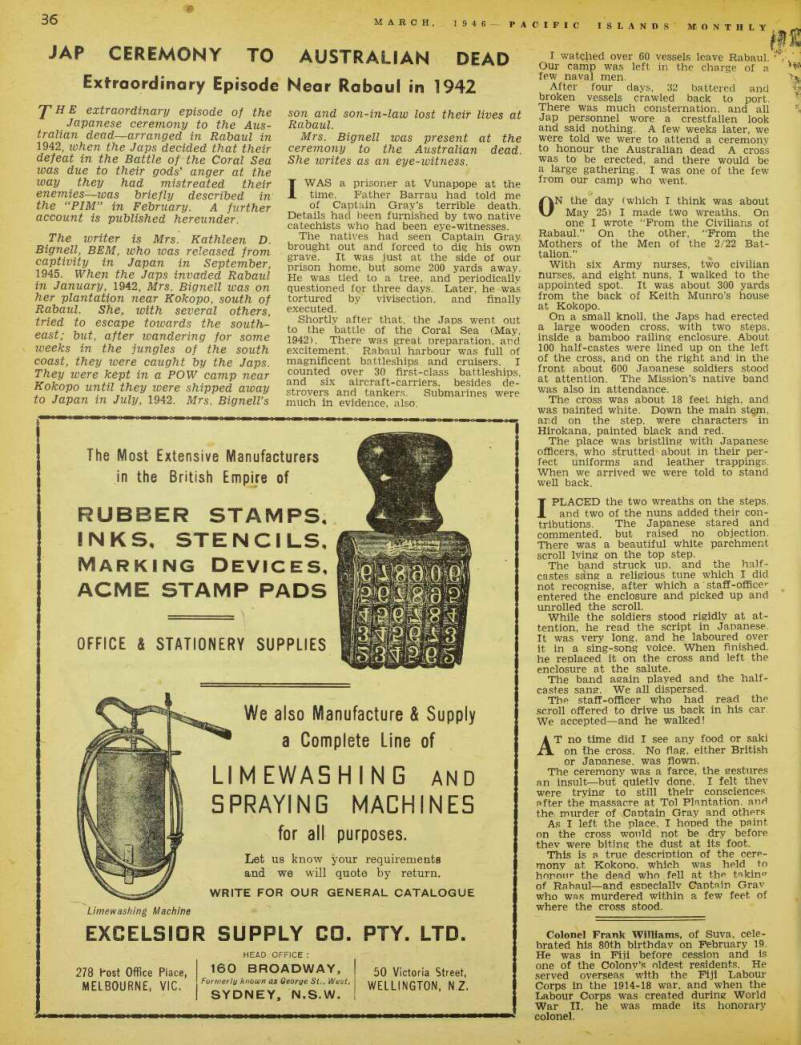
Jap Ceremony To Australian Dead
T H E extraordinary episode of the Japanese ceremony to the Aus tralian dead—arranged in Rabaul in 1942, when the Japs decided that their defeat in the Battle of the Coral Sea was due to their gods' anger at the way they had mistreated their enemies—was briefly described in the “PIM” in February. A further account is published hereunder.
The writer is Mrs. Kathleen D.
Bignell, BEM, who was released from captivity in Japan in September, 1945. When the Japs invaded Rabaul in January, 1942, Mrs. Bignell was on her plantation near Kokopo, south of Rabaul. She, with several others, tried to escape towards the south east; but, after wandering for some weeks in the jungles of the south coast, they were caught by the Japs.
They were kept in a POW camp near Kokopo until they were shipped away to Japan in July, 1942. Mrs. BignelVs
son and son-in-law lost their lives at Rabaul.
Mrs. Bignell was present at the ceremony to the Australian dead.
She writes as an eye-witness.
I WAS a prisoner at Vunapope at the time. Father Barrau had told me of Captain Gray’s terrible death.
Details had been furnished by two native catechists who had been eye-witnesses.
The natives had seen Captain Gray brought out and forced to dig his own grave. It was just at the side of our prison home, but some 200 yards away.
He was tied to a tree, and periodically questioned for three days. Later, he was tortured by vivisection, and finally executed.
Shortly after that, the Japs went out to the battle of the Coral Sea (May, 1942). There was great preparation, and excitement. Rabaul harbour was full of magnificent battleships and cruisers. I counted over 30 first-class battleships, and six aircraft-carriers, besides de stroyers and tankers. Submarines were much in evidence, also.
I watched over 60 vessels leave Rabaul.
Our camp was left in the charge of a few naval men.
After four days, 32 battered and broken vessels crawled back to port.
There was much consternation, and all Jap personnel wore a crestfallen look and said nothing. A few weeks later, we were told we were to attend a ceremony to honour the Australian dead A cross was to be erected, and there would be a large gathering. I was one of the few from our camp who went.
Q ON the day (which I think was about May 25) I made two wreaths. On one I wrote “Prom the Civilians of Rabaul.” On the other, “Prom the Mothers of the Men of the 2/22 Bat talion.” % With six Army nurses, two civilian nurses, and eight nuns, I walked to the appointed spot. It was about 300 yards from the back of Keith Munro’s house at Kokopo.
On a small knoll, the Japs had erected a large wooden cross, with two steps, inside a bamboo railing enclosure. About 100 half-castes were lined up on the left of the cross, and on the right and in the front about 600 Jaoanese soldiers stood at attention. The Mission’s native band was also in attendance.
The cross was about 18 feet high, and was painted white. Down the main stem, and on the step, were characters in Hirokana, painted black and red.
The place was bristling with Japanese officers, who strutted about in their per fect uniforms and leather trappings.
When we arrived we were told to stand well back. 1 PLACED the two wreaths on the steps, and two of the nuns added their con tributions. The Japanese stared and commented, but raised no objection.
There was a beautiful white parchment scroll lying on the top step.
The band struck up. and the half castes a religious tune which I did not recognise, after which a staff entered the enclosure and picked up and unrolled the scroll.
While the soldiers stood rigidly at at tention, he read the script in Japanese.
It was very long, and he laboured over it in a sing-song voice. When finished, he replaced it on the cross and left the enclosure at the salute.
The band again played and the half castes sang. We all dispersed.
The staff-officer who had read the scroll offered to drive us back in his car.
We accepted—and he walked!
AT no time did I see any food or saki on the cross. No flag, either British or Japanese, was flown.
The ceremony was a farce, the gestures an insult—but quietlv done. I felt thev were trying to still their consciences after the massacre at Tol Plantation. and the murder of Captain Gray and others As I left the place, I hoped the paint on the cross would not be dry before thev were biting the dust at its foot.
This is a true description of the cere mony at Kokono, which was held to honour the dead who fell at the taking of Rabaul—and especially Captain Grav who was murdered within a few feet of where the cross stood.
Colonel Frank Williams, of Suva, cele brated his 80th birthday on February 19.
He was in Fiji before cession and is one of the Colony’s oldest residents. He served overseas with the Fiji Labour Corps in the 1914-18 war, and when the Labour Corps was created during World War 11, he was made its honorary colonel.