Tragedy Of Ocean Island
Six Europeans, With Hundreds of Natives, Killed by Japs
THERE now seems no doubt that an other grave tragedy occurred on Ocean Island, after the evacuation of the island by the British, and its occupation by the Japanese.
When the Europeans were withdrawn, the following remained voluntarily on the island, to care for the natives, and the European installations there: Mr. C. G. F. Cartwright, Government Secretary.
Mr. R. W. Third, Government radio operator.
Mr. Cole and Mr. H. A. Mercer, mem bers of the staff of the British Phos phate Commission.
Father Pujebet and Brother Brummell, Roman Catholic missionaries.
Careful investigations which have been made since Australian and British Forces occupied the island in September indicate that all of those men died in 1943.
Mr. Cartwright died in April and Mr.
Mercer in June, both from malnutrition.
Father Pujebet died in August, 1943, after an operation performed by a Japanese doctor. Mr. Cole died in Sep tember, while in a hospital.
There is no conclusive evidence re garding the fate of Mr. Third and Brother Brummell; but one native report
indicates that they were killed by an
injection given them by the Japanese.
There is no evidence of their having been removed from Ocean Island. unfortunately, the massacre of natives and of labourers from the other Groups, oeiore our reoccupation, has left us witn out any direct evidence of the fate of the Europeans. The sole survivor of the massacre lacked any personal know ledge of what occurred.
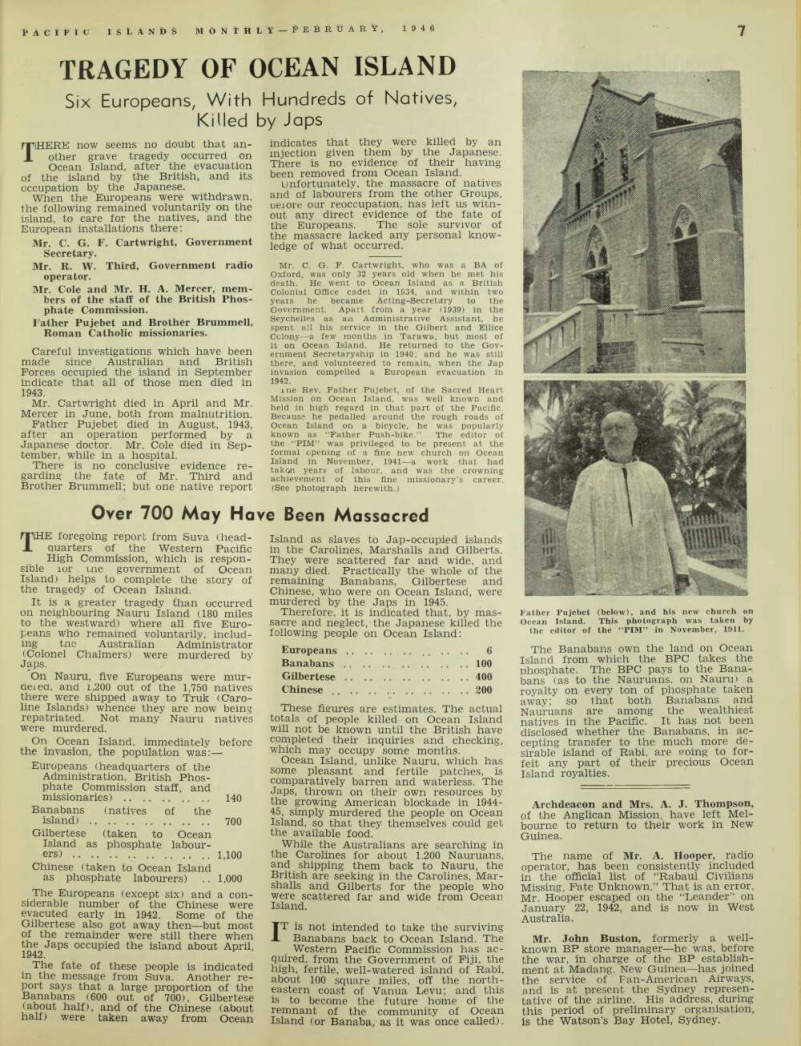
Mr. C. G. F. Cartwright, who was a BA of Oxford, was only 32 years old when he met his death. He went to Ocean Island as a British Colonial Office cadet in 1534, and within two years he became Acting-Secretary to the Government. Apart from a year (1939) in the Seychelles as an Administrative Assistant, he spent all his service in the Gilbert and Ellice Colony—a few months in Tarawa, but most of it on Ocean Island. He returned to the Gov ernment Secretaryship in 1940; and he was still there, and volunteered to remain, when the Jap invasion compelled a European evacuation in 1942. me Rev. Father Pujebet, of the Sacred Heart Mission on Ocean Island, was well known and held in high regard in that part of the Pacific.
Because he pedalled around the rough roads of Ocean Island on a bicycle, he was popularly known as “Father Push-bike.’’ The editor of the “PlM’’ was privileged to be present at the formal opening of a fine new church on Ocean Island in November, 1941 —a work that had takon years of labour, and was the crowning achievement of this fine missionary’s career. (See photograph herewith.)
Over 700 May Have Been Massacred
rE foregoing report from Suva (head quarters of the Western Pacific High Commission, which is respon sible xor me government of Ocean Island) helps to complete the story of the tragedy of Ocean Island.
It is a greater tragedy than occurred on neighbouring Nauru Island (180 miles to the westward) where all five Euro peans who remained voluntarily, includ ing tnc Australian Administrator (Colonel Chalmers) were murdered by Japs.
On Nauru, five Europeans were mur deied, and 1,200 out of the 1,750 natives there were shipped away to Truk (Caro line Islands) whence they are now being repatriated. Not many Nauru natives were murdered.
On Ocean Island, immediately before the invasion, the population was: — Europeans (headquarters of the Administration, British Phos phate Commission staff, and missionaries) 140 Banabans (natives of the island) 700 Gilbertese (taken to Ocean Island as phosphate labour ers) .. 1,100 Chinese (taken to Ocean Island as phosphate labourers) .. 1,000 The Europeans (except six) and a con siderable number of the Chinese were evacuted early in 1942. Some of the Gilbertese also got away then —but most of the remainder were still there when the Japs occupied the island about April, 1942.
The fate of these people is indicated in the message from Suva. Another re port says that a large proportion of the Banabans (600 out of 700), Gilbertese (about half), and of the Chinese (about half) were taken away from Ocean
Island as slaves to Jap-occupied islands in the Carolines, Marshalls and Gilberts.
They were scattered far and wide, and many died. Practically the whole of the remaining Banabans, Gilbertese and Chinese, who were on Ocean Island, were murdered by the Japs in 1945.
Therefore, it is indicated that, by mas sacre and neglect, the Japanese killed the following people on Ocean Island: Europeans .. .. 6 Banabans 100 Gilbertese 400 Chinese 200 These figures are estimates. The actual totals of people killed on Ocean Island will not be known until the British have completed their inquiries and checking, which may occupy some months.
Ocean Island, unlike Nauru, which has some pleasant and fertile patches, is comparatively barren and waterless. The Japs, thrown on their own resources by the growing American blockade in 1944- 45, simply murdered the people on Ocean Island, so that they themselves could get the available food.
While the Australians are searching in the Carolines for about 1.200 Nauruans, and shipping them back to Nauru, the British are seeking in the Carolines, Mar shalls and Gilberts for the people who were scattered far and wide from Ocean Island.
IT is not intended to take the surviving Banabans back to Ocean Island. The Western Pacific Commission has ac quired, from the Government of Fiji, the high, fertile, well-watered island of Rabi, about 100 square miles, off the north eastern coast of Vanua Levu; and this is to become the future home of the remnant of the community of Ocean Island (or Banaba, as it was once called).
The Banabans own the land on Ocean Island from which the BPC takes the phosphate. The BPC pays to the Bana bans (as to the Nauruans, on Nauru) a royalty on every ton of phosphate taken away; so that both Banabans and Nauruans are among the wealthiest natives in the Pacific. It has not been disclosed whether the Banabans, in ac cepting transfer to the much more de sirable island of Rabi, are froing to for feit any part of their precious Ocean Island royalties.
Archdeacon and Mrs. A. J. Thompson, of the Anglican Mission, have left Mel bourne to return to their work in New Guinea.
The name of Mr. A. Hooper, radio operator, has been consistently included in the official list of “Rabaul Civilians Missing, Fate Unknown.” That is an error.
Mr. Hooper escaped on the “Leander” on January 22, 1942, and is now in West Australia.
Mr. John Boston, formerly a well known BP store manager—he was, before the war, in charge of the BP establish ment at Madang, New Guinea—has joined the service of Pan-American Airways, and is at present the Sydney represen tative of the airline. His address, during this period of preliminary organisation, is the Watson’s Bay Hotel, Sydney.
Father Pujebet (below), and his new church on Ocean Island. This photograph was taken by the editor of the “PIM” in November, 1941.