Territorial and Political Changes Coming in
pp. 5-6 · Read in the full issue
Indonesian and Pacific Territories
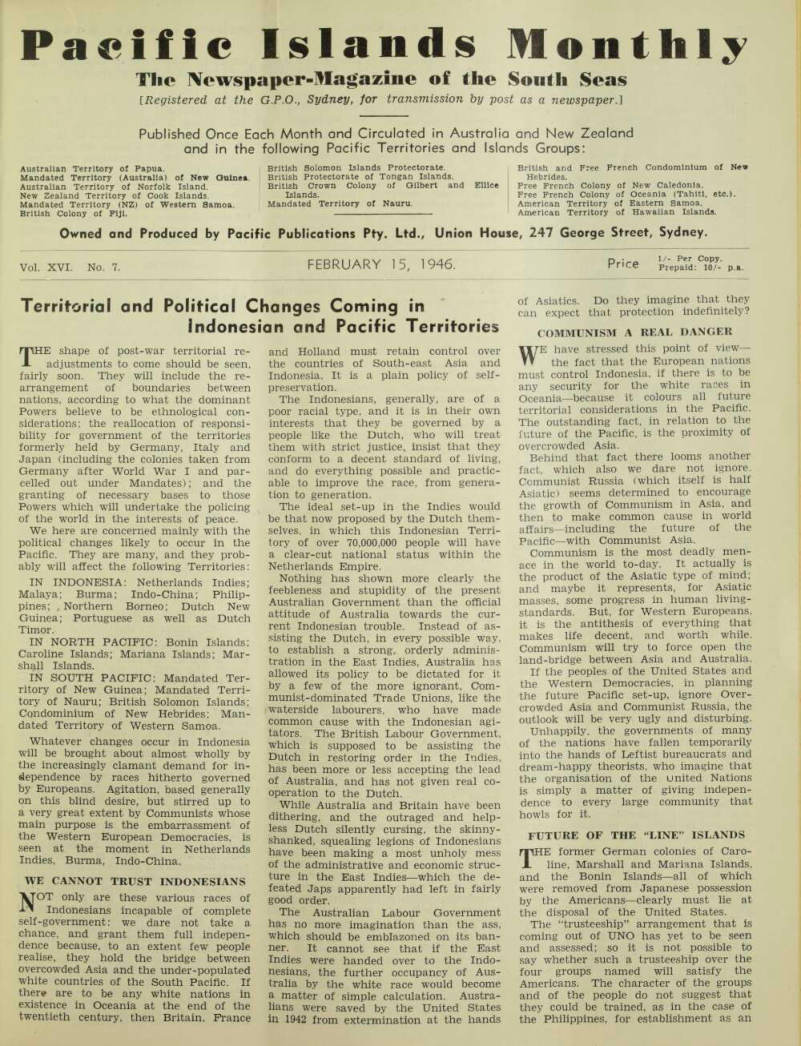
THE shape of post-war territorial re adjustments to come should be seen, fairly soon. They will include the re arrangement of boundaries between nations, according to what the dominant Powers believe to be ethnological con siderations: the reallocation of responsi bility for government of the territories formerly held by Germany, Italy and Japan (including the colonies taken from Germany after World War I and par celled out under Mandates); and the granting of necessary bases to those Powers which will undertake the policing of the world in the interests of peace.
We here are concerned mainly with the political changes likely to occur in the Pacific. They are many, and they prob ably will affect the following Territories; IN INDONESIA: Netherlands Indies; Malaya; Burma; Indo-China; Philip pines; , Northern Borneo; Dutch New Guinea; Portuguese as well as Dutch Timor.
IN NORTH PACIFIC: Bonin Islands; Caroline Islands; Mariana Islands; Mar shall Islands.
IN SOUTH PACIFIC: Mandated Ter ritory of New Guinea; Mandated Terri tory of Nauru; British Solomon Islands; Condominium of New Hebrides; Man dated Territory of Western Samoa.
Whatever changes occur in Indonesia will be brought about almost wholly by the increasingly clamant demand for in dependence by races hitherto governed by Europeans. Agitation, based generally on this blind desire, but stirred up to a very great extent by Communists whose main purpose is the embarrassment of the Western European Democracies, is seen at the moment in Netherlands Indies, Burma, Indo-China.
We Cannot Trust Indonesians
NOT only are these various races of Indonesians incapable of complete self-government: we dare not take a chance, and grant them full indepen dence because, to an extent few people realise, they hold the bridge between overcowded Asia and the under-populated white countries of the South Pacific. If there are to be any white nations in existence in Oceania at the end of the twentieth century, then Britain, Prance
and Holland must retain control over the countries of South-east Asia and Indonesia. It is a plain policy of self preservation.
The Indonesians, generally, are of a poor racial type, and it is in their own interests that they be governed by a people like the Dutch, who will treat them with strict justice, insist that they conform to a decent standard of living, and do everything possible and practic able to improve the race, from genera tion to generation.
The ideal set-up in the Indies would be that now proposed by the Dutch them selves, in which this Indonesian Terri tory of over 70,000,000 people will have a clear-cut national status within the Netherlands Empire.
Nothing has shown more clearly the feebleness and stupidity of the present Australian Government than the official attitude of Australia towards the cur rent Indonesian trouble. Instead of as sisting the Dutch, in every possible way, to establish a strong, orderly adminis tration in the East Indies, Australia has allowed its policy to be dictated for it by a few of the more ignorant, Com munist-dominated Trade Unions, like the waterside labourers, who have made common cause with the Indonesian agi tators. The British Labour Government, which is supposed to be assisting the Dutch in restoring order in the Indies, has been more or less accepting the lead of Australia, and has not given real co operation to the Dutch.
While Australia and Britain have been dithering, and the outraged and help less Dutch silently cursing, the skinny shanked, squealing legions of Indonesians have been making a most unholy mess of the administrative and economic struc ture in the East Indies —which the de feated Japs apparently had left in fairly good order.
The Australian Labour Government has no more imagination than the ass, which should be emblazoned on its ban ner. It cannot see that if the East Indies were handed over to the Indo nesians, the further occupancy of Aus tralia by the white race would become a matter of simple calculation. Austra lians were saved by the United States in 1942 from extermination at the hands
of Asiatics. Do they imagine that they can expect that protection indefinitely?
Communism A Real Danger
WE have stressed this point of view— the fact that the European nations must control Indonesia, if there is to be any security for the white races in Oceania —because it colours all future territorial considerations in the Pacific.
The outstanding fact, in relation to the future of the Pacific, is the proximity of overcrowded Asia.
Behind that fact there looms another fact, which also we dare not ignore.
Communist Russia (which itself is half Asiatic) seems determined to encourage the growth of Communism in Asia, and then to make common cause in world affairs —including the future of the Pacific —with Communist Asia.
Communism is the most deadly men ace in the world to-day. It actually is the product of the Asiatic type of mind; and maybe it represents, for Asiatic masses, some progress in human living standards. But, for Western Europeans, it is the antithesis of everything that makes life decent, and worth while.
Communism will try to force open the land-bridge between Asia and Australia.
If the peoples of the United States and the Western Democracies, in planning the future Pacific set-up, ignore Over crowded Asia and Communist Russia, the outlook will be very ugly and disturbing.
Unhappily, the governments of many of the nations have fallen temporarily into the hands of Leftist bureaucrats and dream-happy theorists, who imagine that the organisation of the united Nations is simply a matter of giving indepen dence to every large community that howls for it.
Future Of The “Line” Islands
rE former German colonies of Caro line, Marshall and Mariana Islands, and the Bonin Islands —all of which were removed from Japanese possession by the Americans —clearly must lie at the disposal of the United States.
The “trusteeship” arrangement that is coming out of UNO has yet to be seen and assessed; so it is not possible to say whether such a trusteeship over the four groups named will satisfy the Americans. The character of the groups and of the people do not suggest that they could be trained, as in the case of the Philippines, for establishment as an
independent nation. The widely-scat tered groups have no great economic value. The Americans may want the Carolines and the Marianas as bases for policing purposes, but the Marshalls would not be of much use.
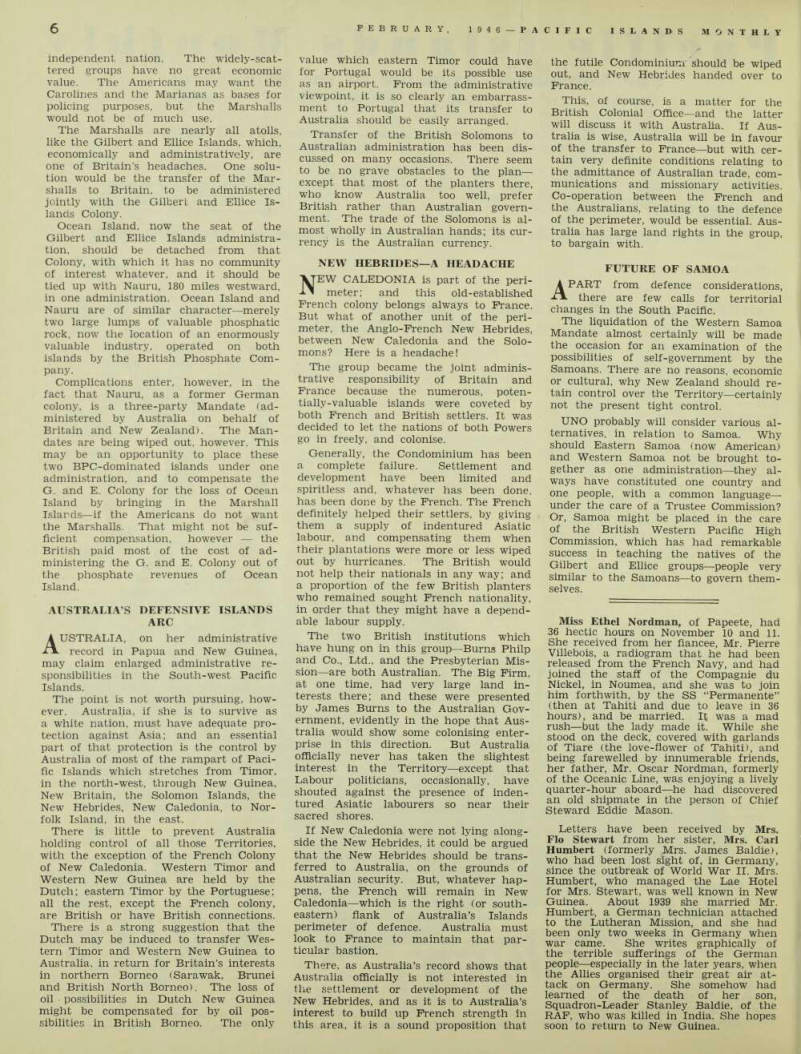
The Marshalls are nearly all atolls, like the Gilbert and Ellice Islands, which, economically and administratively, are one of Britain’s headaches. One solu tion would be the transfer of the Mar shalls to Britain, to be administered jointly with the Gilbert and Ellice Is lands Colony.
Ocean Island, now the seat of the Gilbert and Ellice Islands administra tion, should be detached from that Colony, with which it has no community of interest whatever, and it should be tied up with Nauru, 180 miles westward, in one administration. Ocean Island and Nauru are of similar character—merely two large lumps of valuable phosphatic rock, now the location of an enormously valuable industry, operated on both islands by the British Phosphate Com pany.
Complications enter, however, in the fact that Nauru, as a former German colony, is a three-party Mandate (ad ministered by Australia on behalf of Britain and New Zealand). The Man dates are being wiped out, however. This may be an opportunity to place these two BPC-dominated islands under one administration, and to compensate the G. and E. Colony for the loss of Ocean Island by bringing in the Marshall Islands—if the Americans do not want the Marshalls. That might not be suf ficient compensation, however the British paid most of the cost of ad ministering the G. and E. Colony out of the phosphate revenues of Ocean Island.
Australia’S Defensive Islands
Arc
AUSTRALIA, on her administrative record in Papua and New Guinea, may claim enlarged administrative re sponsibilities in the South-west Pacific Islands.
The point is not worth pursuing, how ever. Australia, if she is to survive as a white nation, must have adequate pro tection against Asia; and an essential part of that protection is the control by Australia of most of the rampart of Paci fic Islands which stretches from Timor, in the north-west, through New Guinea, New Britain, the Solomon Islands, the New Hebrides, New Caledonia, to Nor folk Island, in the east.
There is little to prevent Australia holding control of all those Territories, with the exception of the French Colony of New Caledonia. Western Timor and Western New Guinea are held by the Dutch: eastern Timor by the Portuguese; all the rest, except the French colony, are British or have British connections.
There is a strong suggestion that the Dutch may be induced to transfer Wes tern Timor and Western New Guinea to Australia, in return for Britain’s interests in northern Borneo (Sarawak. Brunei and British North Borneo). The loss of oil possibilities in Dutch New Guinea might be compensated for by oil pos sibilities in British Borneo. The only
value which eastern Timor could have for Portugal would be its possible use as an airport. From the administrative viewpoint, it is so clearly an embarrass ment to Portugal that its transfer to Australia should be easily arranged.
Transfer of the British Solomons to Australian administration has been dis cussed on many occasions. There seem to be no grave obstacles to the plan— except that most of the planters there, who know Australia too well, prefer British rather than Australian govern ment. The trade of the Solomons is al most wholly in Australian hands; its cur rency is the Australian currency.
New Hebrides—A Headache
NEW CALEDONIA is part of the peri meter; and this old-established French colony belongs always to France, But what of another unit of the peri meter, the Anglo-French New Hebrides, between New Caledonia and the Solo mons? Here is a headache!
The group became the joint adminis trative responsibility of Britain and France because the numerous, poten tially-valuable islands were coveted by both French and British settlers. It was decided to let the nations of both Powers go in freely, and colonise.
Generally, the Condominium has been a complete failure. Settlement and development have been limited and spiritless and, whatever has been done, has been done by the French. The French definitely helped their settlers, by giving them a supply of indentured Asiatic labour, and compensating them when their plantations were more or less wiped out by hurricanes. The British would not help their nationals in any way; and a proportion of the few British planters who remained sought French nationality, in order that they might have a depend able labour supply.
The two British institutions which have hung on in this group—Burns Philp and Co., Ltd., and the Presbyterian Mis sion—are both Australian. The Big Firm, at one time, had very large land in terests there; and these were presented by James Burns to the Australian Gov ernment, evidently in the hope that Aus tralia would show some colonising enter prise in this direction. But Australia officially never has taken the slightest interest in the Territory—except that Labour politicians, occasionally, have shouted against the presence of inden tured Asiatic labourers so near their sacred shores.
If New Caledonia were not lying along side the New Hebrides, it could be argued that the New Hebrides should be trans ferred to Australia, on the grounds of Australian security. But, whatever hap pens, the French will remain in New Caledonia—which is the right (or south eastern) flank of Australia’s Islands perimeter of defence. Australia must look to France to maintain that par ticular bastion.
There, as Australia’s record shows that Australia officially is not interested in the settlement or development of the New Hebrides, and as it is to Australia’s interest to build up French strength in this area, it is a sound proposition that
the futile Condominium should be wiped out, and New Hebrides handed over to France.
This, of course, is a matter for the British Colonial Office—and the latter will discuss it with Australia. If Aus tralia is wise, Australia will be in favour of the transfer to France —but with cer tain very definite conditions relating to the admittance of Australian trade, com munications and missionary activities.
Co-operation between the French and the Australians, relating to the defence of the perimeter, would be essential, Aus tralia has large land rights in the group, to bargain with.
Future Of Samoa
APART from defence considerations, there are few calls for territorial changes in the South Pacific.
The liquidation of the Western Samoa Mandate almost certainly will be made the occasion for an examination of the possibilities of self-government by the Samoans. There are no reasons, economic or cultural, why New Zealand should re tain control over the Territory—certainly not the present tight control.
UNO probably will consider various al ternatives, in relation to Samoa. Why should Eastern Samoa (now American) and Western Samoa not be brought to gether as one administration—they al ways have constituted one country and one people, with a common language under the care of a Trustee Commission?
Or, Samoa might be placed in the care of the British Western Pacific High Commission, which has had remarkable success in teaching the natives of the Gilbert and Ellice groups—people very similar to the Samoans —to govern them selves.
Miss Ethel Nordman, of Papeete, had 36 hectic hours on November 10 and 11.
She received from her fiancee, Mr. Pierre Villebois, a radiogram that he had been released from the French Navy, and had joined the staff of the Compagnie du Nickel, in Noumea, and she was to join him forthwith, by the SS “Permanente” (then at Tahiti and due to leave in 36 hours), and be married. It was a mad rush —but the lady made it. While she stood on the deck, covered with garlands of Tiare (the love-flower of Tahiti), and being farewelled by innumerable friends, her father, Mr. Oscar Nordman, formerly of the Oceanic Line, was enjoying a lively quarter-hour aboard—he had discovered an old shipmate in the person of Chief Steward Eddie Mason.
Letters have been received by Mrs.
Flo Stewart from her sister, Mrs. Carl Humbert (formerly Mrs. James Baldie), who had been lost sight of, in Germany, since the outbreak of World War 11. Mrs.
Humbert, who managed the Lae Hotel for Mrs. Stewart, was well known in New Guinea. About 1939 she married Mr.
Humbert, a German technician attached to the Lutheran Mission, and she had been only two weeks in Germany when war came. She writes graphically of the terrible sufferings of the German people—especially in the later years, when the Allies organised their great air at tack on Germany. She somehow had learned of the death of her son, Squadron-Leader Stanley Baldie, of the RAF, who was killed in India. She hopes soon to return to New Guinea.