A Tongan Chronology Translated and Arranged by August
pp. 50-52 · Read in the full issue
A Century Of Unity
A Tongan Chronology Translated and Arranged by August Hettig from Material Supplied by Latu Tu’akihekolo
0 N December 4, this year, Tonga will celebrate the 100 th anniversary of the uniting of Tonga under one
King, George Tupou I. The following
is a summary of the important events in the life of this famous Polynesian King, who literally was the maker of modern Tonga ; Year. 1797. Nginingini Ofolanga (George Tupou’s name at birth) is born either at Lifuka, Ha’apai, or at Pea in Tongatapu (exact date and birthplace not found in any record). Taufa, a witch doctor who lived at ’Ahau, and who gave the name of Taufa’ahau to Nginingini foretells that Taufa’ahau would be a great warrior and would win wars. 1806. Taufa’ahau (as he was at this time known), now a young lad of nine, sees the massacre of the men of the “Port au Prince” at Lifuka, Ha’apai. It is believed that only one white man survived this tragedy. His name was Mariner, who later wrote the now famous “Mariner’s Tonga.” 1820. Taufa’ahau’s father, Tu’i (king) Kanokupolu, dies. He was the 17th of that line of Tongan kings. The position of the Tu’i, Kanokupolu line, was then left vacant until 1826. 1826. Taufa’ahau is now made Ruler of Ha’apai (Tu’i Ha’apai). The young man (over six feet in height) ex cells all others in manly sports and fighting. His grand-uncle, Alea motu’a, is chosen by the High Chiefs of Tonga to become the 18th Tu’i Kanokupolu. 1831. On August 7, Taufa’ahau is bap tised by Wesleyan missionaries and given the name of George, and his wife is given the name of Charlotte (Salote in Tongan) in honour of the then reigning King and Queen of England. 1833. Taufa’ahau is now made Ruler of Vavau. The Tongan title of Tu’i Vava’u is given him by High Chief Finau IV of Vava’u. 1837. The King (Aleamotu’a) being now a Christian sends for Taufa’ahau, his grand-nephew, to join him in a Christian crusade of the main island, Tongatapu. This marks the period of the beginning of Taufa’ahau’s wars in Tongatapu. The pagan fort of Ngele’ia at Nuku alofa is easily overcome and this feat is followed by two others, Te’ekiu and Nukunuku (villages near Nuku’alofa). 1839. The first written law of Tonga (the Vava’u Code) is enacted. By this code the powers of the chiefs are limited, and they are directed to give land to their people who were in return obliged to cultivate it properly; amongst other things, marriage, prohibition of alcoholic liquor and the proper observance of Sunday are dealt with in the Code. 1840. There is a second phase of the Christian crusade of Tongatapu.
Taufa’ahau and his warriors storm
Kolovai Port and capture it. A very formidable rebel army at Pea is overpowered and made Christian during a visit of HMS “Favourite,” with Captain Crocker, to Nuku alofa. Captain Crocker offers to mediate between Taufa’ahau’s war riors and the Pea rebels, and leaves with his party for Pea Fort.
Through some misunderstanding, the captain and several of his party are killed at the gates of the fort.
His body is later brought to Nuku alofa and buried on Mount Veiongo overlooking Nukualofa.
1845. On November 18, King Tleamotu’a dies. Ma’afu, his son, should suc ceed him, but the old King had already made provisions to have Taufa’ahau made his successor. On December 4 (this day has since been always observed in Tonga as a public holiday) this now famous warrior, Taufa’ahau, is unani mously chosen by the chiefs to rule as the 19th Tu’i Kanokupolu.
He is installed at Pangai, Hihifo, under a Koka tree where all the kings of this line had held their coronation. He was the last king to be installed at this spot. The new ruler takes the title King George Tupou I, the 19th in the Tu’i Kanokupolu dynasty. 1848. Ma’afu, who should have been the new king, leaves with followers for Fiji. He lands and conquers the Lau Group In Fiji. (Descendants of these Tongans predominate in the population of these islands to this day.) 1852. Third and last war commences in Tongatapu. Head Chief Vaea sur renders Houma without bloodshed and offers, there and then, to be come Christian together with his people. On August 9, HMS “Cal liope” with Sir Everard Home,
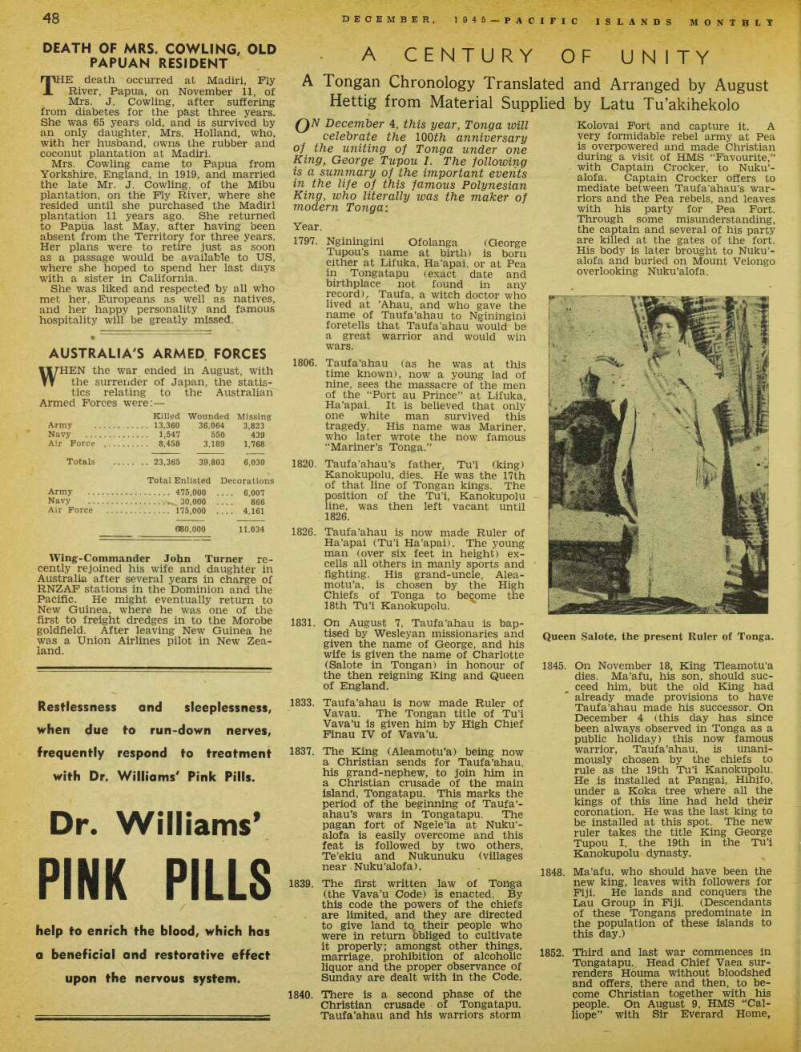
Queen Salote, the present Ruler of Tonga.
arrives at Nukualofa, and there witnesses the subjugation of Pea.
There were Catholic priests (French) at Pea at the time and during the battle their mission or church house is burned. Taufa’ahau here intervened and saved what other belongings the priests had.
Later, the French acknowledge him as Supreme Ruler of Tonga. 1853. King George Tupou I pays a short visit to Sydney, Australia. En route he calls on Cakobau of Fiji. Cako bau promises him his kalia “Marama” (a huge double outrigger canoe). 1854. George Tupou appeals to Cakobau to give up paganism and become a Christian, which is accepted. 1855. Sails for Fiji in 39 double canoes to fetch his promised kalia from Cakobau. Assisted Cakobau to cap ture Kapa in Fiji. Met there his uncle, Ma’afu. Returned from Fiji with his kalia “Marama.” In the same year the King signs a Treaty with France. 1862. First Tongan Parliament meets on June 4. George Tupou first freed his own people in Lifuka in 1835, but the emancipation of 1882 is applied to all Tonga. The main ' principles of the Code of 1862, as it is known were that all Tongans, chiefs and commoners alike, were subject to the laws of the land.
They were set free from forced labour and compulsory contribu tions to the chiefs, and they were given complete control over their own property. In addition a Par liament, consisting of chiefs and representatives of the people, was 1869. Tongan national flag and Tongan coat of arms adopted. 1875. The new constitution of Tonga is formed. Its main divisions are: (1) a declaration of rights; freedom of life, property, worship, etc.; (2) the form of Government: the King, Privy Council and Cabinet, the Legislative Assembly, the Judiciary; (3) the land: declared to belong to the King who could grant estates to his nobles who were to lease portions of this land to their people. Land was not to be sold to Europeans or to anyone else; only leases approved by the Cabinet were to be recognised. The laws of succession to the throne and to titles of nobility were also set forth. 1876. First Government “Gazette” issued on January 1. The King signs a Treaty with Germany. 1877. The Throne made and placed at the Royal Chapel at the Palace, Nukualofa. Part of the famous Koka tree from Pangai used in the decorations on the back of the Throne. 1879. The King signs a Treaty with Great Britain. 1882. The King founds Tonga College for Tongan boys at Nukualofa and also introduces free secondary educa tion, using his private lease money to finance his ideas. 1888. The King signs a Treaty with the United States of America. 1893. On February 18 George Topou dies and on March 17, his second grand child was crowned King George Tupou II at the Palace Chapel, Nuku’alofa.
GEORGE TUPOU II died in 1918, and his daughter, the present ruler of
Tonga, succeeded to the Throne as Queen Salote Tupou 111.
On December 4 this year this last sur viving Pacific Kingdom completes a cen tury of successful and united rule. In the 100 years that have passed since- the coronation of King George Tupou under a Koka tree, Tonga, has had many vicis situdes, To-day Tonga, as all small nations must, looks towards a future that is clouded with uncertainty, but still with the hope that the next century will be another era of undisturbed unity and progress.