"Malaita" To Sail Again
p. 43 · Read in the full issue
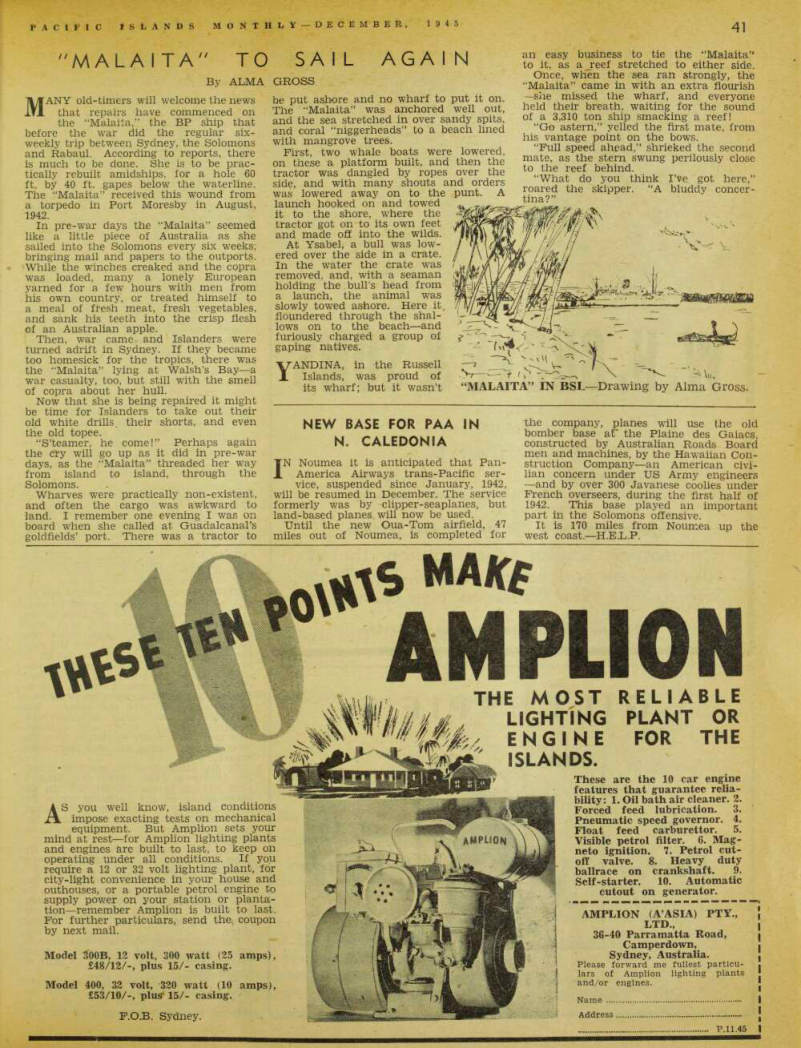
By Alma Gross
MANY old-timers will welcome the news that repairs have commenced on the “Malaita,” the BP ship that before the war did the regular six weekly trip between Sydney, the Solomons and Rabaul. According to reports, there is much to be done. She is to be prac tically rebuilt amidships, for a hole 60 ft. by 40 ft. gapes below the waterline.
The “Malaita” received this wound from a torpedo in Port Moresby in August, 1942.
In pre-war days the “Malaita” seemed like a little piece of Australia as she sailed into the Solomons every six weeks, bringing mail and papers to the outports.
While the winches creaked and the copra was loaded, many a lonely European yarned for a few hours with men from his own country, or treated himself to a meal of fresh meat, fresh vegetables, and sank his teeth into the crisp flesh of an Australian apple.
Then, war came and Islanders were turned adrift in Sydney. If they became too homesick for the tropics, there was the “Malaita” lying at Walsh’s Bay—a war casualty, too, but still with the smell of copra about her hull.
Now that she is being repaired it might be time for Islanders to take out their old white drills, their shorts, and even the old topee.
“S’teamer, he come!” Perhaps again the cTy will go up as it did in pre-war days, as the “Malaita” threaded her way from island to island, through the Solomons.
Wharves were practically non-existent, and often the cargo was awkward to land. I remember one evening I was on board when she called at Guadalcanal’s goldfields’ port. There was a tractor to
be put ashore and no wharf to put it on.
The “Malaita” was anchored well out, and the sea stretched in over sandy spits, and coral “niggerheads” to a beach lined with mangrove trees.
First, two whale boats were lowered, on these a platform built, and then the tractor was dangled by ropes over the side, and with many shouts and orders was lowered away on to the punt. A
launch hooked on and towed it to the shore, where the tractor got on to its own feet and made off into the wilds.
At Ysabel, a bull was low ered over the side in a crate.
In the water the crate was removed, and, with a seaman holding the bull’s head from a launch, the animal was slowly towed ashore. Here it floundered through the shal lows on to the beach —and furiously charged a group of gaping natives.
YANDINA, in the Russell Islands, was proud of its wharf; but it wasn’t
an easy business to tie the “Malaita” to it, as a reef stretched to either side.
Once, when the sea ran strongly, the “Malaita” came in with an extra flourish —she missed the wharf, and everyone held their breath, waiting for the sound of a 3,310 ton ship smacking a reef!
“Go astern,” yelled the first mate, from his vantage point on the bows.
“Full speed ahead,” shrieked the second mate, as the stern swung perilously close to the reef behind.
“What do you think I’ve got here,” roared the skipper. “A bluddy concer tina?”