When Fiji Wanted More Indians
p. 42 · Read in the full issue
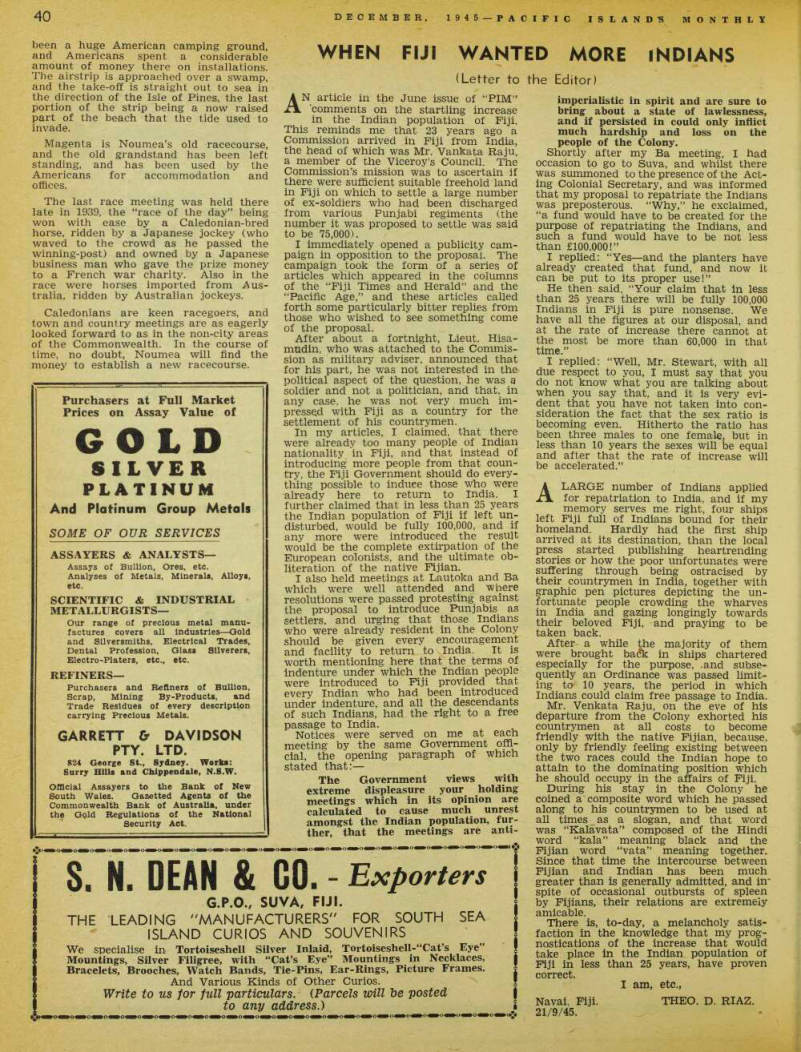
(Letter to the Editor)
AN article in the June issue of “PIM” comments on the startling increase in the Indian population of Fiji.
This reminds me that 23 years ago a Commission arrived in Fiji from India, the head of which was Mr. Vankata Raju, a member of the Viceroy’s Council. The Commission’s mission was to ascertain if there were sufficient suitable freehold land in Fiji on which to settle a large number of ex-soldiers who had been discharged from various Punjabi regiments (the number it was proposed to settle was said to be 75,000).
I immediately opened a publicity cam paign in opposition to the proposal. The campaign took the form of a series of articles which appeared in the columns of the “Fiji Times and Herald” and the “Pacific Age,” and these articles called forth some particularly bitter replies from those who wished to see something come of the proposal.
After about a fortnight, Lieut. Hisa mudin, who was attached to the Commis sion as military adviser, announced that for his part, he was not interested in the political aspect of the question, he was a soldier and not a politician, and that, in any case, he was not very much im pressed with Fiji as a country for the settlement of his countrymen.
In my articles, I claimed, that there were already too many people of Indian nationality in Fiji, and that instead of introducing more people from that coun try, the Fiji Government should do every thing possible to induce those who were already here to return to India. I further claimed that in less than 25 years the Indian population of Fiji if left un disturbed, would be fully 100,000, and if any more were introduced the result would be the complete extirpation of the European colonists, and the ultimate ob literation of the native Fijian.
I also held meetings at Lautoka and Ba which were well attended and where resolutions were passed protesting against the proposal to introduce Punjabis as settlers, and urging that those Indians who were already resident in the Colony should be given every encouragement and facility to return to India. It is worth mentioning here that the terms of indenture under which the Indian people were introduced to Fiji provided that every Indian who had been introduced under indenture, and all the descendants of such Indians, had the right to a free passage to India.
Notices were served on me at each meeting by the same Government offi cial, the opening paragraph of which stated that; — The Government views with extreme displeasure your holding meetings which in its opinion are calculated to cause much unrest amongst the Indian population, fur ther, that the meetings are anti
imperialistic in spirit and are sure to bring about a state of lawlessness, and if persisted in could only inflict much hardship and loss on the people of the Colony.
Shortly after my Ba meeting, I had occasion to go to Suva, and whilst there was summoned to the presence of the Act ing Colonial Secretary, and was informed that my proposal to repatriate the Indians was preposterous. “Why,” he exclaimed, “a fund would have to be created for the purpose of repatriating the Indians, and such a fund would have to be not less than £100,000!”
I replied; “Yes—and the planters have already created that fund, and now it can be put to its proper use!”
He then said, “Your claim that in less than 25 years there will be fully 100,000 Indians in Fiji is pure nonsense. We have all the figures at our disposal, and at the rate of increase there cannot at the most be more than 60,000 in that time.”
I replied: “Well, Mr. Stewart, with all due respect to you, I must say that you do not know what you are talking about when you say that, and it is very evi dent that you have not taken into con sideration the fact that the sex ratio is becoming even. Hitherto the ratio has been three males to one female, but in less than 10 years the sexes will be equal and after that the rate of increase will be accelerated.”
A LARGE number of Indians applied for repatriation to India, and if my memory serves me right, four ships left Fiji full of Indians bound for their homeland. Hardly had the first ship arrived at its destination, than the local press started publishing heartrending stories or how the poor unfortunates were suffering through being ostracised by their countrymen in India, together with graphic pen pictures depicting the un fortunate people crowding the wharves in India and gazing longingly towards their beloved Fiji, and praying to be taken back.
After a while the majority of them were brought ba(?k in ships chartered especially for the purpose, .and subse quently an Ordinance was passed limit ing to' 10 years, the period in which Indians could claim free passage to India.
Mr. Venkata Raju, on the eve of his departure from the Colony exhorted his countrymen at all costs to become friendly with the native Fijian, because, only by friendly feeling existing between the two races could the Indian hope to attain to the dominating position which he should occupy in the affairs of Fiji.
During his stay in the Colony he coined a composite word which he passed along to his countrymen to be used at all times as a slogan, and that word was “Kalavata” composed of the Hindi word “kala” meaning black and the Fijian word “vata” meaning together.
Since that time the intercourse between Fijian and Indian has been much greater than is generally admitted, and in' spite of occasional outbursts of spleen by Fijians, their relations are extremely amicable.
There is, to-day, a melancholy satis faction in the knowledge that my prog nostications of the increase that would take place in the Indian population of Fiji in less than 25 years, have proven correct.
I am, etc.,
Navai, Fiji. 21/9/45,