Tropicalities
pp. 11-13 · Read in the full issue
pROM Mr. J. D. Davidson, of the
Wembley Hotel, Sydney, we have
received the following : “I have been reading a book by Bodham Wetham, published in London, in 1876, and came across the following (/ have read of it before, but not in so much detail)”: The sinu gaga (excoecaria agolochia), or poison sinu, is found in mangrove swamps, has a glossy foliage, oblong leaves and small green flowers in catkins. When the tree is wounded a lot of white milky juice flows out which burns the skin. It is analogous to the Manzanillo of South America. It is an almost certain cure for leprosy.
The leper is rubbed with green leaves and then buried in them. A small fire is then kindled, and a few pieces of wood laid on. As soon as a thick black smoke arises the leper is bound hand and foot, a rope is fastened to his heels, by means of which he is drawn up over the fire so that his head is about 15 inches from the ground in the midst of the poi sonous smoke. The door of the house is then closed, and the sufferer allowed to remain, often for hours. When he is sufficiently smoked, the fire is removed, the slime scraped from his body, and deep gashes cut in the skin until the blood flows freely. The leper is then taken down, and laid in mats to recover, or die.
The agony is dreadful, but the cure is generally complete. rRRITORIES folk will be glad to know that Brigadier D. M. Cleland, who was the executive head of the Production Control Board in the Terri tories, is now a high executive official in the Australian Liberal Party. If the non-Labour parties should get control of the Australian Government next year— a consummation for which all Terri torians nightly pray—we shall have, close to the people in authority, a good friend who understands Territories’ problems and conditions. If Mr. Ward and his like should be thrown off the Govern ment benches in 1946—a thing that does not now appear probable—the Territories would have known 4£ years of rule by Brass-hats, professors and anthropolo gists—the most tragic and, economically and administratively, the most disastrous period in the history of New Guinea and Papua. • MORE about Western Samoa’s visitor, writer and artist, Robert Gibbings (November “PIM”), who plans to do a book on the Territory. He arrived in Apia on the October “Matua” but within a few days had departed for an outer island for the rising of the palolo— scheduled for October 26.
Mr.-Gibbings is an Irishman, son of a one-time Canon of Cork Cathedral; he was a lecturer of book production at the University of Reading for seven years and director of the Golden Cockerel Press for nine; he has written several books about England and his own country and one on Tahiti; and some of the world’s most famous museums exhibit his wood en gravings. Besides all this, he is a painter and sculptor.
He expects to spend a year in Samoa, living among the people, learning the language, making wood-cuts and gather ing material. The actual writing of the book will be done after he leaves the Territory.
Wpstern Samoa as far as anv serious wrfifnei? concerned is Dracticafiv a wmmg is concerned, is practically a vir tAere for a "everaT e books Maybe Mr Glbblnes will Eive us one of* them but at aU B events Bhe 8 he will be remembered there 1 AloSe to the route toTamoa he L Tlready rlferred to as “the pmnting bloke that’s going to Samoa—the one with the beard!” Mr. Gibbings is a large man, with a twinkle in his eye—and a beard—and is popularly supposed to look like an artist. Therefore, I guess he’ll be known as an artist in that part of the globe no matter what line of art he follows. It is to be hoped, for his sake, that underneath the rough and rude Samoan exterior of to-day (alleged to be due to the war) he will find something of that traditional Polynesian charm of which we have all heard so much.—JT. • RUMOUR, which is working overtime in Western Samoa at present, says, that Reparation Estates there is to go in for rubber production in a big way.
Experts are supposed to be in a huddle over the scheme, right now, in Welling ton Reparation Estates is, of course, the New Zealand Government; and a grow your-own-rubber campaign would be all in one piece with Dominion’s aim to be self-supporting. During the war years, a certain number of secondary indus tries have sprung up in New Zealand, and the New Zealand Government is anxious to retain these even at the ex pense of the country’s primary industries.
The reason is not far to seep: more in dustrialisation means more Labour votes; but it is unlikely that, in the post-war world, little New Zealand’s secondary in
dustries will be able to compete in a free world market.
The Dominion’s devotion to a 40-hour week has reached such ridiculous pro portions (it is alleged that doctors, who have already made fortunes out of Social Security, are now petitioning for a 40hours week) that it Is virtually impos sible for its manufacturers to turn out goods that will compete within pounds with countries whose methods are more scientific and whose workers are not quite so exacting. * AS far as rubber-growing is concerned, New Zealand and Samoa should both be interested in the report from in ternational rubber experts who met in New York recently, and forecast that there would be a huge surplus in rubber within the next year or two. The world’s rubber requirements are estimated at about 1,500,000 tons per year, of which the world’s synthetic factories can al ready supply 1,400.000 tons. The raw rubber output of the Far East Is expected to reach 600,000 tons next year and later increase to 1,500,000 tons.
By the time Samoan Reparation Es tates’ rubber trees (which are not yet planted) are in bearing, New Zealand should be able to import all she needs from the East at a fraction of a cost of that produced by the Samoans. However if New Zealand consumers of tyres and hot-water bottles wish to go on indefin itely paying twice as much as the rest of the world for these commodities, there may be merit in the new scheme. * MANY and varied are the reasons for the “unexpected” results of Octo ber 15, when Papuan natives de cided not to make new paper, but return forthwith *to their villages, leaving Papuan industry crippled.
A Sydney “Sunday Sun” correspondent
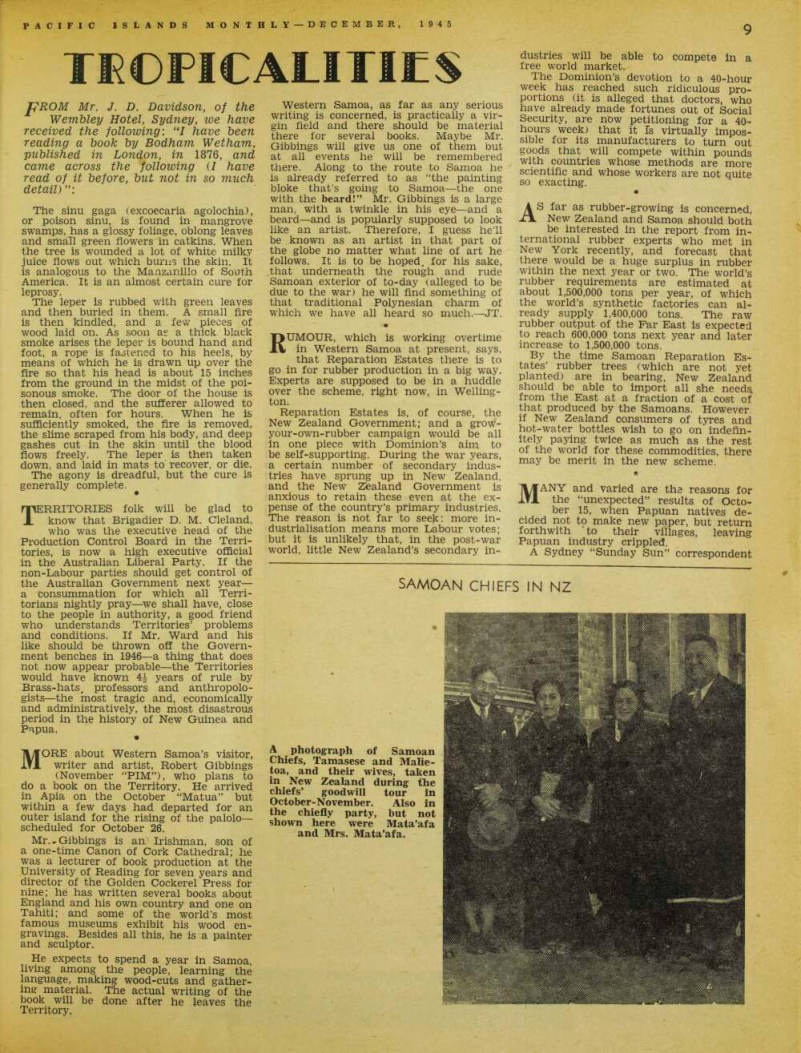
A photograph of Samoan Chiefs, Tamasese and Malie toa, and their wives, taken in New Zealand during the chiefs’ goodwill tour in Octoher-November. Also in the chiefly party, but not shown here were Mata’afa and Mrs. Mata’afa.
Samoan Chiefs In Nz
attributes it to the fact that pre-war, unscrupulous planters fed their labour on a straight diet of“kau-kau,” and that the prospect of returning to this, after several years on ANGAU rations, was just too utterly utter to contemplate.
Therefore, when offered the choice, they pulled up their stakes and lit out for home and mother.
In Sydney on November 30, Territories Minister Ward said that the results of October 15 were a “temporary difficulty and not unforeseen.” He said that natives would resume work in their own good time but in the meantime he refused to “conscript native labour.”
We have it on good authority, from men who were there at the time, that during the period of hiatus natives were conscripted—or, to be more accurate, forced to perform certain essential work.
But perhaps, as in the case of Cohen’s walking-stick (“PIM,” November) such gross details of ill-deeds done are best kept from the delicate susceptibilities of Mr. Ward. ♦ NOW that the attentive waiter belongs to the past, Territorians sigh for that little bit of attention given at meal times by a good house boy. Al though I remember one occasion when the fussiness of a native waiter caused
some embarrassment.
We had a guest for dinner. One of those passers-by who come chugging along in a schooner, drop their pick in the bay, dine and spend the evening, and then sail off over the horizon, perhaps never to be met with again.
This particular guest belonged to the rough diamond class. He was making a hearty meal and entertaining us with the story of his adventurous life, and using his knife to cut his meat, scoop up a piece of butter, or wave in the air to illustrate a point of his narrative. I could see that the boy who was waiting on the table seemed -agitated, but could not guess the reason. Finally, he picked up the butter-knife from the table, and held it before our guest’s eyes, and in a voice quivering with exasperation, said:— “ Tm ’e nife belong butter, Master!”— A.G. * AN article by, Mrs, K. Seton in June “PIM” stated that the only place where one can land between Faisi in the Shortlands, and Kieta in Bou gainville (which are under different ad ministrations) is Refuge Island. Mrs.
Seton commented on the fact that the island was barren and uninviting and that she had never heard of anyone who had landed there. Now a reader writes to tell of someone who did: “In the later part of November, 1916, Mr. Norman Wheatley’s schooner, ‘Niue,’ with a serious accident case from Vella La Vella on board, left Faisi for Kieta in the hope of getting surgical aid there.
The details of the journey then were much the same as Mrs. Seton described 12 or more years later—and a permit to land would only be granted in special circumstances.
“The ‘Niue’ was unprepared for the task; her engine was giving trouble and she also lacked the necessary power for such a trip through currents and tide rips. But there was no alternative —it was a case of urgent necessity.
“Making no headway, it was decided to anchor at Refuge Island and wait for the turn of the tide, which would then be in our favour, instead of dead against us. We had a couple of ‘boys’ taken on at Faisi for their local knowledge.
Trusting to them, we dropped anchor where they said ‘Jack’ did, and found ourselves tossing helplessly among the breakers, aground on the reef.
“All that could be done in such a pre dicament was tried. The engine failed to move her off astern; and gradually, as the tide fell, we took on a more and
more acute angle, ending up for a few hours with the good ship lying high and dry on her side—so that we could step ashore and explore Refuge Island in a vain search for badly-needed fresh water.
“The natives turned up in great force to help us—mostly with advice. Every thing movable was taken ashore—and taken back again when at last we had got back into deep water, through the combined effect of a rising tide and dy namiting the coral.
“The natives, after each explosion, would dive down to indicate to us the best place for the next charge. Norman Wheatley lit each fuse from his cigar.
I never shall forget the tall black figures moving about in the moonlight, the coco nut flares all around, and Norman direct ing operations in his own perfect and inimitable manner.
“There was no doctor at Kieta. Our patient was Captain McEachran, and his condition was serious. So we continued on to Rabaul. They amputated his arm, and he also lost the sight of his right eye.”
Captain McEachran lost his life at Port Moresby early in World War 11.