Men Lost In Rabaul
p. 10 · Read in the full issue
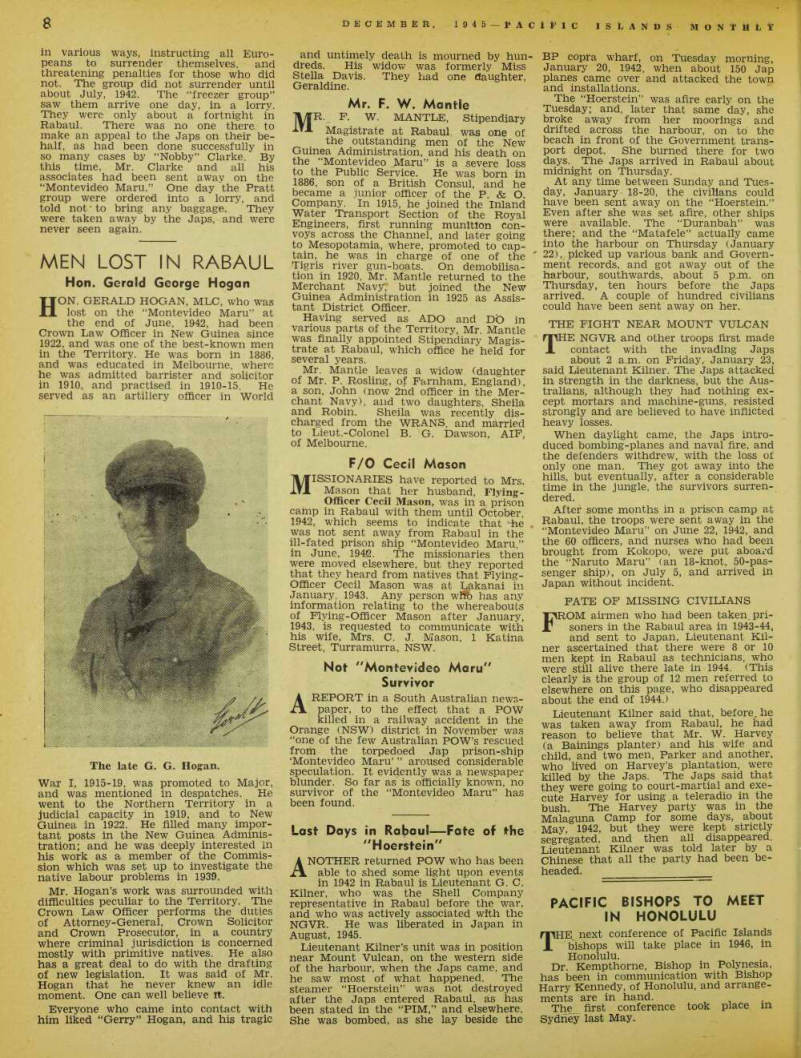
Hon. Gerald George Hogan
Hon. Gerald Hogan, Mlc, Who Was
lost on the “Montevideo Maru” at the end of June, 1942, had been Crown Law Officer in New Guinea since 1922, and was one of the best-known men in the Territory. He was born in 1886, and was educated in Melbourne, where he was admitted barrister and solicitor in 1910, and practised in 1910-15. He served as an artillery officer in World
War I, 1915-19, was promoted to Major, and was mentioned in despatches. He went to the Northern Territory in a judicial capacity in 1919, and to New Guinea in 1922. He filled many impor tant posts in the New Guinea Adminis tration; and he was deeply interested in his work as a member of the Commis sion which was set up to investigate the native labour problems in 1939.
Mr. Hogan’s work was surrounded with difficulties peculiar to the Territory. The Crown Law Officer performs the duties of Attorney-General, Crown Solicitor and Crown Prosecutor, in a country where criminal jurisdiction is concerned mostly with primitive natives. He also has a great deal to do with the drafting of new legislation. It was said of Mr.
Hogan that he never knew an idle moment. One can well believe it.
Everyone who came into contact with him liked “Gerry” Hogan, and his tragic
and untimely death is mourned by hun dreds. His widow was formerly Miss Stella Davis. They had one daughter, Geraldine.
Mr. F. W. Mantle
MR. F. W. MANTLE, Stipendiary Magistrate at Rabaul was one of the outstanding men of the New Guinea Administration, and his death on the “Montevideo Maru” is a severe loss to the Public Service. He was born in 1886, son of a British Consul, and he became a junior officer of the P. & O.
Company. In 1915, he joined the Inland Water Transport Section of the Royal Engineers, first running munition con voys across the Channel, and later going to Mesopotamia, where, promoted to cap tain, he was in charge of one of the Tigris river gun-boats. On demobilisa tion in 1920, Mr. Mantle returned to the Merchant Navy,' but joined the New Guinea Administration in 1925 as Assis tant District Officer, Having served as ADO and DO in various parts of the Territory, Mr. Mantle was finally appointed Stipendiary Magis trate at Rabaul, which office he held for several years.
Mr. Mantle leaves a widow (daughter of Mr. P. Rosling, of Farnham, England), a son, John (now 2nd officer in the Mer chant Navy), and two daughters, Sheila and Robin. Sheila was recently dis charged from the WRANS, and married to Lieut.-Colonel B. G. Dawson, AIF, of Melbourne.
F/O Cecil Mason
MISSIONARIES have reported to Mrs.
Mason that her husband, Flying- Officer Cecil Mason, was in a prison camp in Rabaul with them until October, 1942, which seems to indicate that he was not sent away from Rabaul in the ill-fated prison ship “Montevideo Maru,” in June, 1948. The missionaries then were moved elsewhere, but they reported that they heard from natives that Flying- Officer Cecil Mason was at Lakanai in January, 1943. Any person who has any information relating to the whereabouts of Flying-Officer Mason after January, 1943, is requested to communicate with his wife, Mrs. C. J. Mason, 1 Katina Street, Turramurra, NSW.
Not "Montevideo Maru"
Survivor
A REPORT in a South Australian news paper, to the effect that a POW killed in a railway accident in the Orange (NSW) district in November was “one of the few Australian POW’s rescued from the torpedoed Jap prison-ship ‘Montevideo Maru’ ” aroused considerable speculation. It evidently was a newspaper blunder. So far as is officially known, no survivor of the “Montevideo Maru” has been found.
Last Days in Rabaul—Fate of the
"Hoerstein"
ANOTHER returned POW who has been able to shed some light upon events in 1942 in Rabaul is Lieutenant G. C.
Kilner, who was the Shell Company representative in Rabaul before the war, and who was actively associated with the NGVR. He was liberated in Japan in August, 1945.
Lieutenant Kilner’s unit was in position near Mount Vulcan, on the western side of the harbour, when the Japs came, and he saw most of what happened. The steamer “Hoerstein” was not destroyed after the Japs entered Rabaul, as has been stated in the “PIM,” and elsewhere.
She was bombed, as she lay beside the
BP copra wharf, on Tuesday morning, January 20, 1942, when about 150 Jap planes came over and attacked the town and Installations.
The “Hoerstein” was afire early on the Tuesday; and, later that same day, she broke away from her moorings and drifted across the harbour, on to the beach in front of the Government trans port depot. She burned there for two days. The Japs arrived in Rabaul about midnight on Thursday.
At any time between Sunday and Tues day, January 18-20, the civilians could have been sent away on the “Hoerstein.”
Even after she was set afire, other ships were available. The “Duranbah” was there; and the “Matafele” actually came into the harbour on Thursday (January 22), picked up various bank and Govern ment records, and got away out of the harbour, southwards, about 5 p.m, on Thursday, ten hours before the Japs arrived. A couple of hundred civilians could have been sent away on her.
The Fight Near Mount Vulcan
THE NGVR and other troops first made contact with the invading Japs about 2 a.m. on Friday, January 23, said Lieutenant Kilner. The Japs attacked in strength in the darkness, but the Aus tralians, although they had nothing ex cept mortars and machine-guns, resisted strongly and are believed to have inflicted heavy losses.
When daylight came, the Japs intro duced bombing-planes and naval fire, and the defenders withdrew, with the loss of only one man. They got away into the hills, but eventually, after a considerable time in the jungle, the survivors surren dered.
After some months in a prison camp at Rabaul, the troops were sent away in the “Montevideo Maru” on June 22, 1942, and the 60 officers, and nurses who had been brought from Kokopo, were put aboard the “Naruto Maru” (an 18-knot, 50-pas senger ship), on July 5, and arrived in Japan without incident.
Fate Of Missing Civilians
FROM airmen who had been taken, pri soners in the Rabaul area in 1943-44, and sent to Japan, Lieutenant Kil ner ascertained that there were 8 or 10 men kept in Rabaul as technicians, who were still alive there late in 1944. (This clearly is the group of 12 men referred to elsewhere on this page, who disappeared about the end of 1944.) Lieutenant Kilner said that, before, he was taken away from Rabaul, he had reason to believe that Mr. W. Harvey (a Bainings planter) and his wife and child, and two men, Parker and another, who lived on Harvey’s plantation, were killed by the Japs. The Japs said that they were going to court-martial and exe cute Harvey for using a teleradio in the bush. The Harvey party was in the Malaguna Camp for some days, about May, 1942, but they were kept strictly segregated, and then all disappeared.
Lieutenant Kilner was told later by a Chinese that all the party had been be headed.
The late G. G. Hogan.