On The Trail Of New Wealth
pp. 55-58 · Read in the full issue
In Fiji
Random Notes by R. W. Robson
WE were a mixed party—D. R. Cole, of North America, seeking new sources of certain foodstuffs; H. A. Mitchell, of Australia, seeking new supplies of candle-nuts; Pat Costello, of Suva, seek ing pleasure and interest wherever it might be found in Viti Levu; and I, re visiting people and places from whom I had been cut off by six years of war. We had a good car, 350 mnes of road from Suva back to Suva, and three days of liberty.
There was nothing to write about be tween Suva and Nausori. Heavy rain storms hid the landscape, and Nausori s usually busy street was silent under Sab batarian gloom. * * * WE were miles out, heading north wards through the Rewa Valley, when I found my first story—an industry based on the excreta of bats.
Pat pointed to a group of limestone caves in the steep side of a jungled hill.
This, he said, was the headquarters of Fijian Fertilisers, Ltd. Endless genera tions of bats had made their home there; and their accumulated droppings found great favour in a world hungry for fer tilisers. This particular manure goes to New Zealand.
Unusual —but it made sense. The guano industry, which brought millions to South Seas traders last century, was based on the droppings of sea-birds, which roosted throughout long ages on the low-lying equatorial islands. ♦ * * WE left the rain behind. Luxuriant jungle pressed in upon our valley highway. Mitchell gave a “View Hulloa,” stopped the car, and scrambled down a green bank. Candle-nuts!
We followed, and watched curiously while he gathered some nuts, and pinched them, and hammered them, and knifed them, and —I thought he was kissing them—but he was only tasting the kernel.
And so we had our first lesson on candle nuts.
Every Islander knows the candle-nut — the walnut-sized, intensely hard product of the dark-green tree, that .is so rich in oil that, when a number are strung to gether on a vine, they can be lit like a candle. Hitherto, the nuts have not been regarded as commercially valuable, be cause; (a) the trees are widely scattered; (b) it is difficult to separate the kernel ffom the very hard shell. But now the world is seeking paint and varnish oils of quality, and, in that respect, candle nut oil is valuable —in fact, the candle nut tree is botanically allied to the tung tree, from which comes the valuable com ponent of the finest varnishes. Mr.
Mitchell’s company is experimenting with candle-nut; and, if the result is satisfac tory, candle-nuts will be cultivated, in the same way as the tung tree.
We learned that the kernel contains 65 per cent, of oil, of which 60 per cent, can be obtained by extraction. We also discovered that Fiji apparently has a number of varieties of candle-nut. ♦ ♦ * BREAKFAST had been early. Four masculine stomachs clamoured. Pat smiled sweetly, and directed the car to the gateway of a neat roadside bunga low.
We were introduced to Mr. and Mrs.
Storck, members of a well-known pioneering family. While our charming hostess made morning tea, we astonished foreigners learned that this place, in the heart of Fiji, was a model dairy
farm. Mr. Storck, with a small staff of Indians, milks 90 cows, and sends the cream to a dairy factory, 20 miles away.
One hundred and twenty good fowls, there among the pawpaws and candle nuts, fed on bran mash and coconut meal, gave 60 eggs per day.
The place itself was impressively busi nesslike; but what struck me most was the pioneering angle. What has been done by Mr. Storck, in this green and pleasant tropical valley, can be done in fertile, tax-free Fiji by other dairy farmers who, so to speak, know their onions.
Labour? Yes, labour is a problem here, as everywhere in the Pacific Terri tories to-day. They say the Fiji Indians are undependable. But Mr. Storck had a satisfactory staff of Indians; and a Taveuni coconut planter, whom I met the previous day, carries on with Indian labour—supplied from an Indian village which he has established on his planta tion. Those Indians had land to work, and security of tenure.
The rapidly growing Indian com munity is hungry for arable land, but there is little land available —it all be longs to the -Fijians. If the European land-owners can make a little land available to the Indians, after the man ner of the Taveuni planter, some solu tion of the primary producer’s labour problem may be found.
AS we came into high country, in the valley of the Upper Rewa, Pat pointed to a distant peak.
“Up there,” said Pat, indicating a high peak, “there grows a lemon tree. If you shake it, lemons fall into three rivers— the Rewa, the Ba and the Sigatoka.”
“And the answer’s a lemon,” said Cole.
In the friendliest way, we refused to believe Pat, but we got the general idea.
We were close to an interesting point in Viti Levu—a watershed where the head waters of three big rivers almost meet.
Thenceforward, we were haunted by lemons. For the rest of that day, all the way through to the north coast, we noticed heavily-laden lemon trees scat tered through the rich valleys. Here and there, we cut open a fruit —they were generally big and juicy. I saw Cole and Mitchell go into huddles, their keen com mercial minds intently calculating.- But who wants train-loads of lemon juice? * * * 1, newly come from a country where un happy people will almost commit mayhem for a house or its equivalent materials, was fascinated by the roadside building operations of Fijians and Indians.
Everywhere, at that altitude, grows the Nangasau grass—exactly like the Kunai or Kurukuru grass of Papua and New Guinea. Everywhere, also, are clumps of bamboo. From these excellent and abundant materials, the Fijians make their neat and comfortable houses. The frames are of bamboo or similar poles; the roofs are of Nangasau; and the walls, in an ascending scale of crafts manship and beauty are: (a) all grass; (b) all split cane; (c) partly split cane and partly plaited leaves. A well-built “bure,” of the latter type, is most attrac
tive in appearance, and pleasant to live in' Well I soliloquised, these fortunate people ’ have no trouble about shelter.
Many of their villages, with green lawns and gay flowers, are models of beauty, neatness and cleanliness. But what about food? * * * * SO I began to note down every kind
s lde f °“oad Tvaflabtelo “SS£
neonle And here is my list exactly as ? ??rihhled it down in Le - Mo (taro) 1 A staple foodstuff growing & S soSnt5 SOm " CUlt1 ’
Kavala (sweet potato).
Bananas, breadfruits and pawpaws.
Coconut palms. Lemon trees.
Rice, in occasional cultivation.
Maize and corn. An occasional pineanple Dahl (a foodstuff favoured by the Indians) And, of course, pigs and fowls in large numbers Little wonder that the Fiji Indian is a bigger and broader man than his underfed forebear from the old country! ♦ * * HERE and there we noticed an unusual palm—the dwarf Malayan introduced several years
Sss
“f g SSWI' the dwarf
ol ?the”ground; 2S,
not take, hr a hmrSane, the thrashing that is suffered by the tall palms. wwtp mmp to a rice mill There are
w S-sg?
Safsrais..
rl ßound behind the mill I found Cole,
sadly contemplating a vast heap of spongy stuff, something like bran or pol lard. I learned that that heap repre sented great treasure, if only there were some practicable way of getting at it.
Two-thirds of the padi becomes edible rice, while one-third is thrown away, in this heap of waste. Cole told me that that waste contains certain valuable vitamins—unspellable, but much in demand.
Every year, hundreds of tons of the un wanted husks of the rice-grain are thus thrown away. With them, go vitamins enough to maintain life comfortably, under certain conditions. We noticed that certain wild things—especially birds —showed a keen interest in those heaps of waste. Instinct triumphant over science. * * * ON the shores of Viti Levu Bay we cam« to the pretty Fijian town of Nanoukaloa, laid out garden-wise under the palms and breadfruit trees, in the shade of a remarkable conical hill.
We disembarked, to pay our respects to the chief.
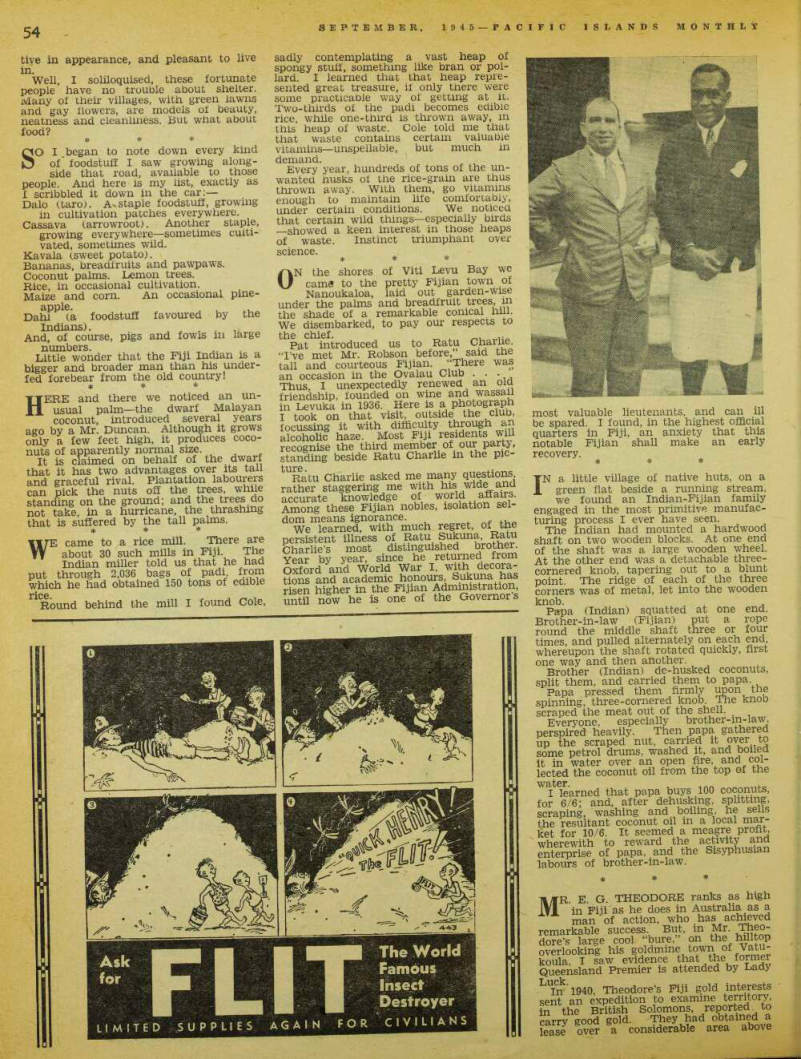
Pat introduced us to Ratu Charlie.
“I’ve met Mr. Robson before,” said the tall and courteous Fijian. “There was an occasion in the Ovalau Club . . • Thus, I unexpectedly renewed an old friendship, founded on wine and wassail in Levuka in 1936. Here is a photograph I took on that visit, outside the club, focussing it with difficulty through an alcoholic haze. Most Fiji residents will recognise the third member of our party, standing beside Ratu Charlie in the pic ture Ratu Charlie asked me many questions rather staggering me with his wide and accurate knowledge of wprld affairs.
Among these Fijian nobles, isolation sel dom means ignorance.
We learned, with much regret, of the persistent illness of Ratu Sukuna, Ratu Charlie’s most distinguished brother.
Year by year, since he returned from Oxford and World War I, with decora tions and academic honours Sukuna has risen higher in the Fijian Administration, until now he is one of the Governors
most valuable lieutenants, and can ill be spared. I found, in the highest official quarters in Fiji, an anxiety that this notable Fijian shall make an early recovery. * * * IN a little village of native huts, on a green flat beside a running stream, we found an Indian-Fijian family engaged in the most primitive manufac turing process I ever have seen.
The Indian had mounted a hardwood shaft on two wooden blocks. At one end of the shaft was a large wooden wheel.
At the other end was a detachable three cornered knob, tapering out to a blunt point. The ridge of each of the three corners was of metal, let into the wooden knob. , , Papa (Indian) squatted at one end.
Brother-in-law (Fijian) put a rope round the middle shaft three or four times, and pulled alternately on each end whereupon the shaft rotated quickly, first one way and then another.
Brother (Indian) de-husked coconuts, split them, and carried them to papa.
Papa pressed them firmly upon the spinning, three-cornered knob. The knob scraped the meat out of the shell.
Everyone, especially brother-in-law, perspired heavily. Then papa gathered up the scraped nut, carried it over to some petrol drums, washed it, and boiled it in water over an open fire, and col lected the coconut oil from the top of the water I learned that papa buys 100 coconuts, for 6/6: and, after dehusking, splitting, scraping, washing and boiling, he sells the resultant coconut oil in a local mar ket for 10/6. It seemed a meagre P r wherewith to reward the activity and enterprise of papa, and the Sisyphusian labours of brother-in-law. ♦ * * MR E. G. THEODORE ranks as high in Fiji as he does in Australia as a man of action, who has achieved remarkable success But, in Mr. Theo dore’s large cool “bure,” on the hilltop overlooking his goldmine town of Vatu koula, I saw evidence that the former Queensland Premier is attended by Baay LU I C n’l94O, Theodore’s Fiji gold interests sent an expedition to examine territory, in the British Solomons, reported to carry good gold. They had obtained a lease over a considerable area above
Berande, on the north coast of Guadal canal, and were planning considerable operations, when Mr, Tojo’s activities caused a suspension of the enterprise.
When the Theodore party cached their equipment and departed, temporarily, Guadalcanal was little more than a name on a map, signifying a big, primitive island, only partly explored.
On the wall of Mr. Theodore’s “bure” I saw a map of Guadalcanal, with the Theodore gold leases indicated by shad ing. The leases are right alongside the Henderson airfield (built by the Japs for the use of the Americans), and are near to the large, new administrative centre at Point Cruse.
Thus, one of the Solomons’ gold seekers’ chief problem transport is Who would have guessed that the gold leases, pegged in 1940, would become, in 1942 part of one of the most famous battlefields of the Pacific war? ♦ * * MANY people are wondering why Emneror and Loloma mines are not paying the rich dividends once pro mised by their operations.
I found neither depression nor pes simism among the large European staff at work at Vatukoula. Everything indi cated that this is a period of exploration and development rather than of produc tion. . , . , The punishing taxation which the stupid Australian politicians are imposing upon those of their countrymen whose enterprise has been extended to other countries is having some remarkable repercussions. Why should the Aus tralian-Fiji gold interests concentrate on making profits, when so large a pro portion of those profits are grabbed by the tax-gatherers? , . .
Mr H J. C. Connolly, expert geologist, was there that week, making a survey and laying out a programme of future digging. mHE results of introducing strange X animals, birds and reptiles into Fiji always has interested me. So, when a thing like a large, elongated rat scuttled across the road, I began to ask questions.
“Are the mongoose still increasing in numbers?” I asked Pat.
“Mongeese,” suggested Cole, tenta tively.
“Mongooses,” said Mitchell, with the Australian’s readiness for argument.
I thought “mongoose” could be either singular or plural, but I not sure. So I told them the story of the man who was writing to an animal dealer, to order two of the creatures. He wrote “mon gooses.” and crossed it out. He tried “mongeese,” and liked that less. So, finally, he said; “Please send me a mon goose, and let me know how to feed it.
And, as a matter of convenience, you had better send me another one.” ♦ ♦ * rE mongoose was brought in to com bat rats in the sugar plantations, and has served his purpose well. Un like the birds minahs and bulbuls, which have almost wiped out the native birds of Fiii —the mongoose has not up set the balance of nature. Except that he helps himself to chickens, occasion allv, he Is harmless.
Another immigrant, the giant toad, is at an interesting stage. He was brought to Fill a few years ago, from America, to get rid of insect pests, and he grew amazingly, not only in numbers but in stature. Life was easy and food abun dant.
But the activity of the toad soon re duced the garden pests. The immigrant found life harder and tougher—he fed less frequently and he had to hunt busily.
Consequently, he shrank perceptibly in size, and now there are not so many of him about. Where, in 1936, I used to meet this huge, startlingly ugly reptile in almost any Suva garden, I found fewer toads in 1945—and they less than half the size of their progenitors.
Suva gardeners wil not hear a word against them they have brought the garden pests definitely under control. * * * I. „ A 1 , . , N three days’ drive around Viti Levu, we made the acquaintance of four noteis: Tavua Hotel, managed by Mr. H.
Garnett.
Ba Hotel, managed by Mr. and Mrs.
Christmas.
Lautoka Hotel, managed by Mr.
Johnston cifT , . n .
Tvr?i conducted b y Ml - and Mrs Steve Monk.
The three first-named are owned by Mr H. H. Ragg and run as a chain— and a very good job he makes of it.
Being fresh from the horrors of Austrahan hotel food and service, in wartime, I had thoroughly enjoyed the excellent menus and the swift, silent Indian service of the Grand Pacific Hotel in Suva. But neither food nor service, in the four country hotels, suffered in a comparison on the contrary, I should have been happy to have stayed a week or two in any of those smaller hotels.
The Tavua Hotel, standing high on the hillside above the township, is handsome and very well-equipped; and when I saw Mr. Garnett’s array of rods and tackle, and heard about the big-game fish which wait for deep-sea anglers outside the reef there. I visualised a new industry, in the best Zane Grey tradition, in that part nf fV\p PnHflp 0 a , , . . . , F ill an <<1 h r servants, playing a solo the u 19,1I 9,1 ! 1 ’ sui ™n°. n Z lsi lu rs }° these hotels, as their forebears, beating the same wioden drums, called the men to frequent and bloody wars. It is a happy idea, though one is a little puzzled, at first, to know what all the noise is about
QOME may find the long road, along the O dry northern shore of Viti Levu, a little monotonous. The interior hills are steep and bare; all the flats between the foothills and the sea are covered with sugar-cane; the dusty highway passes through innumerable Indian villages, with here and there a Fi J ian settlement, In sharp contrast with the south side of the island, there is little rain here. But there also is little humidity—it is a coun try where the white man perspires inf re quently, and gets roses in his cheeks.
But the observant vi£ itor will find It a fascinating 100 miles. Here is the heart 0 f the Indian problem of Fiji. There are Indians everywhere. Industrious Indians, cutting the cane and stacking it for transport on the Sugar Company’s coastal railway. Trading Indians, swarm ing around their little shops In the towns and villages, supplying every possible kind of artisan and distributing service. old Indians, with white beards and skinny shanks, squatting beside the road, tending two or three cattle. Young Indians, well fed and smart looking, going i n groups to their schools. i was deeply interested in the Indian children To a great extent, the future G f this rich British Colony lies in their hands ™° re J
I with
J£° 3 ?„Sfjkej
th fii nd l a sf 09e J?nlnnlP
IpiKS 6
Swiii
A° Alhes in World War 11,
£pSS Tniia w/
out American dollars. But we can do
ipuch
Indians—youngsters who are free from the very depressing Influences of Mother jndia, and who already, owing to their Fiji enviroment. are an improvement ■nr»nn fTiplt* father*? nhv*?icallv and 3hn,nllv ’ P nysicauy ana sp .™7. y , „ .
Indian schools are conducted with intelligence, vision and « especially strength—we yet may find a
solution of a problem that has appeared insoluble. * * * IN the Ba Hotel we had washed away the road dust with Australian beer —yes, Australian! I, who had not even seen Australian bottled beer for years, could buy it at normal prices any where in Fiji—when Pat lifted his head.
“I can hear an engine in a new place,’ he exclaimed, and he led us forth to investigate. , . , We came to a large, newly concreted shed, where machinery whirred.
“Sahib, I have here a seed with five vitamins in it,” said a turbaned Indian, head of the establishment. Cole, who follows vitamins around the earth, dashed into the front line. „ , It was extraordinary set-up—full of oscillating belts driving home-made gad gets designed to get the oil out of pea nuts. (The precious “seed” was peanut.) The boss said he got 30 per cent, of oil, and most of the balance was cake, for which he received £lB per ton. If the outfit pays under present conditions—the noisy engine drove a shaft at floor level, so that all operatives were momentarily threatened with decapitation by un guarded belts—it would pay twice as well under modern factory organisation.
But it was another interesting example of Indian enterprise. * * * BETWEEN Lautoka and Nadi there is a wide area of rolling ground covered with pineapples—and more bo The Company’s half-million pine apple-canning enterprise, launched in the late ’thirties, was interrupted by the war, which cut out transport, supplies of tin plate, and various other essential ser vices. The company kept the new indus try going, in modified form. It did little canning; but it bottled much pineapple juice for the armed forces Now the company is getting back into action—and it is doing its own planting That— according to local report—was no. the original idea The Co ,^ p^ y Ts fanting a big factory, and did a lot of planting by way of demonstration. T It was expected that the Indian farmers and anyone else interested, would grow pineapples, on a guarantee that the company would at an agreed price, all their produce. So far neither the Indians nor anyone else have shown any interest iff pineapple production
surprising thing, in view of the value of this new industry. But the war is only just finished, and it is a little too soon to judge. .
The Fiji Government, very wisely, is doing everything within reason, to en courage the enterprise. Unquestionably, Fiji pineapples have a future. * * * MY allotted space is filled; yet I have by no means finished this account of healthy private enterprises found in a tour around Fiji.
I am prepared to believe, from obser vations and from what has been told to me, that the gold industry of Fiji need not end at Vatoukula. From Tavua right along westwards to Lautoka, the coastal ranges bear the same unusual appear ance. If there is gold behind Tavua, there should be gold in there behind Ba and Lautoka. I was told of an Indian who, not long ago, employing most primi tive methods, got gold worth more than £4,000 in the hills behind Lautoka.
Between Lautoka an Sigatoka we were introduced by Pat to “Mike Regan, mayor of Tau.” Mr. Regan has established at Tau a model township and a flourishing little lime industry, manned by Fijians, and supplying the considerable needs of the Vatoukula goldmines. All Fiji land is starving for lime here is part of the answer. But it must form the subject of another story. ♦ * * AS the car wound through rain-jungles and tortuous gorges of the south coast, I turned to my friends.
“Well,” I said, “how many hungry people have we seen in these three days?”
“Not one,” they agreed.
“How many ragged, or shelterless, or diseased?”
None, that we had seen.
But we had seen a very large Territory, partly covered with food crops, and still capable of vastly increased agriculture, and literally pulsating with the spirit of progress and enterprise.
There is no doubt about the future of Fiji.