Rabaul Women Released
pp. 53-54 · Read in the full issue
Three Years' Starvation and Misery in Japan
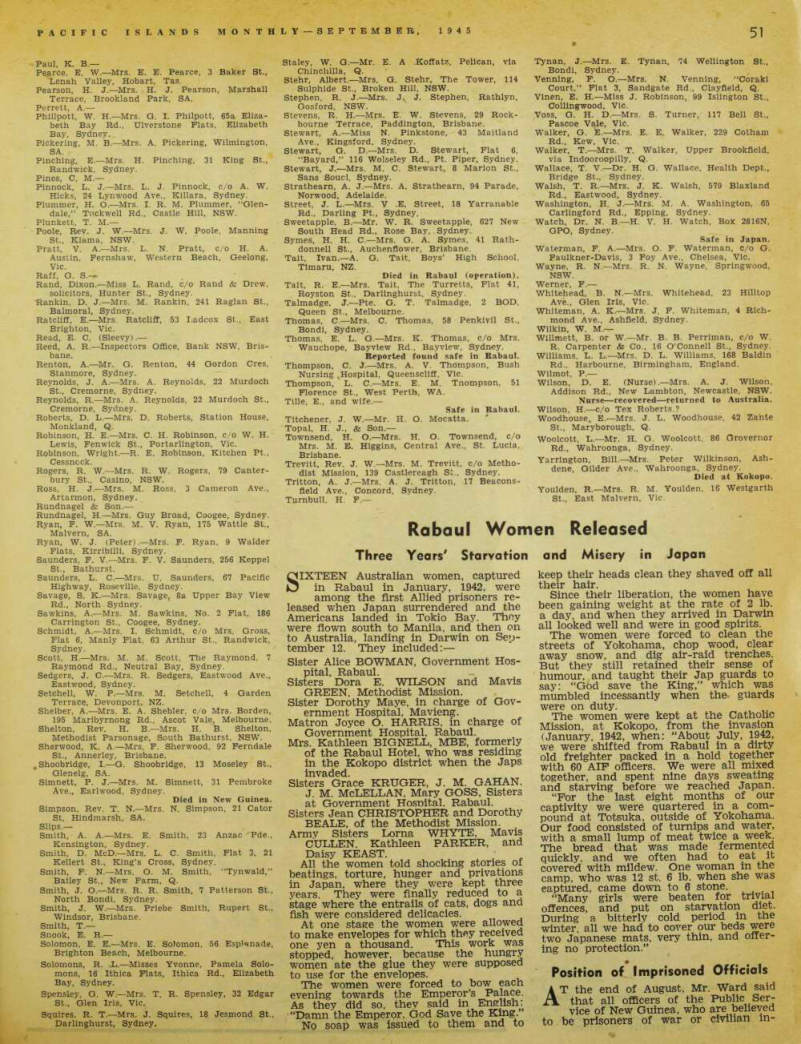
SIXTEEN Australian women, captured
in Rabaul in January, 1942, were among the first Allied prisoners re leased when Japan surrendered and the Americans landed in Tokio Bay. They were flown south to Manila, and then on to Australia, landing in Darwin on Sep tember 12. They included:— Sister Alice BOWMAN, Government Hos pital, Rabaul.
Sisters Dora E. WILSON and Mavis GREEN, Methodist Mission.
Sister Dorothy Maye, in charge of Gov ernment Hospital, Mavieng.
Matron Joyce O. HARRIS, in charge of Government Hospital, Rabaul.
Mrs. Kathleen BIGNELL, MBE, formerly of the Rabaul Hotel, who was residing in the Kokopo district when the Japs invaded.
Sisters Grace KRUGER, J. M. GAHAN.
J. M. McLELLAN, Mary GOSS, Sisters at Government Hospital. Rabaul.
Sisters Jean CHRISTOPHER and Dorothy BEALE, of the Methodist Mission.
Army Sisters Lorna WHYTE, Mavis CULLEN. Kathleen PARKER, and Daisy KEAST.
All the women told shocking stories of beatings, torture, hunger and privations in Japan, where they were kept three years. They were finally reduced to a stage where the entrails of cats, dogs and fish were considered delicacies.
At one stage the women were allowed to make envelopes for which they received one yen a thousand. This work was stopped, however, because the hungry women ate the glue they were supposed to use for the envelopes.
The women were forced to bow each evening towards the Emperor’s Palace.
As they did so, they said in English; “Damn the Emperor, God Save the King.
No soap was issued to them and to
keep their heads clean they shaved off all their hair.
Since their liberation, the women have been gaining weight at the rate of 2 lb. a day, and when they arrived in Darwin all looked well and were in good spirits.
The women were forced to clean the streets of Yokohama, chop wood, clear away snow, and dig air-raid trenches.
But they still retained their sense of humour, and taught their Jap guards to say; “God save the King,” which was mumbled incessantly when the guards were on duty.
The women were kept at the Catholic Mission, at Kokopo, from the invasion (January, 1942, when: “About July, 1942, we were shifted from Rabaul in a dirty old freighter packed in a hold together with 60 AIF officers. We were all mixed together, and spent nine days sweating and starving before we reached Japan.
“For the last eight months of our captivity we were quartered in a com pound at Totsuka, outside of Yokohama.
Our food consisted of turnips and water, with a small lump of meat twice a week The bread that was made fermented quickly, and we often had to eat it covered with mildew. One woman in the camp, who was 12 st. 6 lb. when she was eaptured, came down to 6 stone, “Many girls were beaten for trivial offences, and put on starvation diet.
During a bitterly cold period in the winter, all we had to cover our beds were two Japanese mats, very thin, and offer ing no protection.”
Position of Imprisoned Officials
AT the end of August, Mr. Ward said that all officers of the Public Ser vice of New Guinea, who are believed to be prisoners of war or civilian in
ternees, have been assigned to positions In the Provisional Administration, at least equivalent to the positions they held in the Public Service of New Guinea. He said that 112 Administration officers of New Guinea were believed to be prisoners.
Onlv one had held a position correspond ing to positions in the Papua-New Guinea Administration for which applications had been invited by advertisement.
None of the officers who returned in the near future would be prejudiced by not having had a chance of applying foi positions similar to their old ones, Mr.
Ward said.
Progress of the Fund
rE position of the Rehabilitation Fund (for the assistance of released
Territories prisoners) organised by
the New Guinea Women’s Club, Sydney, now is as follows:
The Committee invited the “Younger Set” to afternoon tea on September 8, to discuss the formation of this branch.
There were 26 guests present. They formed a committee: President: Joan Pennefather.
Secretary: Margery Allan.
Treasurer: Joan Washington.
There will be another stall at the Bal cony entrance of the Theatre Royal on Friday, October 5, for the Fund, and the organisation of a supply of gifts is well in hand.
Rev. James Benson Alive
REV. JAMES BENSON, of the Angli can Mission in North-eastern Papua, has been found alive in a prison camp near Rabaul. Thus another chapter is added to the tragic life of this mis sionary.
NE Papua missionaries became fugi tives when Japs invaded at Gona about August, 1942. Mr. Benson got away into the jungle with two nursing sisters, May Hayman and Mavis Wilkinson. The two women were murdered by the Japs (this crime is dealt with in the Webb report, just published throughout the world), and natives then reported that Mr. Benson was taken to Buna and beheaded. His death was announced in this journal in October, 1942, and again in November.
The Rev. and Mrs. Benson were mis sionaries in New Guinea over 20 years ago. Then, to educate their children, they returned to Australia, and he be came Rector of Bodalla, NSW. One night, he drove his car into the river at the unlighted Bateman’s Bay crossing, and his wife and children were drowned.
Mr. Benson retired for some years into a Monastery at Goulburn. Then he sought a life of greater activity and ser vice, and was sent to the mission field, where he was greatly esteemed.
Sergeant W. H. Simpson, of Port Moresby, who has the distinction of bearing the number PXI in World War ll—in other words, he was the first man with a Papuan address to enlist in 1939 —got his discharge recently, and now is eagerly awaiting an opportunity to re turn home. He was associated with oil and gold-seeking enterprises, and public works projects in Papua before 1939. He served in Libya and Syria in IQ4O and 1941, and returned with his division to Australia in 1942. Soon afterwards he was transferred to ANGAU, with which unit he served until discharge. Many men, less experienced and skilled, were given commissioned rank; but Mr.
Simpson, having firm opinions which he was not afraid to express, fell into dis
favour among some gentlemen who wear brass hats, and—despite six years’ good service—he was kept in the ranks of non coms.
now IS as luuuwo. £ s. d.
Previously acknowledged .. ..
556 1 8 0 6 0 0 0 Major and Mrs. Meares .. . • 0 5 0 t tz> "R \X7nrHpn 1 LilCUt. iv. o. wuiucii Mr. and Mrs. Price (proceeds 16 5 Q pottery) y 0 0 Mr and Mrs. Battis 1 1 Mr and Mrs. H. H. Quinton .. 3 0 0 Bulolo Gold Dredging 21 0 0 Transfer, from General A/c. . 15 0 0 Mr. and Mrs. Drummond Thomson 3 3 0 Mrs. J. Allan (proceeds of tray) .. . - ; • • - 15 e 6 0 5 0 JVL1S. A. DUWi iiig £613 19 9