Many Fortunes
p. 17 · Read in the full issue
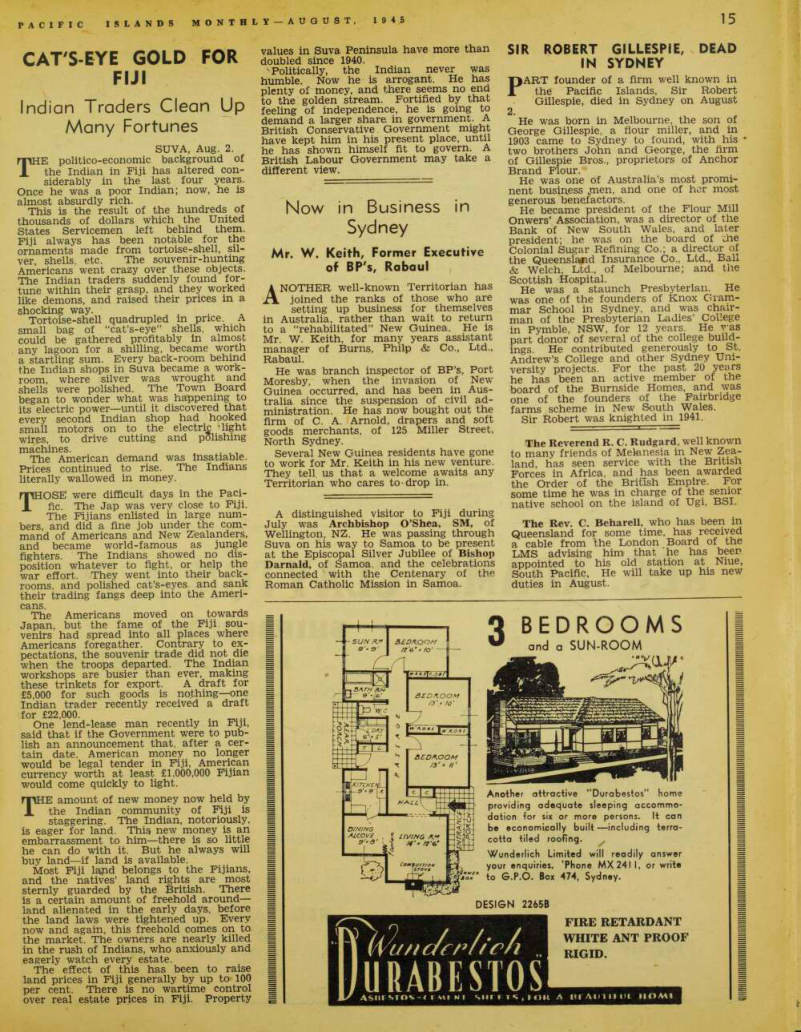
Cat's-Eye Gold For
Fiji
Indian Traders Clean Up Many Fortunes
Suva, Aug. 2.
rE politico-economic background of
the Indian in Fiji has altered con siderably in the last four years.
Once he was a poor Indian; now, he is almost absurdly rich. , , This is the result of the hundreds of thousands of dollars which the United States Servicemen left behind them.
Fiji always has been notable for the ornaments made from tortoise-shell, sil ver, shells, etc. The souvenir-hunting Americans went crazy over these objects.
The Indian traders suddenly found for tune within their grasp, and they worked like demons, and raised their prices in a shocking way.
Tortoise-shell quadrupled in price. A small bag of “cat’s-eye” shells, which could be gathered profitably in almost any lagoon for a shilling, became worth a startling sum. Every back-room behind the Indian shops in Suva became a work room, where silver was wrought and shells were polished. The Town Board began to wonder what was happening to its electric power—until it discovered that every second Indian shop had hooked small motors on to the electric 'light wires, to drive cutting and polishing machines. , The American demand was Insatiable.
Prices continued to rise. The Indians literally wallowed in money. rOSE were difficult days in the Paci fic. The Jap was very close to Fiji.
The Fijians enlisted in large num bers, and did a fine job under the com mand of Americans and New Zealanders, and became world-famous as jungle fighters. The Indians showed no dis position whatever to fight, or help the war effort. They went into their back rooms, and polished cat’s-eyes. and sank their trading fangs deep into the Ameri cans.
The Americans moved on towards Japan, but the fame of the Fiji sou venirs had spread into all places where Americans foregather. Contrary to ex pectations, the souvenir trade did not die when the troops departed. The Indian workshops are busier than ever, making these trinkets for export. A draft for £5,000 for such goods is nothing—one Indian trader recently received a draft for £22,000. , .
One lend-lease man recently in Fiji, said that if the Government were to pub lish an announcement that, after a cer tain date, American money no longer would be legal tender in Fiji, American currency worth at least £1,000,000 Fijian would come quickly to light. rE amount of new money now held by the Indian community of Fiji is staggering. The Indian, notoriously, is eager for land. This new money is an embarrassment to him—there is so little he can do with it. But he always will buy land —if land is available.
Most Fiji lapd belongs to the Fijians, and the natives’ land rights are most sternly guarded by the British. There is a certain amount of freehold around — land alienated in the early days, before the land laws were tightened up. Every now and again, this freehold comes on to the market. The owners are nearly killed in the rush of Indians, who anxiously and eagerly watch every estate.
The effect of this has been to raise land prices in Fiji generally by up to 100 per cent. There is no wartime control over real estate prices in Fiji. Property
values in Suva Peninsula have more than doubled since 1940. - Politically, the Indian never was humble. Now he is arrogant. He has plenty of money, and there seems no end to the golden stream. Fortified by that feeling of independence, he is going to demand a larger share in government. A British Conservative Government might have kept him in his present place, until he has shown himself fit to govern. A British Labour Government may take a different view.