Csr Co. Not A Robber In Fiji
p. 16 · Read in the full issue
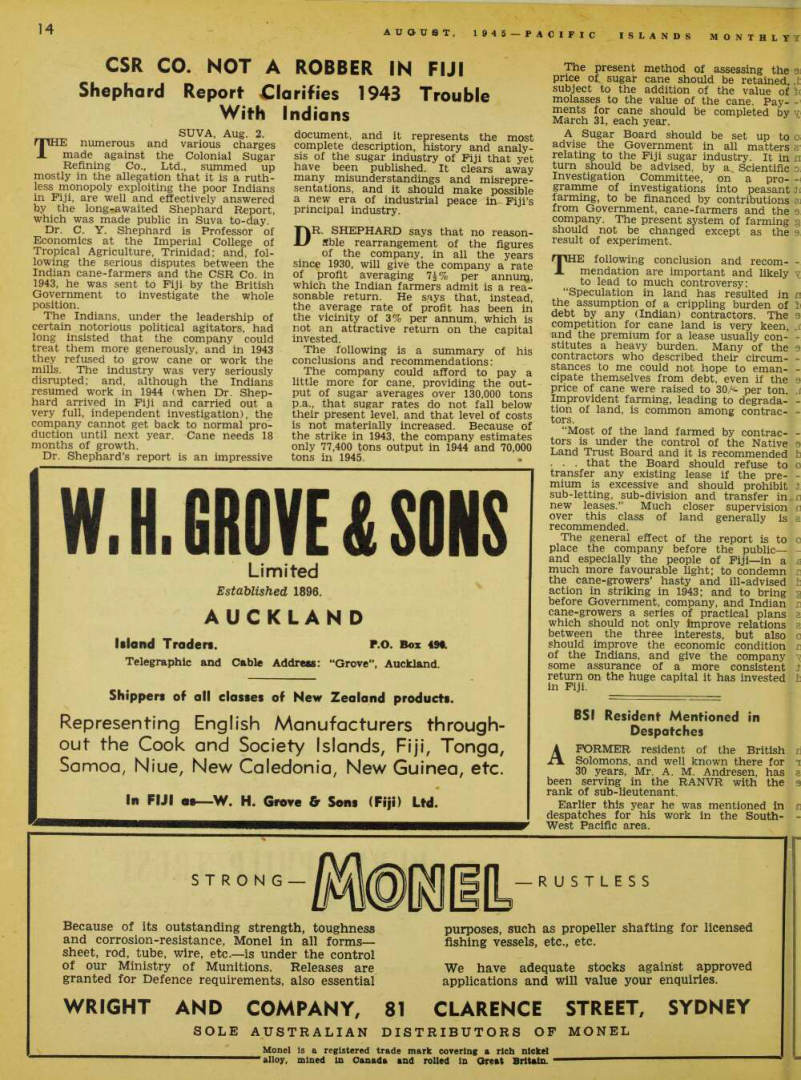
Shephard Report Clarifies 1943 Trouble With Indians
mui , . SUVA, Aug. 2. rpHE numerous and various charges X made against the Colonial Sugar Refining Co., Ltd., summed up mostly in the allegation that it is a ruthless monopoly exploiting the poor Indians in Fiji, are well and effectively answered by the long-awaited Shephard Report, which was made public in Suva to-day.
Dr. C. Y. Shephard is Professor of Economics at the Imperial College of Tropical Agriculture, Trinidad: and, following the serious disputes between the Indian cane-farmers and the CSR Co. in 1943, he was sent to Fiji by the British Government to investigate the whole position, The Indians, under the leadership of certain notorious political agitators, had long insisted that the company could treat them more generously, and in 1943 they refused to grow cane or work the mills. The industry was very seriously disrupted: and. although the Indians resumed work in 1944 (when Dr. Shephard arrived in Fiji and carried out a very full, independent investigation), the company cannot get back to normal production until next year. Cane needs 18 months of growth.
Dr. Shephard’s report is an impressive
document, and it represents the most complete description, history and analy sis of the sugar industry of Fiji that yet have been published. It clears away many misunderstandings and misrepre sentations, and it should make possible a new era of industrial peace in Fiji’s principal industry, T\R. SHEPHARD says that no reason- U able rearrangement of the figures of the company, in all the years since 1930, will give the company a rate of profit averaging 7£% per annum, which the Indian farmers admit is a rea sonable return. He says that, instead, the average rate of profit has been in the vicinity of 3% per annum, which is not an attractive return on the capital invested.
The following is a summary of his conclusions and recommendations: The company could afford to pay a little more for cane, providing the out put of sugar averages over 130,000 tons p.a., that sugar rates do not fall below their present level, and that level of costs is not materially increased. Because of the strike in 1943, the company estimates only 77,400 tons output in 1944 and 70,000 tons in 1945. *
The present method of assessing the price of sugar cane should be retained, subject to the addition of the value of molasses to the value of the cane. Pay ments for cane should be completed by March 31, each year.
A Sugar Board should be set up to advise the Government in all matters relating to the Fiji sugar industry. It in turn should be advised, by a Scientific Investigation Committee, on a pro gramme of investigations into peasant farming, to be financed by contributions from Government, cane-farmers and the company. The present system of farming should not be changed except as the result of experiment. rpHE following conclusion and recom- A mendation are important and likely to lead to much controversy: “Speculation in land has resulted in the assumption of a crippling burden of debt by any (Indian) contractors. The competition for cane land is very keen, and the premium for a lease usually con stitutes a heavy burden. Many of the contractors who described their circum stances to me could not hope to eman cipate themselves from debt, even if the price of cane were raised to per ton.
Improvident farming, leading to degrada tion of land, is common among contrac tors.
“Most of the land farmed by contrac tors is under the control of the Native Land Trust Board and it is recommended . . . that the Board should refuse to transfer any existing lease if the pre mium is excessive and should prohibit sub-letting, sub-division and transfer in. new leases.” Much closer supervision over this class of land generally is recommended.
The general effect of the report is to place the company before the public— and especially the people of Fiji—in a much more favourable light; to condemn the cane-growers’ hasty and ill-advised action in striking in 1943; and to bring before Government, company, and Indian cane-growers a series of practical plans which should not only improve relations between the three interests, but also should improve the economic condition of the Indians, and give the company some assurance of a more consistent return on the huge capital it has invested in Fiji.