"Shangri-La"
pp. 12-13 · Read in the full issue
Freak Plane Accident Discloses Mystery Valley in Dutch N. Guinea
SURELY an undisputed entry in the Guinea “first white stakes, is that of US Women s Army Corps Corporal Margaret SSSSS T^ S & ent SiX weeks n in an unknown Dutch New Guinea valley and was rescued from it by unorthodox means i' Q „ *,• whin Mlss . Hastm £ s sent out Sjfi u a ?i? communication was estabhn^p d Ji e c tw «l n i he castawa ys and their kfnri ” wovinJ Qd fu me S £ n ? e ? a i lts T‘ any behind w whole US Army Qtipi fo h ’ she sot them; also some lipstick, face powder and socks. But that s j? y vl? ... , ne?s»nnl^ y ii?’ Wlth , 22 - °tber US Army i- he nt for a Sl g h tseeing over the mountains of Dutch „ 7 £ w , G l linea - Tha Piane crashed against been , ddescribedr r i bed as a “snowrSS P w mountain. Two soldiers and i mgs u w ! r ? t 5 e J °? ly surviv ors.
They were befriended by tall, friendly K down into a wide > {SSriTu tl i y* a^ d valley > completely landlocked by high ranges. (See cover photo, m^i SS H 6 ;L „„„ • J . . \he three survivors lived in a village val i ey discovered by patrolimg aurcra.ft. Rations were then dropped to them, and parachuting medical men and other personnel dropped into the valley to attend to their minor injuries and clear a landing-strip for a rescuing tSSToiiw T 1 1 i, ■ °« July h a g llder was towed f - va rl: y and i anc *ed on the prepared strip, the castaways and several of the rescuers climbed aboard and, in minutes, a transport plane had swooped down and snapped up the glider on a tow-line. The whole operation was novel and hazardous, but was carried out with complete success. Within an hour, the whole party was back in Hollandia.
mHIS valley, whose existence was A hitherto unsuspected, is about 150 miles from Hollandia and in the heart of the Oranje Mountains It has
been called ShangrMa-S S vailey
by newspaper men, and the name seems likely to stick.
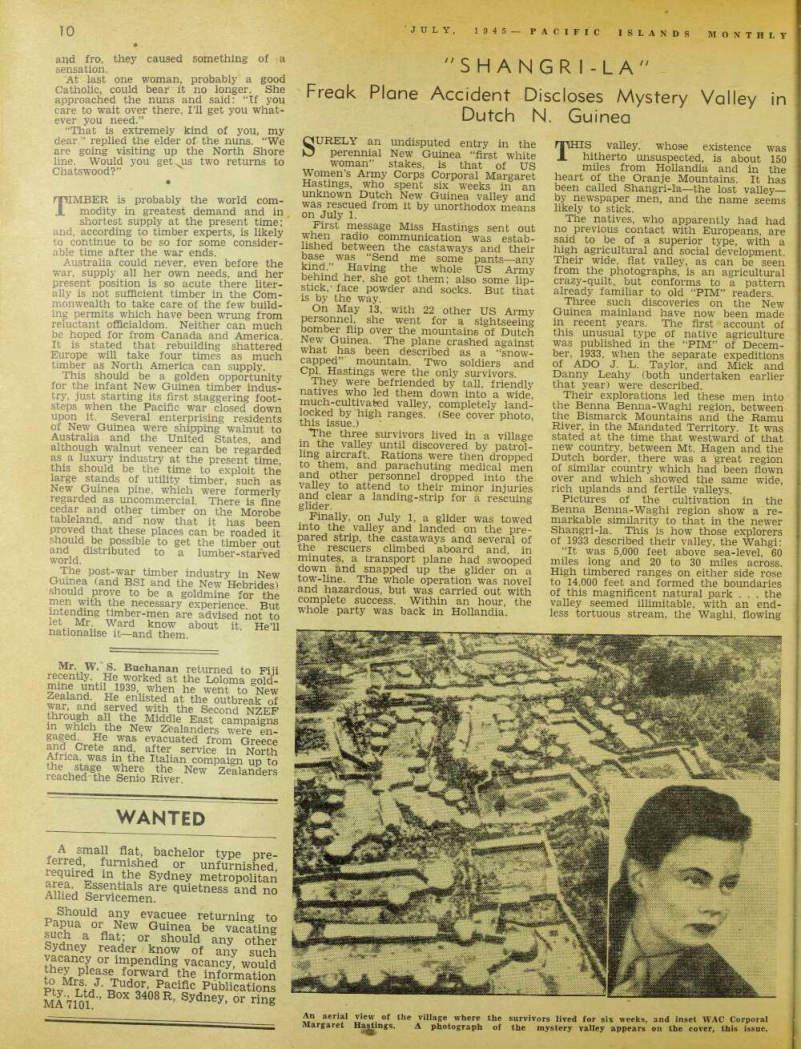
The natives, who apparently had had no previous contact with Europeans, are said to be of a superior type, with a high agricultural and social development. ? heir wide ’ flat vaUe y- as can be seen from the photographs, is an agricultural crazy-quilt, but conforms to a pattern already familiar to old “PIM” readers Three such discoveries on the New Guinea mainland have now been made in recent years. The first account of this unusual type of native agriculture was published in the “PIM” of Decem ber, 1933, when the separate expeditions of ADO J. L. Taylor, and Mick and Danny Leahy (both undertaken earlier that year) were described.
Their explorations led these men into the Benna Benna-Waghi region, between the Bismarck Mountains and the Ramu River, in the Mandated Territory. It was stated at the time that westward of that new country, between Mt. Hagen and the Dutch border, there was a great region of similar country which had been flown over and which showed the same wide, rich uplands and fertile valleys, Pictures of the cultivation in the Benna Benna-Waghi region show a re markable similarity to that in the newer Shangri-la. This is how those explorers of 1933 described their valley, the Wahgi: “It was 5,000 feet above sea-level, 60 miles long and 20 to 30 miles across, High timbered ranges on either side rose to 14,000 feet and formed the boundaries of this magnificent natural park . . . the valley seemed illimitable, with an end less tortuous stream, the Waghi, flowing
An aerial view of the village where the survivors lived for six weeks, and inset WAC Corporal Margaret Hayings. A photograph of the mystery valley appears on the cover, this issue.
through its great grass plains and high terraces. Here and there, park-like plan tations of casuarina dotted the pale-green landscape ...
“The Waghi people are well built and good looking; the men mostly go bearded.
Except on one occasion they were friendly, and the patrols were received without show of hostility. They live in small farm houses, not in villages, and lay out their gardens with mathematical precision.
“Both the Benna Benna people and the Waghi are probably of non-Mela nesian origin, but more work would have to be done among them before this could be stated definitely.”
Mick Leahy wrote fascinatingly about this valley in his book: “The Land That Time Forgot.” rE discoveries of Leahy and Taylor were practically ignored by Austra lia and the world outside. But the next discovery, in 1935, attracted a great deal of publicity and kept the world agog for the traditional seven days. This was when the late Jack Hides, while on patrol in the Strickland-Kikori region of Papua, completed the picture sketched by Tay lor and the Leahy brothers and proved that the great upland region that begins south of Mt. Hagen continues southward, deep into Papua, as a vast inland plateau of extraordinary fertility, peopled hy the one superior class of natives. Hides wrote about his discoveries in several books, the first of which was “Papuan Wonderland.”
It would appear, now, that north-west again, in the high mountain ranges in Dutch Territory, other hidden valleys and unspoiled native peoples await dis covery by post-war explorers. Probably these people would be better off undis covered; but that is too much to be hoped for. No doubt they will in due course be introduced to the blessings of our civilisation.