Interesting Wedding In Apia
pp. 11-12 · Read in the full issue
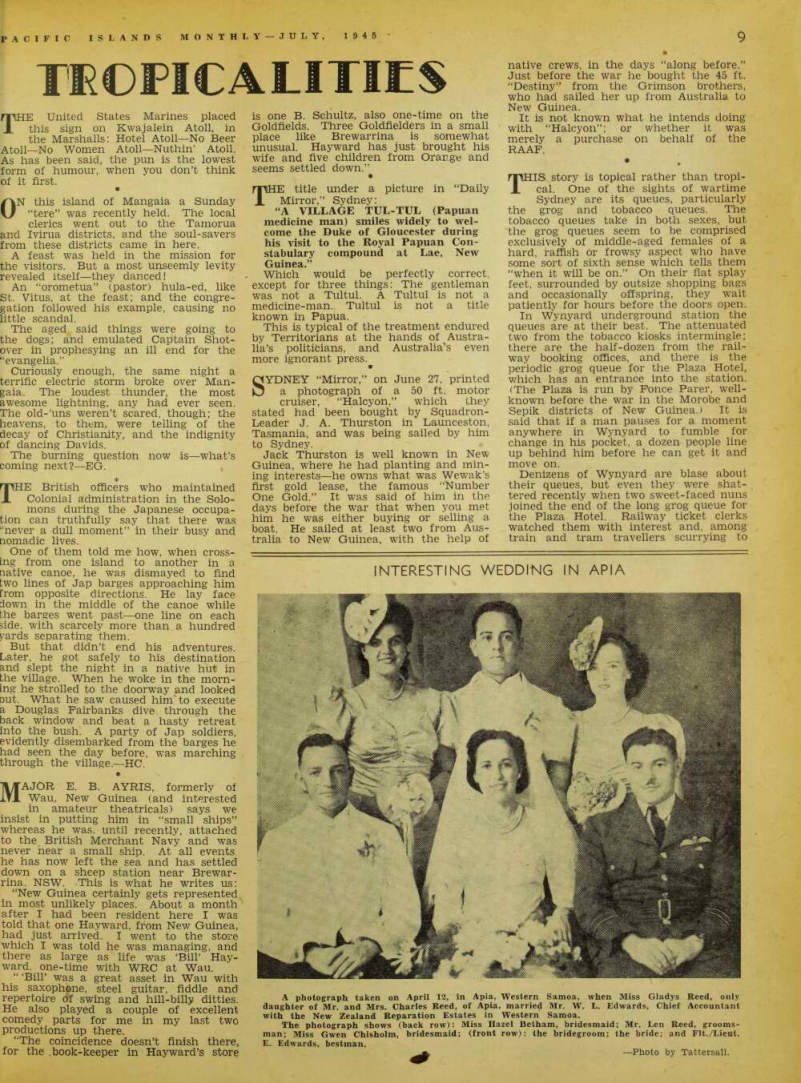
A photograph taken on April 12, in Apia, Western Samoa, when Miss Gladys Reed, only daughter of Mr, and Mrs. Charles Reed, of Apia, married Mr, W. L. Edwards, Chief Accountant with the New Zealand Reparation Estates in Western Samoa.
The photograph shows (back row): Miss Hazel Betham, bridesmaid; Mr. Len Reed, grooms man; Miss Gwen Chisholm, bridesmaid; (front row): the bridegroom; the bride; and Fit./Lieut.
E. Edwards, bestman. —Photo by Tattersall.
and fro, they caused something of a sensation.
At last one woman, probably a good Catholic, could bear it no longer. She approached the nuns and said: “If you care to wait over there, I’ll get you what ever you need.”
“That is extremely kind of you, my dear.” replied the elder of the nuns. “We are going visiting up the North Shore line. Would you two returns to Chatswood?” * rMBER is probably the world com modity in greatest demand and in shortest supply at the present time; and, according to timber experts, is likely to continue to be so for some consider able time after the war ends.
Australia could never, even before the war, supply all her own needs, and her present position is so acute there liter ally is not sufficient timber in the Com monwealth to take care of the few build ing permits which have been wrung from reluctant officialdom. Neither can much be hoped for from Canada and America.
It is stated that rebuilding shattered Europe will take four times as much timber as North America can supply.
This should be a golden opportunity for the infant New Guinea timber indus try, just starting its first staggering foot steps when the Pacific war closed down upon it. Several enterprising residents of New Guinea were shipping walnut to Australia and the United States, and although walnut veneer can be regarded as a luxury industry at the present time, this should be the time to exploit the large stands of utility timber, such as New Guinea pine, which were formerly regarded as uncommercial. There is fine cedar and other timber on the Morobe tableland, and ' now that it has been proved that these places can be roaded it should be possible to get the timber out and distributed to a lumber-starved world.
The post-war timber industry in New Guinea (and BSI and the New Hebrides) should prove to be a goldmine for the men with the necessary experience. But intending timber-men are advised not to let Mr Ward know about it. Hell nationalise it—and them.
Mr - W. S. Buchanan returned to Fiii recently. He worked at the Loloma gold nune until 1939, when he went to New Zealand. He enlisted at the outbreak of war, and served with the Second NZEF through all the Middle East campaigns in which the New Zealanders were en gaged- He was evacuated from Greece and Crete and, after service in North Africa, was in the Italian compaign up to le w^ere the New Zealanders reached the Senio River.