Father Rougier
pp. 36-37 · Read in the full issue
Interesting Fiji Memories of 40 Years Ago
PATHER ROUGIER, formerly a mis sionary in Fiji, died in Tahiti several years ago, after a very successful business career. He owned plantations and traded in certain of the Line Islands. He was reputed to be very rich. He gave away large sums to the church, and to charity, and he was held in very high regard in Tahiti. He left his property and his business to his nephew.
In the following article, H. W. Garnett tells the interesting story of Father Rougier*s early life in Fiji. rTHER Rougier was in charge of the Catholic Mission at Naililili, on the Rewa River, in the early 1900’s.
He was an outstanding type of man in those days, with his long, reddish beard and forceful nature. He had the welfare of the Mission very much at heart and his zeal for acquiring converts to the Catholic faith very nearly ended in a nice little tribal war.
It appears that the Chief of Namosi, with some 2.000 of his fdTTowers, wished to forsake the Wesleyan Church for the
Catholic, and Father Rougier proceeded to the Namosi district, where the baptism ceremony was to take place. After the ceremony, he pointed out that the natives should surrender all the Wesleyan Bibles, which he would replace with Catholic ones. These books were duly passed in; and some of them were in such a torn and dilapidated condition that he decided to have a bonfire on his return to Naili lili.
As he was poling his punt home, past the Wesleyan stronghold, his feelings overcame his sense of tact, and he derisively scattered pages from the torn Wesleyan Bibles along the banks of the river*: On his return to Naililili, he burned the old, torn books, along with other worn-out church gear, and he had a good fire. These acts of scorn, as the Wesleyan Missionaries saw them, caused a good deal of ill-feeling, and representa tions were made to the Governor, who publicly reprimanded Father Rougier. An explanation and apology were sent to the Wesleyan Mission.
ALASTING monument to the memory of Father Rougier is the picturesque church standing on the bank of the Rewa River, at Naililili, to-day. This
church took nearly four years to build, and is constructed entirely of limestone.
Each day, the Mission sisters, with their youthful charges, poled out to the reefs, and returned with their punts laden with coral, which was pounded, burnt and used for the erection of the church.
The man who had much to do the construction of the church—he might even have been the architect—was a Frenchman named Cecile, and his history is a strange one.
During one of Father Rougier’s period ical visits to Levuka, he came across this countryman of his, and when he returned to Naililili he took Cecile with him. Rumour has it that Cecile came of a noble and wealthy French family, and had been deported for life to New Cale donia for some political offence, but he had escaped from that island.
Whatever mystery obscured the origin of Monsieur Cecile, there is no doubt that his association with Father Rougier was colourful and greatly influenced that shrewd old gentleman’s later life.
The story current on the Rewa, in those early days, was that after Cecile had been at Naililili for some years, a letter came for him, from France, inform
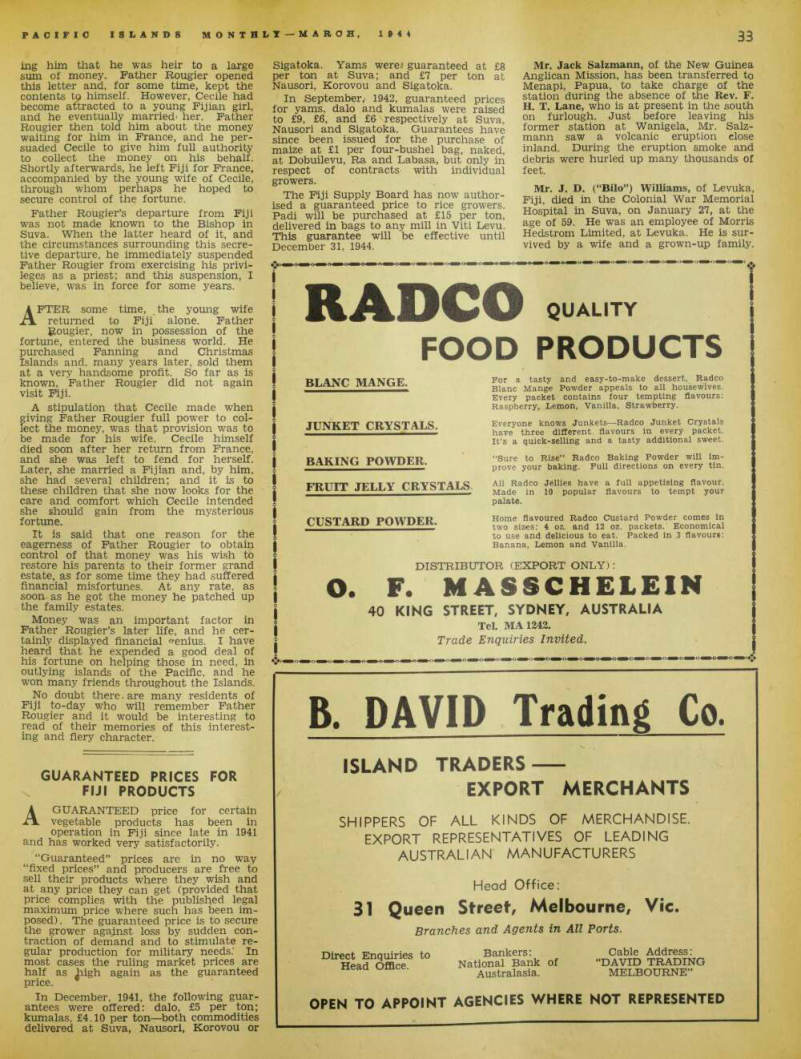
Father Rougier.
ing him that he was heir to a large sum of money. Father Rougier opened this letter and, for some time, kept the contents to himself. However, Cecile had become attracted to a young Fijian girl, and he eventually married- her. Father Rougier then told him about the money waiting for him in France, and he per suaded Cecile to give him full authority to collect the money on his behalf.
Shortly afterwards, he left Fiji for France, accompanied by the young wife of Cecile, through whom perhaps he hoped to secure control of the fortune.
Father Rougier’s departure from Fiji was not made known to the Bishop in Suva. When the latter heard of it, and the circumstances surrounding this secre tive departure, he immediately suspended Father Rougier from exercising his privi leges as a priest; and this suspension, I believe, was in force for some years.
AFTER some time, the young wife returned to Fiji alone. Father Rougier, now in possession of the fortune, entered the business world. He purchased Fanning and Christmas Islands and, many years later, sold them at a very handsome profit. So far as is known, Father Rougier did not again visit Fiji.
A stipulation that Cecile made when giving Father Rougier full power to col lect the money, was that provision was to be made for his wife, Cecile himself died soon after her return from France, and she was left to fend for herself.
Later, she married a Fijian and, by him, she had several children; and it is to these children that she now looks for the care and comfort which Cecile intended she should gain from the mysterious fortune.
It is said that one reason for the eagerness of Father Rougier to obtain control of that money was his wish to restore his parents to their former grand estate, as for some time they had suffered financial misfortunes. At any rate, as soon as he got the money he patched up the family estates.
Money was an important factor in Father Rougier’s later life, and he cer tainly displayed financial o-enius. I have heard that he expended a good deal of his fortune on helping those in need, in outlying islands of the Pacific, and he won many friends throughout the Islands.
No doubt there. are many residents of Fiji to-day who will remember Father Rougier and it would be interesting to read of their memories of this interest ing and fiery character.