Mosquitoes
p. 35 · Read in the full issue
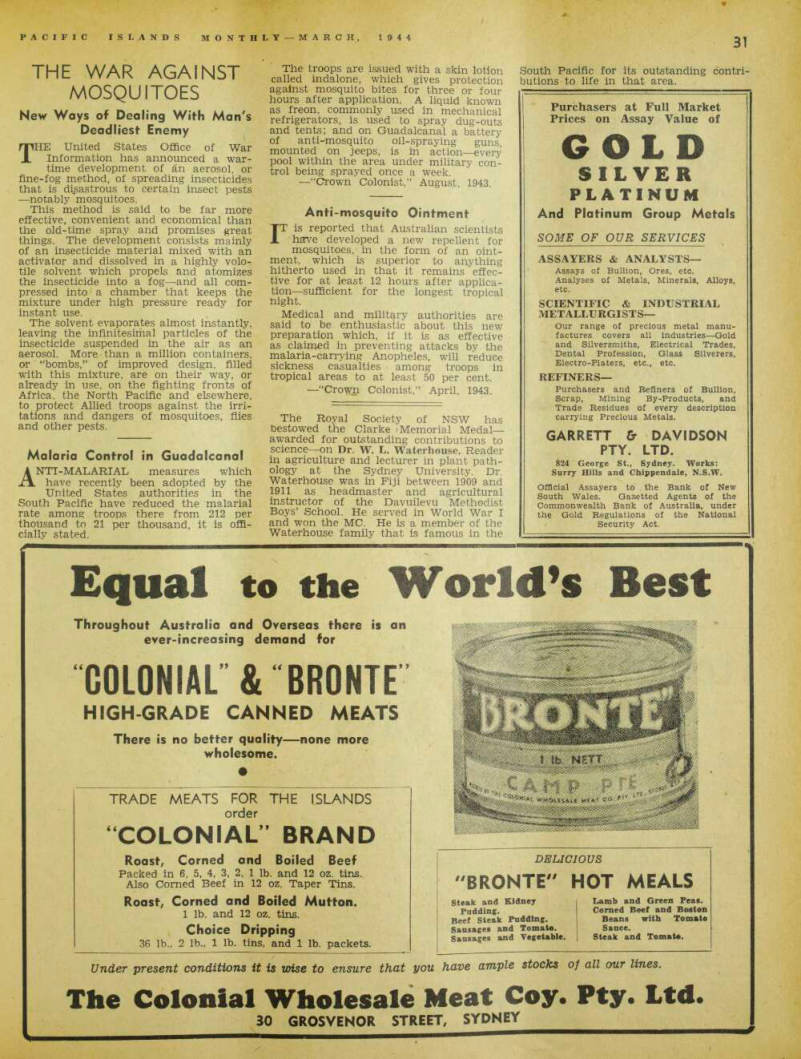
The War Against
New Ways of Dealing With Man's
Deadliest Enemy
THE United States Office of War Information has announced a war time development of an aerosol, or fine-fog method, of spreading insecticides that is disastrous to certain insect pests —notably mosquitoes.
This method is said to be far more effective, convenient and economical than the old-time spray and promises great things. The development consists mainly of an insecticide material mixed with an activator and dissolved in a highly volo tile solvent which propels and atomizes the insecticide into a fog—and all com pressed into a chamber that keeps the mixture under high pressure ready for instant use.
The solvent evaporates almost instantly, leaving the infinitesimal particles of the insecticide suspended in the air as an aerosol. More than a million containers, or “bombs,” of improved design, filled with this mixture, are on their way, or already in use, on the fighting fronts of Africa, the North Pacific and elsewhere, to protect Allied troops against the irri tations and dangers of mosquitoes, flies and other pests.
Malaria Control in Guadalcanal
Anti-malarial measures which have recently been adopted by the United States authorities in the South Pacific have reduced the malarial rate among troops there from 212 per thousand to 21 per thousand, it is offi cially stated.
The troops are issued with a skin lotion called indalone, which gives protection against mosquito bites for three or four hours after application. A liquid known as freon, commonly used in mechanical refrigerators, is used to spray dug-outs and tents; and on Guadalcanal a battery of anti-mosquito oil-spraying guns, mounted on jeeps, is in action—every pool within the area under military con trol being sprayed once a week. —“Crown Colonist,” August, 1943.
Anti-mosquito Ointment
IT is reported that Australian scientists have developed a new repellent for mosquitoes, in the form of an oint ment, which is superior to anything hitherto used in that it remains effec tive for at least 12 hours after applica tion-sufficient for the longest tropical night.
Medical and military authorities are said to be enthusiastic about this new preparation which, if it is as effective as claimed in preventing attacks by the malaria-carrying Anopheles, will reduce sickness casualties among troops in tropical areas to at least 50 per cent. —'“Crowri Colonist,” April, 1943.
The Royal Society of NSW has bestowed the Clarke Memorial Medal awarded for outstanding contributions to science—on Dr. W. L. Waterhouse, Reader in agriculture and lecturer in plant path ology at the Sydney University. Dr.
Waterhouse was in Fiji between 1909 and 1911 as headmaster and agricultural instructor of the Davuilevu Methodist Boys’ School. He served in World War I and won the MC. He is a member of the Waterhouse family that is famous in the
South Pacific for its outstanding contri butions to life in that area.