Deaths Of Brave
p. 15 · Read in the full issue
Airmen
Squadron-Leader Hyde, Formerly of New Guinea
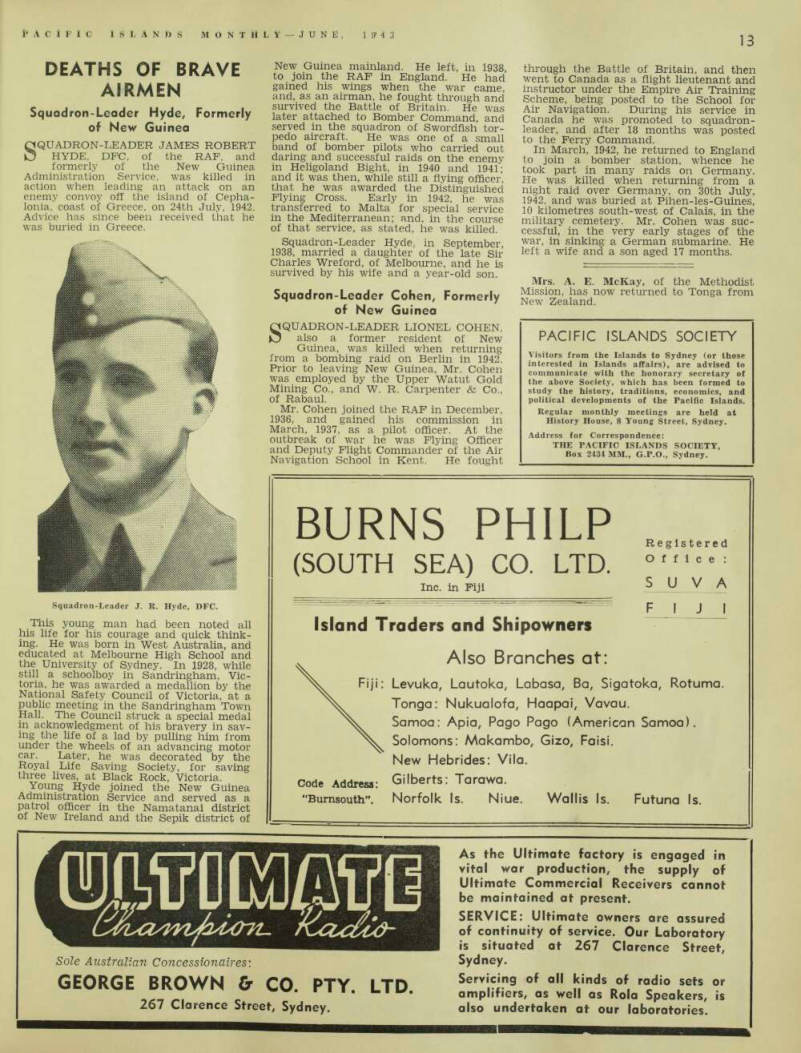
Squadron-Leader James Robert
HYDE, DEC, of the RAF, and formerly of the New Guinea Administration Service, was killed in action when leading an attack on an enemy convoy off the island of Cepha lonia, coast of Greece, on 24th July, 1942.
Advice has since been received that he was buried in Greece.
This young man had been noted all his life for his courage and quick think ing. He was born in West Australia, and educated at Melbourne High School and the University of Sydney. In 1928, while still a schoolboy in Sandringham, Vic toria, he was awarded a medallion by the National Safety Council of Victoria, at a public meeting in the Sandringham Town Hall. The Council struck a special medal in acknowledgment of his bravery in sav ing the life of a lad by pulling him from under the wheels of an advancing motor car. Later, he was decorated by the Royal Life Saving Society, for saving three lives, at Black Rock, Victoria.
Young Hyde joined the New Guinea Administration Service and served as a patrol officer in the Namatanai district of New Ireland and the Sepik district of
New Guinea mainland. He left, in 1938, to join the RAF in England. He had gained his wings when the war came, and, as an airman, he fought through and survived the Battle of Britain. He was later attached to Bomber Command, and served in the squadron of Swordfish tor pedo aircraft. He was one of a small band of bomber pilots who carried out daring and successful raids on the enemy in Heligoland Bight, in 1940 and 1941; and it was then, while still a flying officer, that he was awarded the Distinguished Flying Cross. Early in 1942. he was transferred to Malta for special service in the Mediterranean; and, in the course of that service, as stated, he was killed.
Squadron-Leader Hyde, in September, 1938, married a daughter of the late Sir Charles Wreford, of Melbourne, and he is survived by his wife and a year-old son.
Squadron-Leader Cohen, Formerly
of New Guinea
Squadron-Leader Lionel Cohen,
also a former resident of New Guinea, was killed when returning from a bombing raid on Berlin in 1942.
Prior to leaving New Guinea, Mr. Cohen was employed by the Upper Watut Gold Mining Co., and W. R. Carpenter & Co., of Rabaul.
Mr. Cohen joined the RAF in December, 1936, and gained his commission in March, 1937, as a pilot officer. At the outbreak of war he was Flying Officer and Deputy Flight Commander of the Air Navigation School in Kent. He fought
through the Battle of Britain, and then went to Canada as a flight lieutenant and instructor under the Empire Air Training Scheme, being posted to the School for Air Navigation. During his service in Canada he was promoted to squadron leader, and after 18 months was posted to the Ferry Command.
In March, 1942, he returned to England to join a bomber station, whence he took part in many raids on Germany.
He was killed when returning from a night raid over Germany, on 30th July, 1942, and was buried at Pihen-les-Guines, 10 kilometres south-west of Calais, in the military cemetery. Mr. Cohen was suc cessful, in the very early stages of the war, in sinking a German submarine. He left a wife and a son aged 17 months.
Mrs. A. E. McKay, of the Methodist Mission, has now returned to Tonga from New Zealand.
Squadron-Leader J. R. Hyde, DFC.