No Cosmetics!
p. 42 · Read in the full issue
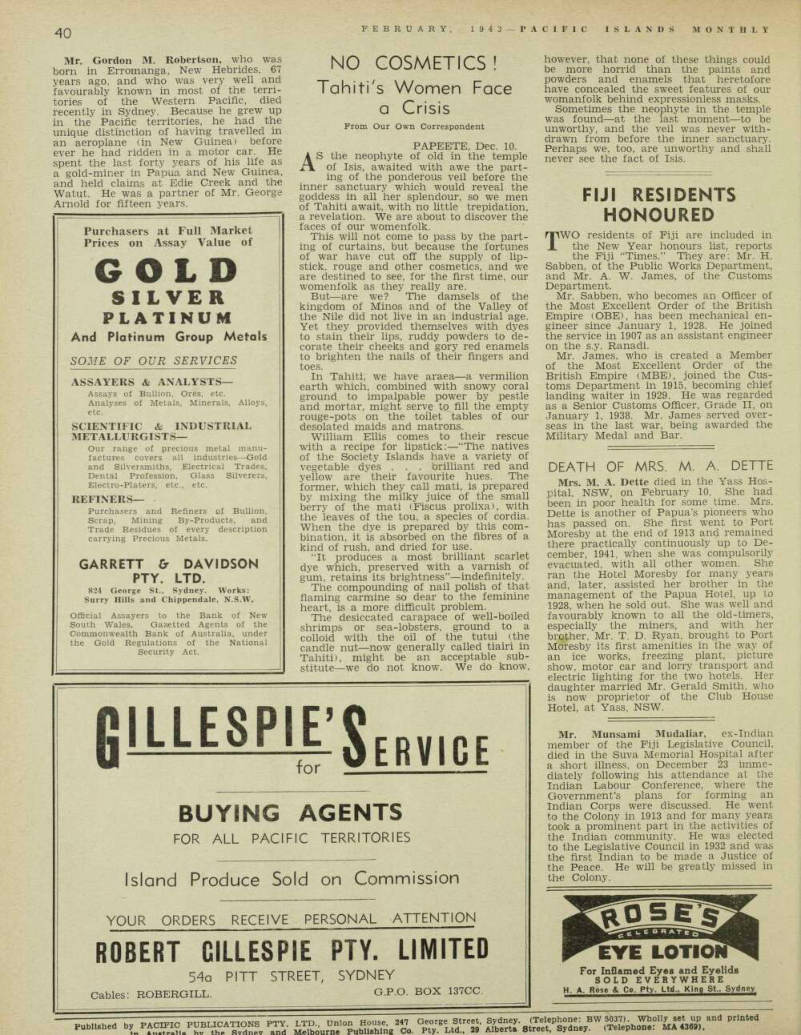
Tahiti's Women Face a Crisis
From Our Own Correspondent
Papeete, Dec. 10.
AS the neophyte of old in the temple of Isis, awaited with awe the part ing of the ponderous veil before the inner sanctuary which would reveal the goddess in all her splendour, so we men of Tahiti await, with no little trepidation, a revelation. We are about to discover the faces of our womenfolk.
This will not come to pass by the part ing of curtains, but because the fortunes of war have cut off the supply of lip stick, rouge and other cosmetics, and we are destined to see, for the first time, our womenfolk as they really are.
But —are we? The damsels of the kingdom of Minos and of the Valley of the Nile did not live in an industrial age.
Yet they provided themselves with dyes to stain their lips, ruddy powders to de corate their cheeks and gory red enamels to brighten the nails of their fingers and toes.
In Tahiti, we have araea—a vermilion earth which, combined with snowy coral ground to impalpable power by pestle and mortar, might serve the empty rouge-pots on the toilet tables of our desolated maids and matrons.
William Ellis comes to their rescue with a recipe for lipstick:—“The natives of the Society Islands have a variety of vegetable dyes . . . brilliant red and yellow are their favourite hues. The former, which they call mati, is prepared by mixing the milky juice of the small berry of the mati (Fiscus prolixa), with the leaves of the tou, a species of cordia.
When the dye is prepared by this com bination, it is absorbed on the fibres of a kind of rush, and dried for use.
“It produces a most brilliant scarlet dye which, preserved with a varnish of gum, retains its brightness”—indefinitely.
The compounding of nail polish of that flaming carmine so dear to the feminine heart, is a more difficult problem.
The desiccated carapace of well-boiled shrimps or sea-lobsters, ground to a colloid with the oil of the tutui (the candle nut—now generally called tiairi in Tahiti), might be an acceptable sub stitute—we do not know. We do know,
however, that none of these things could be more horrid than the paints and powders and enamels that heretofore have concealed the sweet features of our womanfolk behind expressionless masks.
Sometimes the neophyte in the temple was found —at the last moment—to be unworthy, and the veil was never with drawn from before the inner sanctuary.
Perhaps we, too, are unworthy and shall never see the fact of Isis.