Boogie Woogie
pp. 41-42 · Read in the full issue
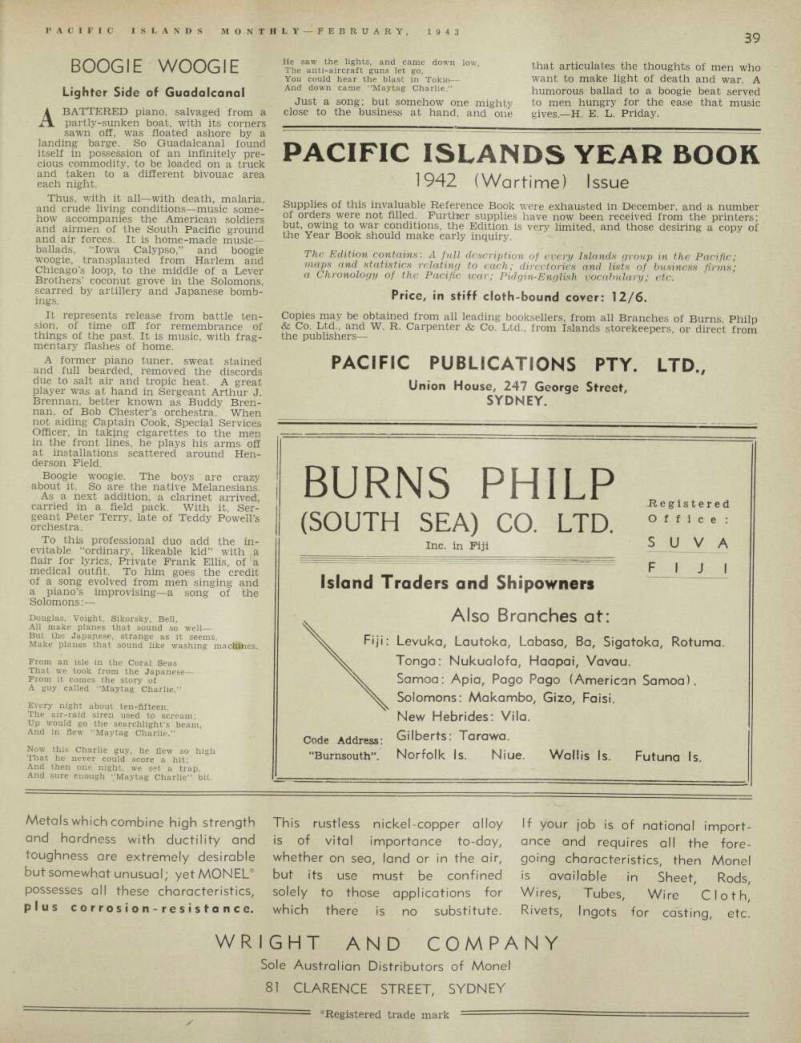
Lighter Side of Guadalcanal
A BATTERED piano, salvaged from a partly-sunken boat, with its corners sawn off, was floated ashore by a landing barge. So Guadalcanal found itself in possession of an infinitely pre cious commodity, to be loaded on a truck and taken to a different bivouac area
each night.
Thus, with it all—with death, malaria, and crude living conditions —music some how accompanies the American soldiers and airmen of the South Pacific ground and air forces. It is home-made music— ballads, “lowa Calypso,” and boogie woogie, transplanted from Harlem and Chicago’s loop, to the middle of a Lever Brothers’ coconut grove in the Solomons, scarred by artillery and Japanese bomb ings.
It represents release from battle ten sion, of time off for remembrance of things of the past. It is music, with frag mentary flashes of home.
A former piano tuner, sweat stained and full bearded, removed the discords due to salt air and tropic heat. A great player was at hand in Sergeant Arthur J.
Brennan, better known as Buddy Bren nan, of Bob Chester’s orchestra. When not aiding Captain Cook, Special Services Officer, in taking cigarettes to the men in the front lines, he plays his arms off at installations scattered around Hen derson Field.
Boogie woogie. The boys are crazy about it. So are the native Melanesians.
As a next addition, a clarinet arrived, carried in a field pack. With it, Ser geant Peter Terry, late of Teddy Powell’s orchestra.
To this professional duo add the in evitable “ordinary, likeable kid” with a flair for lyrics, Private Frank Ellis, of a medical outfit. To him goes the credit of a song evolved from men singing and a piano’s improvising—a song of the Solomons:— Douglas, Voight, Sikorsky, Bell, All make planes that sound so well— But the Japanese, strange as it seems, Make planes that sound like washing machines.
From an isle in the Coral Seas That we took from the Japanese— From it comes the story of A guy called “Maytag Charlie.”
Every night about ten-fifteen.
The air-raid siren used to scream; Up would go the searchlight’s beam, And in flew “Maytag Charlie.”
Now this Charlie guy, he flew so high That he never could score a hit; And then one night, we set a trap, And sure enough “Maytag Charlie” bit.
He saw the lights, and came down low, The anti-aircraft guns let go, You could hear the blast in Tokio— And down came “Maytag Charlie.”
Just a song; but somehow one mighty close to the business at hand, and one
that articulates the thoughts of men who want to make light of death and war. A humorous ballad to a boogie beat served to men hungry for the ease that music
gives.-
H. E. L. Friday.
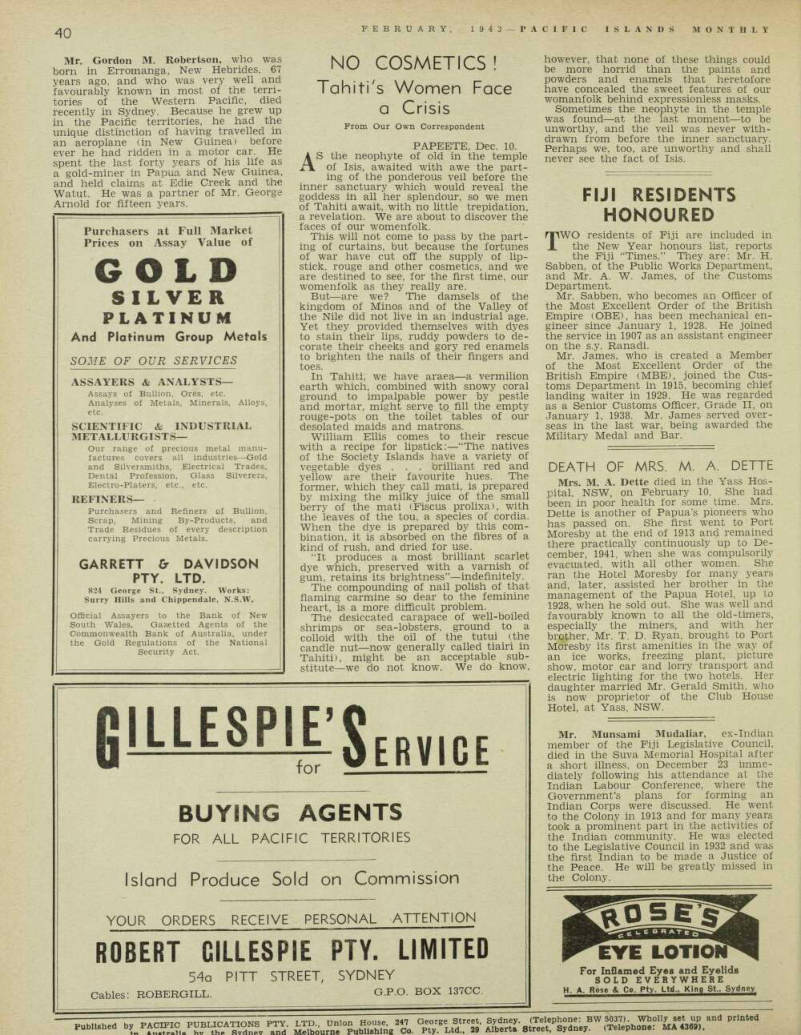
Mr. Gordon M. Robertson, who was born in Erromanga, New Hebrides, 67 years ago, and who was very well and favourably known in most of the terri tories of the Western Pacific, died recently in Sydney. Because he grew up in the Pacific territories, he had the unique distinction of having travelled in an aeroplane (in New Guinea) before ever he had ridden in a motor car. He spent the last forty years of his life as a gold-miner in Papua and New Guinea, and held claims at Edie Creek and the Watut. He was a partner of Mr. George Arnold for fifteen years.