The Valuable Oil-Palm
pp. 24-25 · Read in the full issue
Some Lessons From Indies And Malaya
Supplied by the Netherlands Indies Government Information Service
“TT has taken a war to make some of us Empire conscious,” said the “Liverpool Echo” (England), recently.
“We need a re-awakening in the Empire spirit; we need to re-capture the pioneering ardour which built up the Empire, and a refreshing breeze of modern scientific ideas and methods must blow the cobwebs from many sections of our Empire administration.”
Having released that broadside, the paper went on to show one way in which such an awakening can be produced. It does so, moreover, by urging the people of the British Empire to learn from the people of the Dutch Empire. This is now the “Liverpool Echo” views the problem - “We can learn much from the Dutch, who accomplished many remarkable things in the Netherlands East Indies before the Yellow Invader arrived. The Dutch had done particularly well, because they went to great pains to enlist the wholehearted co-operation of the native population, and made it worth
while for them to share in the march of progress.
“An example of how the Dutch meth ods and results compare with ours is shown in the history of the palm oil trade, with which, of course, Liverpool has many important links.
“Natives of West Africa, where the oil palm is indigenous, have for 500 years been using palm oil for edible purposes and for anointing the body; but it was only in the latter part of the nineteenth century that the great industrial possi bilities of palm oil were realised, “It was not until about 1914 that the Dutch introduced oil palm seed into Sumatra, on a commercial scale, although they had done quite a lot of experiment ing, hybridising, etc., before this time. By 1924 the export of palm oil from the Dutch East Indies was 5,118 tons. Ten years later it had grown to 121,260 tons . and in 1939—the year in which war broke cut—the total of 226,047 tons was exported.
“Let us now compare the records of experts from British West Africa during
the same period:— 1914 76,000 tons 1924 127,083 „ 1934 113.000 „ 1939 128,000 „ “It will be seen that in West Africa no progress whatever has been made during the last fifteen years.
“How have the Dutch achieved their results? First of all, they gave a great deal of study to selecting and improving the seed. They concentrated on produc ing a tree which would be dwarf in size, and would not therefore require climb ing. This meant that the fruit could be gathered with or without the aid of a ladder. They also succeeded in produc-
ing a fruit which has a thick pericarp, and gives a greater yield of oil per ton of nuts gathered. At the same time, however, it must be realised that in doing this they sacrificed a certain amount of weight in the resulting palm kernel after extracting the oil.
“Having obtained these results in their nurseries they commenced plantations on a large scale. Narrow-track railways were laid through the plantations to carry the fresh fruit straight to the crushing mills. Scientific methods were used for extracting the oil; with the result that an oil almost free of acid was produced, and was therefore capable of being used for all edible purposes.
“Then they turned their attention to storing and shipping in bulk, thus ensur ing no loss in weight during shipment, and no contamination of the oil in any way.
“The Dutch East Indies, by these methods, has captured practically the whole of the US trade in palm oil.
“Compare that progress with the state of affairs in West Africa, where no great effort has been made to improve the quality of the seed, although a little has been done by Government, and by private enterprise, to distribute the selected seed to the farmer. Unfortunately, however, this has not yet shown any results, and the palm tree in West Africa is still looked upon as a forest product, rather than as a fruit tree,.
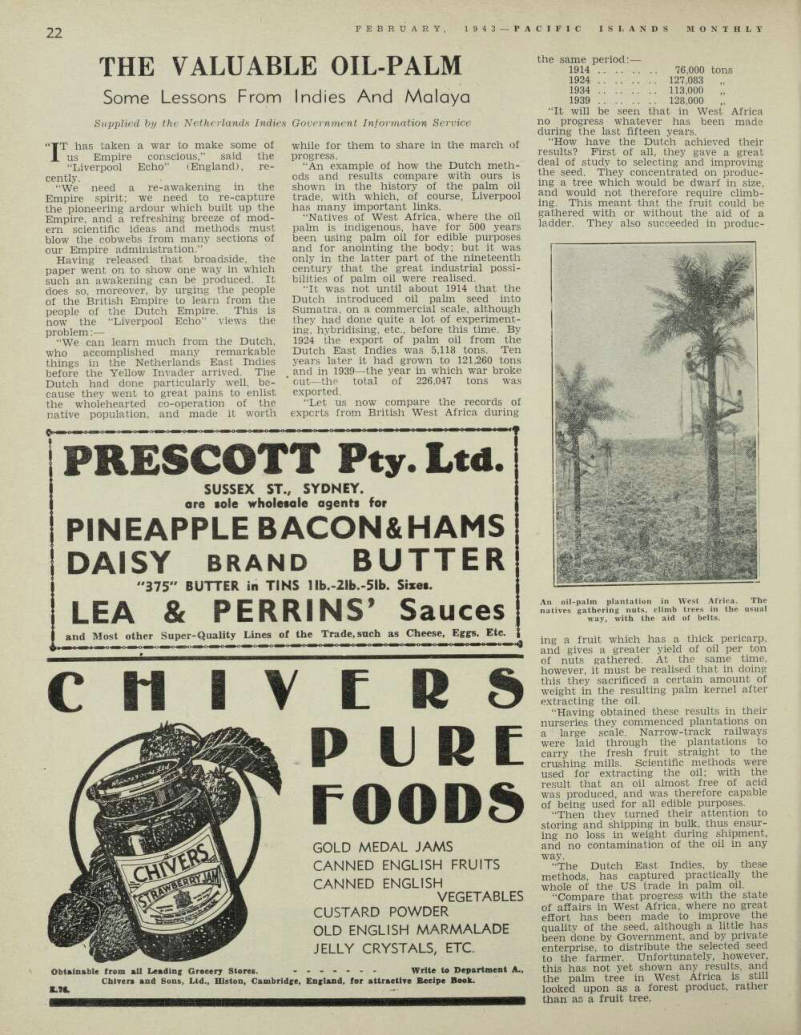
An oil-palm plantation in West Africa. The natives gathering nuts, climb trees in the usual way, with the aid of belts.
“The result has been that many old trees—some 50 feet high-yield very little fruit, and great risks are run by the climbers to collect the fruit. A few hand operated presses are being used by the more enlightened farmers, but generally speaking the palm oil is still extracted by slow and wasteful native processes.
“Although a certain amount of edible oil is produced by these small presses, the bulk of the oil is inferior in quality to that produced in the Dutch East Indies, both from the point of view of cleanliness and excessive acidity.
“In West Africa, with one or two exceptions, no European plantations have been permitted, with a result that the palm oil industry remains in the hands of the Africans, with very little urge either to improve the quality or the quantity which the country is capable of exporting.
“As an indication of what can be done in the development of this industry, the figures for British Malaya, where the palm oil industry has been developed, run very much in line with those of the Dutch East Indies. In 1924 Malava exported 286 tons of palm oil. In 1934 the figure had risen to 15,979 tons. By 1939 it was up to 59,774.”
EDITORIAL NOTE; More than ten years ago, the “PIM” published details of the valuable oil-palm of West Africa, which then was being introduced to the Netherlands Indies and Malaya, and Pacific Territories administrations were urged to take an interest in this new development in planting. The accom panying picture (which we find still in our files) was also published then, to show South Seas planters what the oil palm looked like. Nothing was done; not one administrative official displayed the slightest emotion. It is little satisfac tion, now. to say “I fold you so”—but, in sober fact, would a plantation of oil palms anywhere in the South Seas he worth something under present condi tions? Or would it?