Occupation
pp. 22-26 · Read in the full issue
Wewak Now In Enemy
Developments on Northern Coast of New Guinea
NEW GUINEA.—Wewak: Eighteen enemy fighters intercepted one of our heavy bombers on reconnaissance, and in a running engagement lasting one hour and 35 minutes, three Zeros were shot down and two others probably destroyed.
Our bomber reached its base.—Com munique of January 24.
WHO, knowing the Wewak of a short year ago, would have believed that to-day, above its aerodrome, American and Australian airmen strive with the Japanese for mastery of the skies!
Wewak, someone told me in 1935 when I was heading that way, was the last
place God thought of making; and, in a land of outlandish places, one somehow hesitated before claiming Wewak as one’s home-town. Even one’s boys, if recruited in other parts of the Territory, turned fawn-coloured with horror at the prospect of being taken there, and backed off muttering, "Me no like! This fella kanaka savvy kaikai man!”
No more men actually were eaten in Wewak than in Rabaul; but the evil reputation of the kunai country, on the Sepik plains over the range beyond Wewak, had affected the whole district, and indentured labourers going there for the first time actually expected to be hit on the head as soon as they stepped on to the beach, and dragged off forthwith to the cooking fires.
By 1935, the miners of Morobe had be come streamlined, super-charged models.
They got their groceries and beer in from the coast in huge Junkers freight carrying planes; they had movies and electricity, motor cars and hotels — literally, everything that opened and shut —in Wau, their commercial centre. To mention, therefore, that one intended to "mine” in the Wewak district was to ask for all the contempt of the Great — although they themselves were but re cently arrived from the mire of bully beef and rice, travel per boot, and a beerless world. Only the nit-witted, one gathered, bothered to look for gold any where other than in the rice Morobe.
In 1935, too, the coconut was no longer the "Consol of the East”—nor of the South Seas, either—and the few plan tations along the Finsch Coast certainly could not hope to put the district on the map as a copra producer.
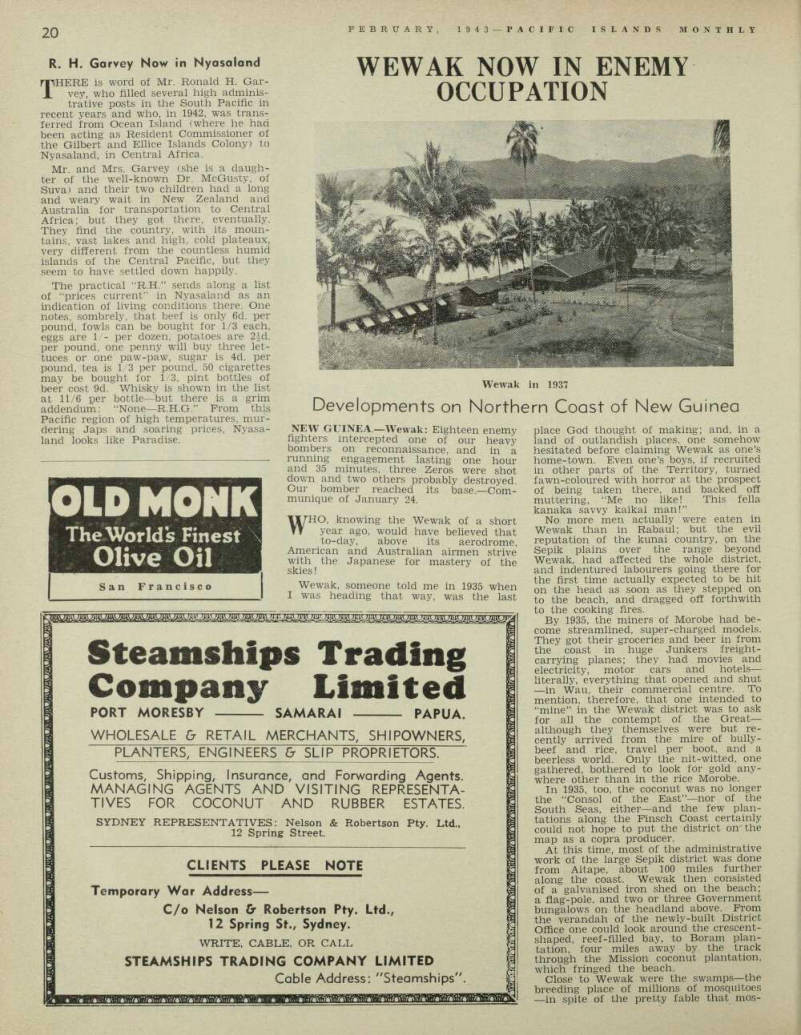
At this time, most of the administrative work of the large Sepik district was done from Aitape, about 100 miles further along the coast. Wewak then consisted of a galvanised iron shed on the beach; a flag-pole, and two or three Government bungalows on the headland above. From the verandah of the newly-built District Office one could look around the crescent shaped, reef-filled bay, to Boram plan tation, four miles away by the track through the Mission coconut plantation, which fringed the beach.
Close to Wewak were the swamps—the breeding place of millions of mosquitoes —in spite of the pretty fable that mos
Wewak in 1937
quitoes do not breed in such brackish places—and the home of alligators. But the swamps were not extensive, as such swamps can be in the Territory, and they soon gave place to firm, good land, where excellent coconuts were grown.
On the point of land opposite Wewak was Boram plantation, where, at this time, there was a general store in which everything from a prospecting dish to a bottle of beer could be bought, and where some accommodation for the public was usually provided. Boram, therefore, bulked larger in the eye of the resident than did Wewak. And here, to meet the “Macdhui” on her six-weekly call, came a queer collection of people, although in numbers they could be counted on the fingers. Miners, scratching for gold on the Schilling and Nagum Rivers; re cruiters of native labour from Aitape and the Sepik foothills; traders and plan tation men from up the coast; “lik-lik” doctors on medical-patrol, geologists, and even an odd anthropologist.
BUT, early in 1936, there came a change. The Morobe goldfields were rapidly becoming industrialised.
The fantastic richness of the early years, when all a man needed was a rough sluice-box and a team of boys to win a hundred or two hundred ounces of gold in a day, was passing. Instead, huge dredges and other scientific mining machinery, were being used to work the poorer portions of the field. The day of the individual prospector and alluvial miner was then almost ended.
So he pushed further out, first to the Watut, and Black Cat, and other new fields within walking distance of Wau, and then some hardy souls got as far as thinking of Wewak and its hinterland.
Ray Parer flew across the headwaters of the Sepik, and was in the process of organising an expedition there, when officialdom came down on the idea with a heavy hand. There was some desul tory prospecting done in the Aitape dis trict and inland from Boram. And the men who had been located on the Schilling and Nagum were forever follow ing up any fresh rumour or inspiration that might lead to greater things in the gold-mining business.
It was from the Nagum, in January, 1936, that two men, Jack Thurston and Harry Tudor, set out overland for Kara wop and, on the way, on the Sepik fall of the range, discovered the stream which put the Sepik district on the map as a goldfield. In April of that same year a mining lease was granted to them, and Number One Gold, as the natives called it, became the nucleus of the district.
The fame of Number One Gold spread —and lost nothing in richness in the spreading. The news of its supposedly
enormous richness reached Morobe; and then, into Wewak and Boram, by steamer and schooner, came restless, seeking prospectors. Up over the mountains they went, their boys carrying their food and light tent-sails and mining gear, plough ing through the mud of the swamps and the tracks. Usually they called at Num ber One Gold to get the lay of the land, and then spread out over the valleys and foothills of the Prince Alexander moun tains. There was no concentrated rich ness in this ’goldfield—fair gold was scattered over the length and breadth of it, but often 20 miles separated claims and leases.
HERE there were none of the con veniences of Morobe. There was one way of getting about —to walk; one way of getting supplies in from the sea coast —by native carriers. But although many came and, finding noth ing, passed on, about 200 finally settled in the district, built their bush houses, organised their work and got some sort of order into their supply problems. In the initial months it was, for everyone, a continual fight against isolation, malaria, bush typhus, bad food; and a continual quest for native carriers and gold.
Towards the end of 1936, Ray Parer arrived to work a claim pegged for him by a friend. Where Ray went, there went his plane also, and down on the edge of the Sepik plain at Maprik, and out at Worn, on the coast, twin strips of landing ground were cleared of their kunai grass. Then back and forth, as Ray required stores or diversion, the miners of the district heard his plane droning overhead, and many thousands of stone-age men in the thickly populated kunai-country saw, for the first time, a “balus.”
Shortly afterwards, Guinea Airways were invited to extend their freight and passenger service; but the Morobe air ways companies came and went, unable to make sufficient profit out of this scattered district, and it was not until the next year that Wewak gained a re gular air service, owned and operated by Kevin Parer, young brother of Ray.
Kevin was killed in the first Japanese blitz on Salamaua, in January, 1942.
IN 1937 the aerodromes of the district became an Administrative matter.
Maprik was levelled by Government surveyors in a manner hitherto unknown and quite unappreciated by the local natives, who were rounded up to do the job. At Wewak a fine new drome was built between the town and the Mission.
Level and smooth, it stretched away, larger than any other drome in the Terri tory, with room to spare for extension.
Local pride may account for the local opinion that it was the finest aerodrome in the country.
Two miles of road were constructed through the swamps to connect airfield and township, and in the space of a few months, down below Wewak headland, a branch of W. R. Carpenter & Company, a freezer and a dozen Chinese shops sprang up. The three Government build ings had increased many-fold. The wire less station and operator, formerly stationed at Aitape, had been brought to Wewak long since. There was a hospital, a resident doctor and a nurse.. Wewak no longer was quite the last spot God thought of making.
To those who lived inland, in the wet, steaming, jungle-covered mountains or the stifling heat of the kunai country, the new Wewak meant much. No longer was it necessary to live on bully-beef and rice—most camps were within eight hours’ carry of the nearest landing-field, and the freezer supplied everything in the way of European food. No longer was it necessary to carry a sick man for days through the jungle in order that he might receive medical attention.
That was the position when the Japs took Rabaul in January, 1942.
IN the general evacuation of January, 1942, this north-west portion of the mainland also was evacuated. Orders were given that everyone should meet at a point on the Sepik, and here men came, in twos and threes and in small parties.
But there was official blundering some where, and they were left there, while ships that were to have picked them up were sent instead to Madang. The men
(Continued on Page 24)
(Continued from Page 21) had to shift for themselves, as best they could.
Some were able to escape in small boats and, after incredible journeys, reach safety. Others walked overland, up the Sepik and down the Fly, where no white man had been before—and where, in fact, in the days of peace, all white men were prohibited from going. Others found their way in just as miraculous a fashion into other parts of the Terri tory, where they were eventually picked up by plane and flown to safety.
There was no good reason —up until the last few months —why the Allies could not have by-passed enemy-occupied Lae and Salamaua, and established bases there at Wewak. But the Japanese now have got in there, and have bases from which to protect their sea lanes and
moke bomber attacks on Lae and Sala maua, if and when those areas are re occupied by the Allies. The facilities at Wewak were a gift to the Japs. The Wewak airfield can be easily improved and enlarged—the Japs, for instance, could cut down the miles of coconuts in the Mission plantation between Wewak and Boram and get an admirable new air field.
Along the coast towards Aitape are several make-shift landing fields which could be improved. Over the range from Wewak, 15 to 20 minutes’ flight away, stretches the vast kunai-covered Sepik plain, on which Maprik drome is only an example of what can be constructed.
There is no harbour at Wewak; steamers anchored off Boram and Wewak point. The crescent shaped bay is full of coral reefs. But the two large islands of Kairiru and Mushu, north-west of the
township, shelter the anchorage from the fierce north-westerlies which are the curse of the coast between Wewak and Aitape.
TOWARDS the Dutch border the country becomes steeper and more mountainous; but between Wewak and Aitape the highest point in the coastal mountains is between 3,000 and 4,000 feet. There are no roads; and while travel on foot, meandering from village to village, can be tough, in all conscience, the obstacles of terrain met with on the Owen Stanley track, or be tween Wau and Salamaua, do not here exist. The building of a road from Maprik to the Sepik—a plan to open up the huge hinterland that had long been talked about —would have been child's play compared with the construction of the proposed Wau-Salamaua route.
This district of kunai plain and foot hill probably carries a larger self-sup porting native population than any other part of the Territory. An endless chain of villages, some of them over a thou sand strong, made the district tenable for Europeans in the first place. Now these natives can be utilised for carrying and for other manual labour of a military nature.
Time, for these people, has leaped a thousand years in a month or two, and the most primitive backwater of a primi tive country, now echoes to the sound of aerial combat. The Allies are confronted with yet one more New Guinea area from which they have the task of either bomb ing out or digging out the tenacious Jap.