Mrs. Betty Morel
pp. 14-15 · Read in the full issue
Passes On Story of a Notable Woman in the South Seas
Rarotonga, June 20.
npHE death occurred on May 22, of X Mrs. Betty Morel, of Vaitu Planta tion, Arorangi, Rarotonga.
Mrs. Morel was, I think, the most remarkable woman I ever met. Her story is one of adventure, hardship and ser vice that is unique in the history of this group, and possibly of the whole Pacific.
Born of well-to-do parents in a suburb of San Francisco in 1880, she was brought up in the old-fashioned way; prim and proper, clean and tidy to the nth degree. Even as a girl, however, she appears to have evinced a precocity and capacity for deep thought that drew her to the more serious rather than the lighter issues of life. It was then that she met Charles Morel, a man many years her senior, and married him.
Charles Morel was born in Prance, son of a prosperous merchant and shipowner.
At length, a series of catastrophic wrecks undermined the old man’s business, and father and son set out to roam the world in their one remaining sound schooner.
This also was eventually lost on the coast of South America.
The elder Morel died shortly after wards; the son worked his way to the United States and finally saved enough for his great ideal, a home on Tahiti.
An ardent Socialist and Freemason, his influence on his young wife must indeed have been great for her to exchange her comfortable home in San Francisco for a more or less haphazard venture among the fearsome dangers of the great South Sea.
No direct boat being available to Tahiti in those days, the rather oddly assorted man and wife travelled to New Zealand, in order to tranship to Tahiti via Rarotonga. At Rarotonga, however, where they naturally went ashore to glimpse their first South Sea island, they met the British Resident, who fraternally advised Morel not to proceed to Tahiti, but to settle in the equally attractive island of Rarotonga.
This was the year 1899, when land was extremely hard to lease. But at last, with the aid of the Resident, they pro cured a lease on a promising piece of jungle named Vaitu, near Arorangi.
There for 12 years they lived happily, working like slaves, past dark, to weed in the bright moonlight.
The heavy bush was at last reduced to cultivation and, on this small plantation, they produced everything necessary, and more, in the way of foodstuffs, tobacco, kapok and so on.
It was at this time that they imported the seeds and plants from all over the world, that make Vaitu to-day look like a well-subsidised tropical park.
BETTY Morel learned that every single membefl of her immediate family had perished in the San Francisco earthquake of 1906. In 1912, Charles Morel died, leaving a young son, the plantation, and little else.
What a position for a still-young European woman! Hardly a friend in the world (having lived such a secluded life hitherto), a young boy to bring up, financial assets doubtful, if any. Most people would have given up and fled back to penury in the United States; but not this lady of indomitable courage.
By systematic slavery, from dawn till
dark, she not only kept up the planta tion, but actually carried on the good work. At the day of her death Vaitu had definitely the most beautiful grounds of any home in the Cook Islands.
For over 20 years Betty Morel never left her plantation, except once to sign a renewal of her lease. Withal, the extent of her cultural knowledge re mained astounding. Not one artist, man of letters or scientist visited this island but became her friend.
On more homely matters, her know ledge was inexhaustible, drawn as it was from over 40 years of hard experience.
Making wine from local fruits was a specialty.
The quiet burial with no service, as she requested, was over; we, her more inti mate friends, were called on to the verandah.
It was explained that Betty Morel had specially put down six bottles of her best wine for her friends to wish her luck on her last journey. This we did, with all our hearts.—R.J.l.
Mr. Peter Garrity, formerly a lay worker in the Melanesian Mission, New Hebrides, is now studying for the minis try in Christchurch, NZ.
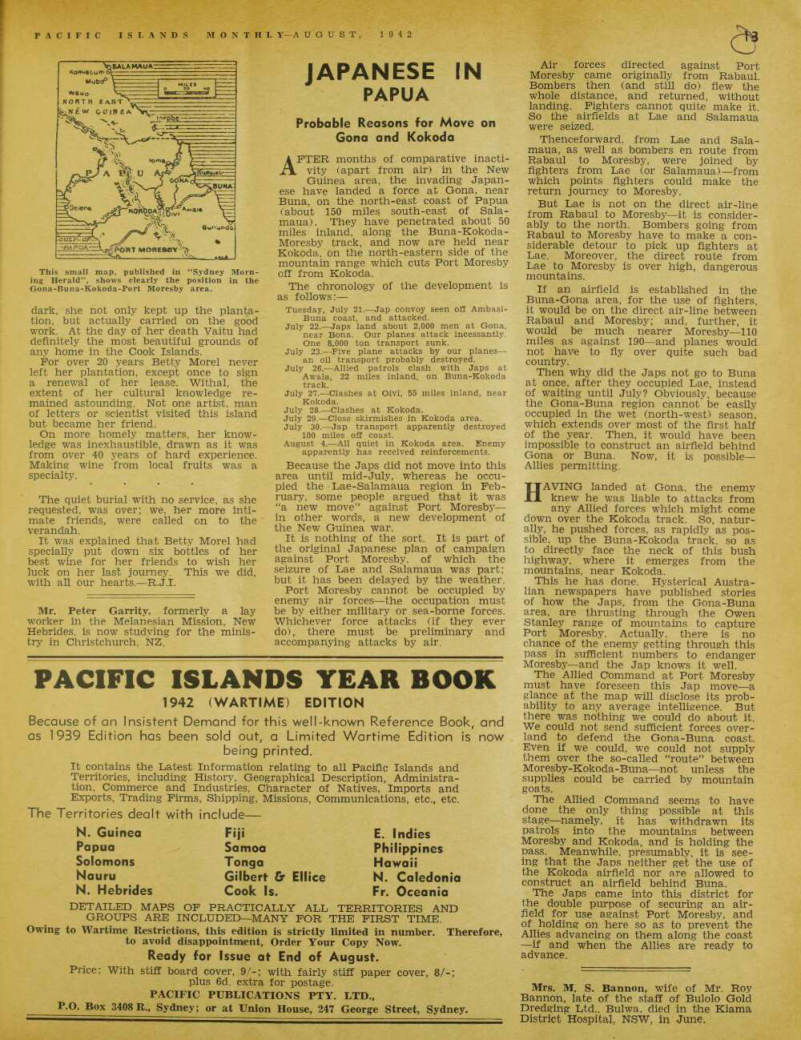
This small map, published in “Sydney Morn ing Herald”, shows clearly the position in the Gona-Buna-Kokoda-Port Moresby area.