The Old Gods Of Huahine
p. 14 · Read in the full issue
How Tone Succumbed to Christianity
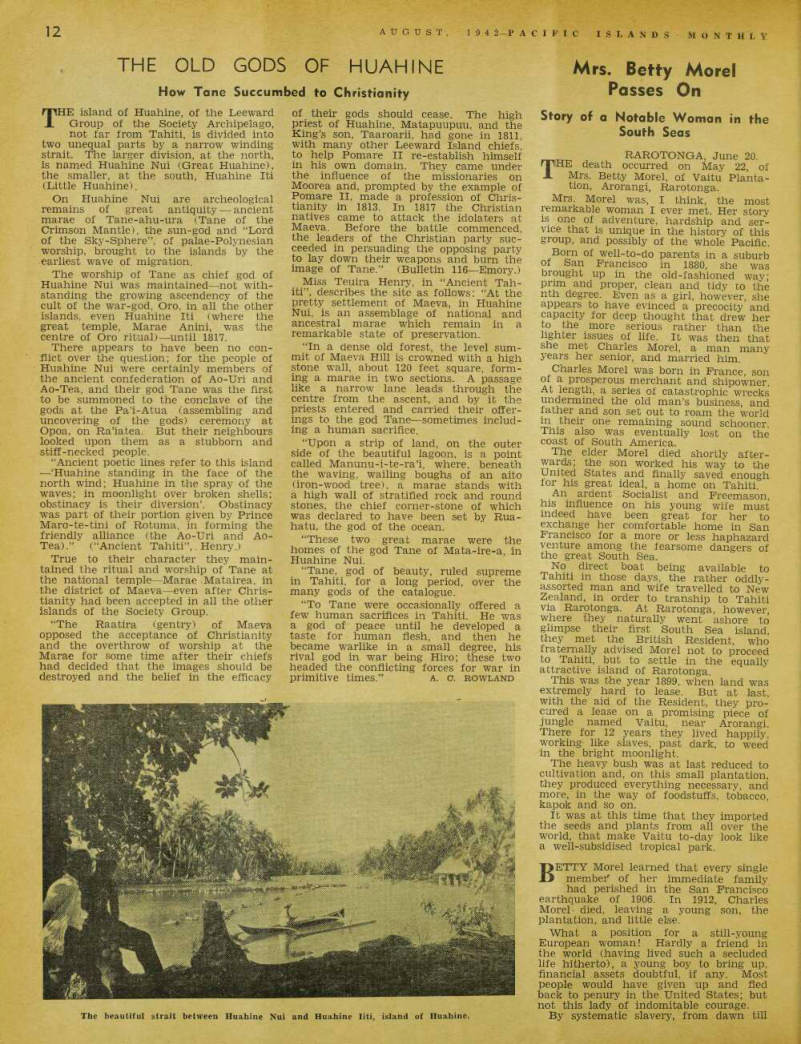
rpHE island of Huahine, of the Leeward X Group of the Society Archipelago, not far from Tahiti, is divided into two unequal parts by a narrow winding strait. The larger division, at the north, is named Huahine Nui (Great Huahine), the smaller, at the south, Huahine Iti (Little Huahine).
On Huahine Nui are archeological remains of great antiquity ancient marae of Tane-ahu-ura (Tane of the Crimson Mantle), the sun-god and “Lord of the Sky-Sphere”, of palae-Polynesian worship, brought to the islands by the earliest wave of migration.
The worship of Tane as chief god of Huahine Nui was maintained—not with standing the growing ascendency of the cult of the war-god, Oro, in all the other islands, even Huahine Iti (where the great temple, Marae Anini, was the centre of Oro ritual) —until 1817.
There appears to have been no con flict over the question; for the people of Huahine Nui were certainly members of the ancient confederation of Ao-Uri and Ao-Tea, and their god Tane was the first to be summoned to the conclave of the gods at the Pa'i-Atua (assembling and uncovering of the gods) ceremony at Opoa, on Ra’iatea. But their neighbours looked upon them as a stubborn and stiff-necked people.
“Ancient poetic lines refer to this island —‘Huahine standing in the face of the north wind; Huahine in the spray of the waves; in moonlight over broken shells; obstinacy is their diversion’. Obstinacy was part of their portion given by Prince Maro-te-tini of Rotuma, in forming the friendly alliance (the Ao-Uri and Ao- Tea).” (“Ancient Tahiti”, Henry.) True to their character they main tained the ritual and worship of Tane at the national temple—Marae Matairea, in the district of Maeva—even after Chris tianity had been accepted in all the other islands of the Society Group.
“The Raatira (gentry) of Maeva opposed the acceptance of Christianity and the overthrow of worship at the Marae for some time after their chiefs had decided that the images should be destroyed and the belief in the efficacy
of their gods should cease. The high priest of Huahine, Matapuupuu, and the King’s son, Taaroarii, had gone in 1811, with many other Leeward Island chiefs, to help Pomare II re-establish himself in his own domain. They came under the influence of the missionaries on Moorea and, prompted by the example of Pomare 11, made a profession of Chris tianity in 1813. In 1817 the Christian natives came to attack the idolaters at Maeva. Before the battle commenced, the leaders of the Christian party suc ceeded in persuading the opposing party to lay down their weapons and burn the image of Tane.” (Bulletin 116—Emory.) Miss Teuira Henry, in “Ancient Tah iti”, describes the site as follows: “At the pretty settlement of Maeva, in Huahine Nui, is an assemblage of national and ancestral marae which remain in a remarkable state of preservation.
“In a dense old forest, the level sum mit of Maeva Hill is crowned with a high stone wall, about 120 feet square, form ing a marae in two sections. A passage like a narrow lane leads through the centre from the ascent, and by it the priests entered and carried their offer ings to the god Tane —sometimes includ ing a human sacrifice.
“Upon a strip of land, on the outer side of the beautiful lagoon, is a point called Manunu-i-te-ra’i, where, beneath the waving, wailing boughs of an aito (iron-wood tree), a marae stands with a high wall of stratified rock and round stones, the chief corner-stone of which was declared to have been set by Rua hatu, the god of the ocean.
“These two great marae were the homes of the god Tane of Mata-ire-a, in Huahine Nui.
“Tane, god of beauty, ruled supreme in Tahiti, for a long period, over the many gods of the catalogue.
“To Tane were occasionally offered a few human sacrifices in Tahiti. He was a god of peace until he developed a taste for human flesh, and then he became warlike in a small degree, his rival god in war being Hiro; these two headed the conflicting forces for war in primitive times.” a. c. Rowland
The beautiful strait between Huahine Nui and Huahine liti, island of Huahine.