Japanese In
p. 15 · Read in the full issue
Papua
Probable Reasons for Move on Gona and Kokoda
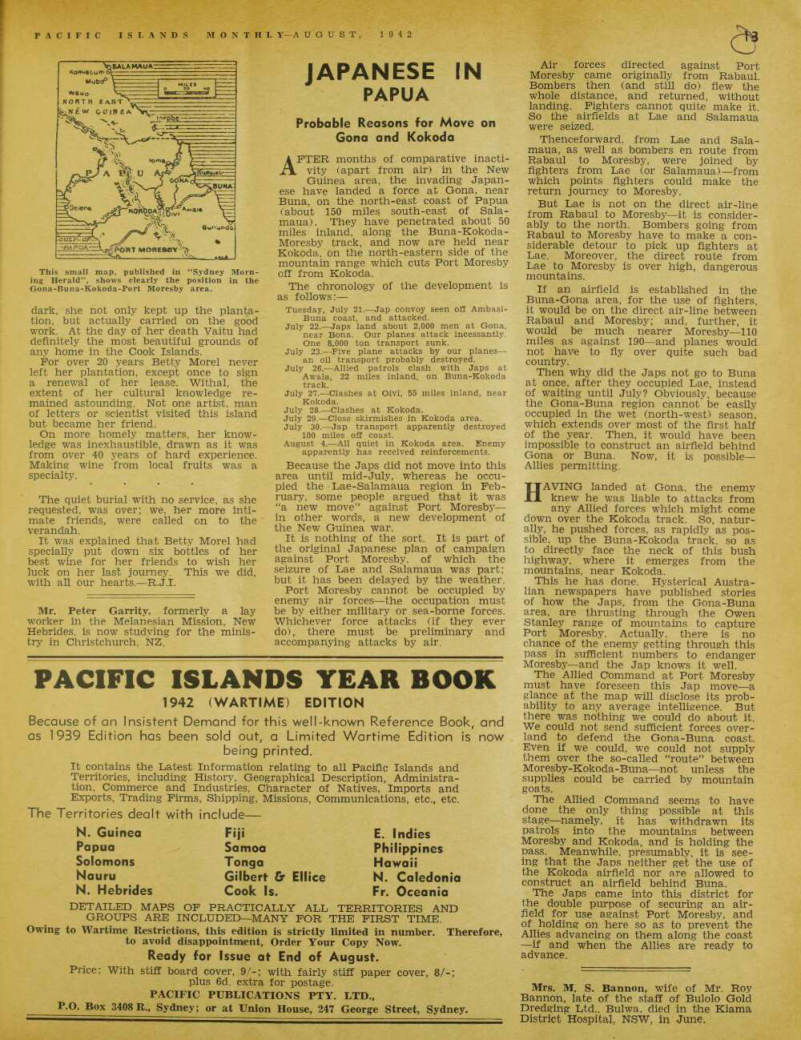
AFTER months of comparative inacti vity (apart from air) in the New Guinea area, the invading Japan ese have landed a force at Gona, near Buna, on the north-east coast of Papua (about 150 miles south-east of Sala maua). They have penetrated about 50 miles inland, along the Buna-Kokoda- Moresby track, and now are held near Kokoda. on the north-eastern side of the mountain range which cuts Port Moresby off from Kokoda.
The chronology of the development is as follows: — Tuesday, July 21.—Jap convoy seen off Ambasi- Buna coast, and attacked.
July 22.—Japs land about 2,000 men at Gona, near Bona. Our planes attack incessantly.
One 8,000 ton transport sunk.
July 23.—Five plane attacks by our planes— an oil transport probably destroyed.
July 26.—Allied patrols clash with Japs at Awala, 22 miles inland, on Buna-Kokoda track.
July 27.—Clashes at Oivi, 55 miles inland, near Kokoda.
July 28. —Clashes at Kokoda.
July 29.—Close skirmishes in Kokoda area.
July 30.—Jap transport apparently destroyed 100 miles off coast.
August 4. —All quiet in Kokoda area. Enemy apparently has received reinforcements.
Because the Japs did not move into this area until mid-July, whereas he occu pied the Lae-Salamaua region in Feb ruary, some people argued that it was “a new move” against Port Moresby— in other words, a new development of the New Guinea war.
It is nothing of the sort. It is part of the original Japanese plan of campaign against Port Moresby, of which the seizure of Lae and Salamaua was part; but it has been delayed by the weather.
Port Moresby cannot be occupied by enemy air forces —the occupation must be by either military or sea-borne forces.
Whichever force attacks (if they ever do), there must be preliminary and accompanying attacks by air.
Air forces directed against Port Moresby came originally from Rabaul.
Bombers then (and still do) flew the whole distance, and returned, without landing. Fighters cannot quite make it.
So the airfields at Lae and Salamaua were seized.
Thenceforward, from Lae and Sala maua, as well as bombers en route from Rabaul to Moresby, were joined by fighters from Lae (or Salamaua)—from which points fighters could make the return journey to Moresby.
But Lae is not on the direct air-line from Rabaul to Moresby—it is consider ably to the north. Bombers going from Rabaul to Moresby have to make a con siderable detour to pick up fighters at Lae. Moreover, the direct route from Lae to Moresby is over high, dangerous mountains.
If an airfield is established in the Buna-Gona area, for the use of fighters, it would be on the direct air-line between Rabaul and Moresby; and, further, it would be much nearer Moresby—llo miles as against 190—and planes would not have to fly over quite such bad country.
Then why did the Japs not go to Buna at once, after they occupied Lae, instead of waiting until July? Obviously, because the Gona-Buna region cannot be easily occupied in the wet (north-west) season, which extends over most of the first half of the year. Then, it would have been impossible to construct an airfield behind Gona or Buna. Now, it is possible— Allies permitting.
HAVING landed at Gona, the enemy knew he was liable to attacks from any Allied forces which might come down over the Kokoda track. So, natur ally, he pushed forces, as rapidly as pos sible, up the Buna-Kokoda track, so as to directly face the neck of this bush highway, where it emerges from the mountains, near Kokoda.
This he has done. Hysterical Austra lian newspapers have published stories of how the Japs, from the Gona-Buna area, are thrusting through the Owen Stanley range of mountains to capture Port Moresby. Actually, there is no chance of the enemy getting through this pass in sufficient numbers to endanger Moresby—and the Jap knows it well.
The Allied Command at Port Moresby must have foreseen this Jap move—a glance at the map will disclose its prob ability to any average intelligence. But there was nothing we could do about it.
We could not send sufficient forces over land to defend the Gona-Buna coast.
Even if we could, we could not supply them over the so-called “route” between Moresby-Kokoda-Buna—not unless the supplies could be carried by mountain goats.
The Allied Command seems to have done the only thing possible at this stage—namely, it has withdrawn its patrols into the mountains between Moresby and Kokoda, and is holding the pass. Meanwhile, presumably, it is see ing that the Japs neither get the use of the Kokoda airfield nor are allowed to construct an airfield behind Buna.
The Japs came into this district for the double purpose of securing an air field for use against Port Moresby, and of holding on here so as to prevent the Allies advancing on them along the coast —if and when the Allies are ready to advance.
Mrs. M. S. Bannon, wife of Mr. Roy Bannon, late of the staff of Bulolo Gold Dredging Ltd.. Bulwa, died in the Kiama District Hospital, NSW, in June.