Lovely Moorea
pp. 35-36 · Read in the full issue
Is Treasure Buried There ?
By A. C. Rowland
MOOREA, satellite of Tahiti, differs greatly from the other islands of the Society Archipelago; resembling, rather, the * picturesque Marquesas Islands.
Its landscape of strangely shaped peaks, pinnacles, battlemented ridges and shadowy gorges, would be forbidding were it not for the dazzling green of foliage which cascades from the highest summits, over scarp and precipice, to the shores of bays that penetrate deeply to the heart of the mountains.
By night, these unearthly mountains,
as shadows against the stars, move the unaccustomed stranger to believe him self transported to some fantastic king dom of wizards, ogres and black en chantments. The more so when the night bird, the Upoa, flies unseen through the darkness; its cry (like the despairing wail of a lost spirit) echoing among the precipices. The true centre and citadel of all the warlocks, sorcerers and witch-doctors of Polynesia—one would imagine.
Surprisingly little legend or tradition concerning Moorea has ccme down to us, although massive marae ruins and stone faced terraces on the slopes of the val leys bear mute witness of a teeming population in pre-historic times.
If, however, they have lacked in the wisdom and practice of the black arts, the inhabitants of Moorea have always excelled in that lighter magic known in the South Seas as the “coconut tele graph”. Moorea people know more about the happenings and gossip of other islands than do the inhabitants of those islands themselves. There is an old say ing—still current—“lf you wish to hear all the gossip of Tahiti, be on the wharf when the boat from Moorea comes in.”
LIKE many another island in these waters, Moorea is reputed to be the hiding-place of vast treasure.
The arrival of a mysterious schooner, which came to anchor in Opunohu Bay, opposite MacFarlane’s place, while we were staying there 32 years ago, set tongues wagging about that treasure story.
The native pilot who brought her in told his friends that the vessel hailed from Peru and had come to Moorea without reporting at Papeete—the port of entry to the colony. He said they were a queer lot aboard: very secretive, and did not want any visitors from shore.
Some years before, a missionary on the island had received a letter from Chile.
Accompanying the letter was an outline drawing, manifestly depicting the Moorea mountains. In the text, the writer alluded vaguely to revolution and the spiriting away of plate and jewels from churches and cathedrals to a distant island of strangely-shaped mountains.
Did the missionary know of any island such as pictured in the drawing?
The pastor made inquiries on Moorea and found some very old natives who, searching their recollection, remembered the coming of a gunboat. Guards had been put ashore to keep the natives at a distance, and there had been much going and coming to some secret place in the mountains. After the gunboat sailed away the natives, thinking some
kind of foreign tapu was over the place, never explored thereabout.
The pastor, after reflection, decided to
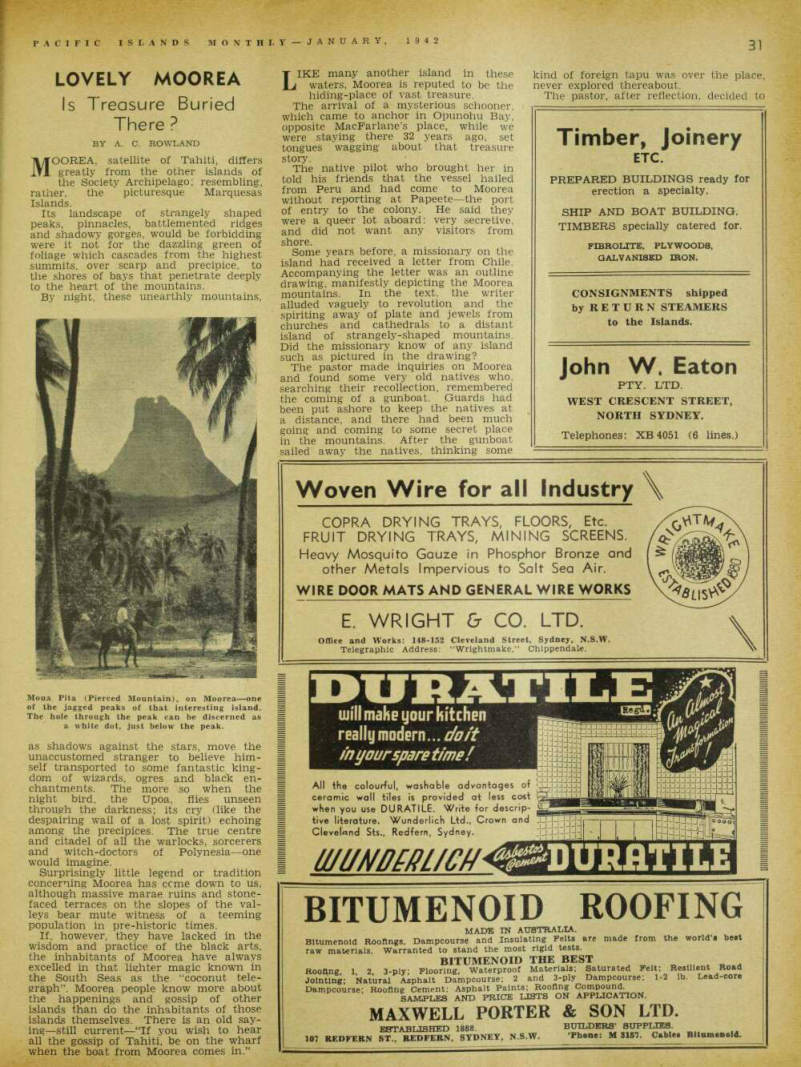
Moua Pita (Pierced Mountain), on Moorea—one of the jagged peaks of that interesting island.
The hole through the peak can be discerned as a white dot, just below the peak.
leave the letter unanswered.
Moorea, at that period, was an un spoiled Polynesian island. The missionf r y. fearful of the consequences of an invasion of treasure-hunters to its calm serenity, allowed the incident of the let ter to fade into misty forgetfulness; where it remained until the Peruvian schooner appeared.
Her stealthy arrival became known, in due time, to the authorities at Tahiti, and the police came over to investigate, The schooner thereupon sailed out Of Opunohu Bay and vanished. vparc i a tor a , later, the islands were destined to witness many a treasure-hunt, in full cry. But. with the exception of the SUS n° expedition in quest of the Chilean trea sure on Moorea has ever been under taken, ’ . . fTIHE missionary’s care to preserve the 1 p i acid tranquillity of the island’s nntivo Ufo noctnnnprl o 7 , native 1116 postponed, for a few years, the inevitable. But Moorea, like many another paradise of peace and serenity, was eventually “discovered” and « nnt jL man”
P"r. on nmP This writer has not set foot on Moorea for over 20 years; yet daily he looks unon its distant mountains, with nostalgic Viewed from Papeete, Moorea stands athwart the western horizon. At the summer solstice in December, the sun
sets a little distance to the south; at the June solstice, a few degrees to the north of the island. During its procession with the seasons, the sun goes down succes sively behind each peak in a blaze of splendour unsurpassed in any other part of the world.
Whatever may have happened on the coasts and in the valleys, the picturesque silhouette of Moorea is still unsullied.
“Discovery” and exploitation have not, as yet, brought sky-line advertising to the South Seas.