Copra
p. 34 · Read in the full issue
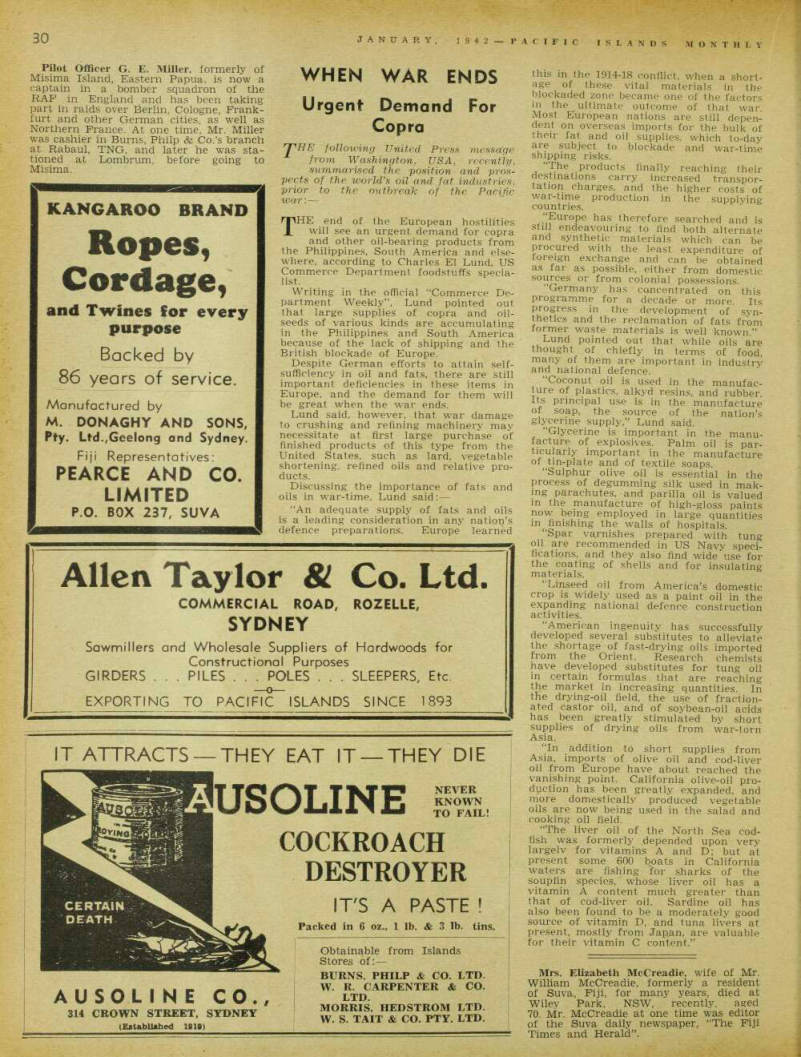
When War Ends
Urgent Demand For Copra
'J'HE following United Press message from Washington, USA, recently, summarised the position and pros pects of the world’s oil and fat industries, prior to the outbreak of the Pacific war :— THE end of the European hostilities will see an urgent demand for copra and other oil-bearing products from the Philippines, South America and else where, according to Charles El Lund, US Commerce Department foodstuffs specia list.
Writing in the official “Commerce De partment Weekly”, Lund pointed out that large supplies of copra and oil seeds of various kinds are accumulating in the Philippines and South America because of the lack of shipping and the British blockade of Europe.
Despite German efforts to attain self sufficiency in oil and fats, there are still important deficiencies in these items in Europe, and the demand for them will be great when the war ends.
Lund said, however, that war damage to crushing and refining machinery may necessitate at first large purchase of finished products of this type from the United States, such as lard, vegetable shortening, refined oils and relative pro ducts.
Discussing the importance of fats and oils in war-time, Lund said: “An adequate supply of fats and oils is a leading consideration in any nation’s defence preparations. Europe learned
this in the 1914-18 conflict, when a short age of these vital materials in the blockaded zone became one of the factors m the ultimate outcome of that war.
Most European nations are still depen dent on overseas imports for the bulk of their fat and oil supplies, which to-day are subject to blockade and war-time shipping risks.
“The products finally reaching their destinations carry increased transpor tation charges, and the higher costs of war-time production in the supplying countries.
“Europe has therefore searched and is still endeavouring to find both alternate and synthetic materials which can be procured with the least expenditure of foreign exchange and can be obtained as far as possible, either from domestic sources or from colonial possessions.
“Germany has concentrated on this programme for a decade or more. Its progress in the development of syn thetics and the reclamation of fats from former waste materials is well known.”
Lund pointed out that while oils are thought of chiefly in terms of food, many of them are important in industry and national defence.
Coconut oil is used in the manufac ture of plastics, alkyd resins, and rubber.
Its principal use is in the manufacture of soap, the source of the nation’s glycerine supply,” Lund said.
“Glycerine is important in the manu facture of explosives. Palm oil is par ticularly important in the manufacture (( tin-plate and of textile soaps.
“Sulphur olive oil is essential in the process of degumming silk used in mak ing parachutes, and parilla oil is valued in the manufacture of high-gloss paints now being employed in large quantities in finishing the walls of hospitals.
“Spar varnishes prepared with tung oil are recommended in US Navy speci fications, and they also find wide use for the coating of shells and for insulating materials.
“Linseed oil from America’s domestic crop is widely used as a paint oil in the expanding national defence construction activities.
“American ingenuity has successfully developed several substitutes to alleviate the shortage of fast-drying oils imported from the Orient. Research chemists have developed substitutes for tung oil in certain formulas that are reaching the market in increasing quantities. In the drying-oil field, the use of fraction ated castor oil, and of soybean-oil acids has been greatly stimulated by short supplies of drying oils from war-torn Asia.
“In addition to short supplies from Asia, imports of olive oil and cod-liver oil from Europe have about reached the vanishing point. California olive-oil pro duction has been greatly expanded, and more domestically produced vegetable oils are now being used in the salad and cooking oil field.
“The liver oil of the North Sea cod fish was formerly depended upon very largelv for vitamins A and D; but at present some 600 boats in California waters are fishing for sharks of the soupfin species, whose liver oil has a vitamin A content much greater than that of cod-liver oil. Sardine oil has also been found to be a moderately good source of vitamin D, and tuna livers at present, mostly from Japan, are valuable for their vitamin C content.”
Mrs. Elizabeth McCreadie, wife of Mr.
William McCreadie, formerly a resident of Suva, Fiji, for many years, died at Wiley Park, NSW, recently, aged 70. Mr, McCreadie at one time was editor of the Suva daily newspaper, “The Fiji Times and Herald”.