Pacific History
p. 18 · Read in the full issue
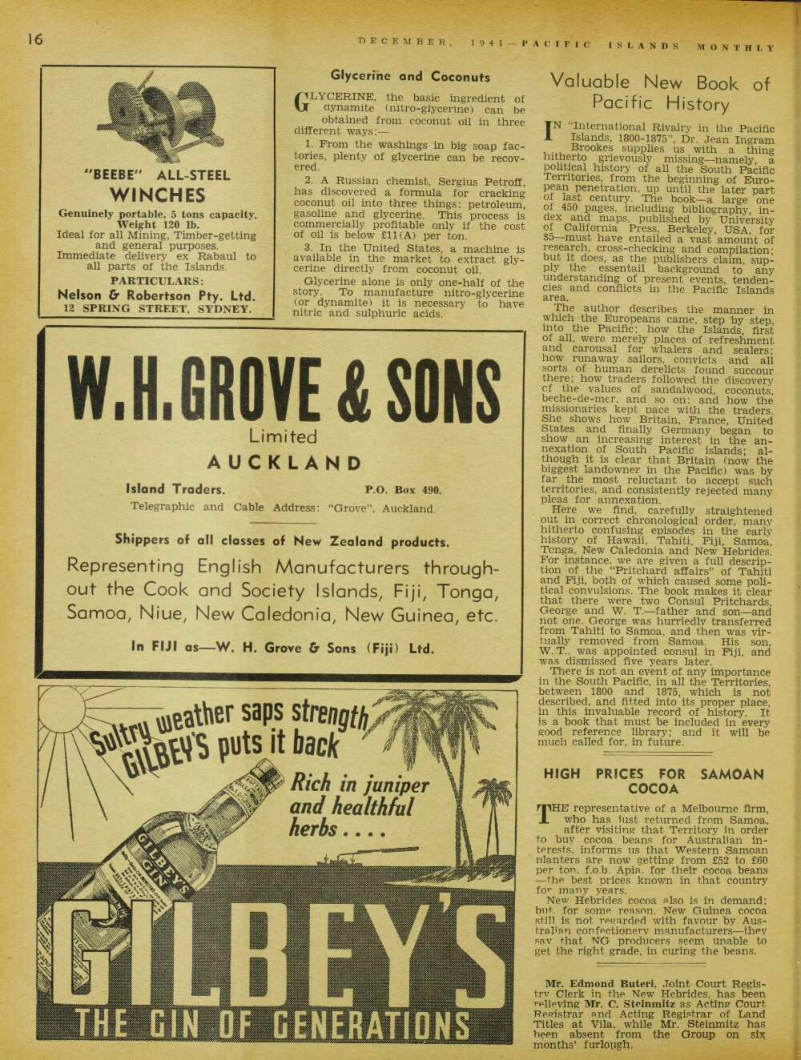
Valuable New Book of Pacific History
IN “International Rivalry in the Pacific Islands, 1800-1875”, Dr. Jean Ingram . ... Brookes supplies us with a thing hitherto grievously missing—namely, a political history of all the South Pacific Territories, from the beginning of Euro pean penetration, up until the later part of last century. The book—a large one of 450 pages, including bibliography, in dex and maps, published by University of California Press, Berkeley, USA, for ss—must have entailed a vast amount of research, cross-checking and compilation; but it does, as the publishers claim, sup ply the essentail background to any understanding of present events, tenden cies and conflicts in the Pacific Islands area.
The author describes the manner in which the Europeans came, step by step, into the Pacific: how the Islands, first of all, were merely places of refreshment and carousal for whalers and sealers; how runaway sailors, convicts and all sorts of human derelicts found succour there; how traders followed the discovery of the values of sandalwood, coconuts, beche-de-mer, and so on: and how the missionaries kept pace with the traders.
She shows how Britain, France, United States and finally Germany began to show an increasing interest in the an nexation of South Pacific islands; al though it is clear that Britain (now the biggest landowner in the Pacific) was by far the most reluctant to accept such territories, and consistently rejected many pleas for annexation.
Here we find, carefully straightened out in correct chronological order, many hitherto confusing episodes in the early history of Hawaii, Tahiti, Fiji, Samoa, Tonga, New Caledonia and New Hebrides.
For instance, we are given a full descrip tion of the “Pritchard affairs” of Tahiti and Fiji, both of which caused some poli tical convulsions. The book makes it clear that there were two Consul Pritchards, George and W. T. —father and son—and not one. George was hurriedly transferred from Tahiti to Samoa, and then was vir tually removed from Samoa. His son, W. T.. was appointed consul in Fiji, and was dismissed five years later.
There is not an event of any importance in the South Pacific, in all the Territories, between 1800 and 1875, which is not described, and fitted into its proper place, in this invaluable record of history. It is a book that must be included in every good reference library; and it will be much called for, in future.