Tangitangs
pp. 17-18 · Read in the full issue
King Of The
Interesting Movement in Gilberts
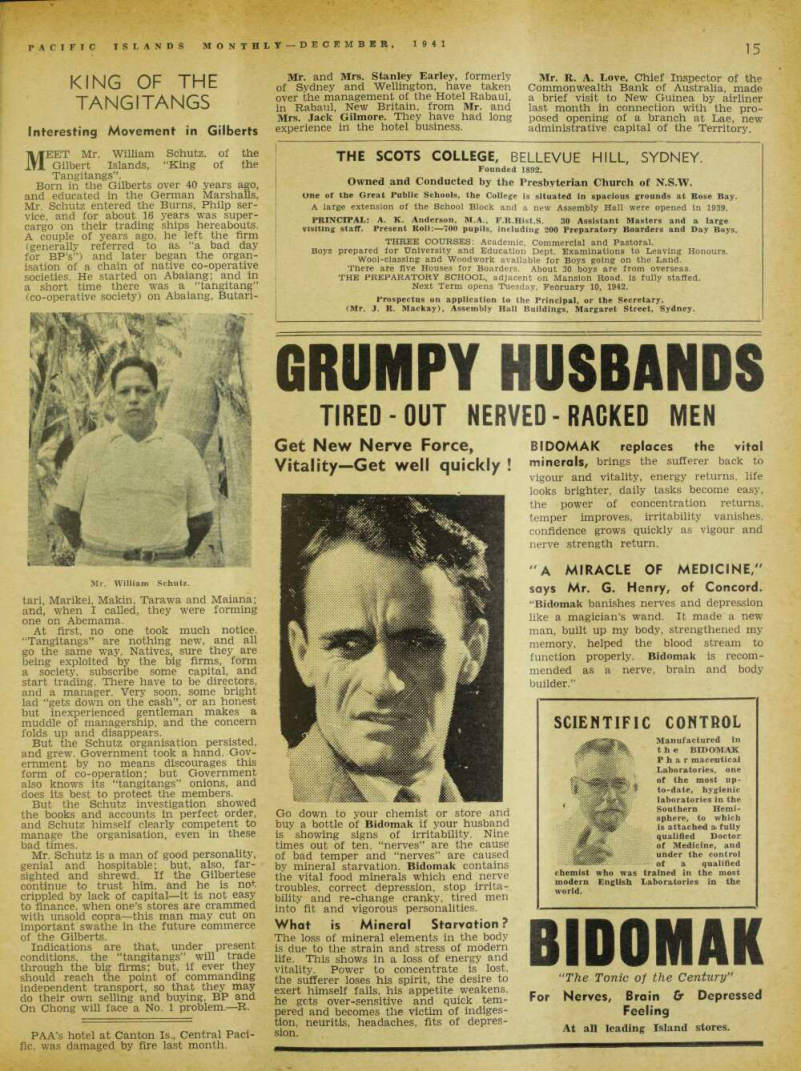
MEET Mr. William Schutz, of the Gilbert Islands, “King of the Tangitangs”.
Born in the Gilberts over 40 years ago, and educated in the German Marshalls, Mr. Schutz entered the Burns, Philp ser vice, and for about 16 years was super cargo on their trading ships hereabouts.
A couple of years ago, he left the firm (generally referred to as “a bad day for BP’s”) and later began the organ isation of a chain of native co-operative societies. He started on Abaiang; and in a short time there was a “tangitang” (co-operative society) on Abaiang, Butari-
tari, Marikei, Makin, Tarawa and Maiana; and, when I called, they were forming one on Abemama.
At first, no one took much notice.
“Tangitangs” are nothing new, and all go the same way. Natives, sure they are being exploited by the big firms, form a society, subscribe some capital, and start trading. There have to be directors, and a manager. Very soon, some bright lad “gets down on the cash”, or an honest but inexperienced gentleman makes a muddle of managership, and the concern folds up and disappears.
But the Schutz organisation persisted, and grew. Government took a hand. Gov ernment by no means discourages this form of co-operation; but Government also knows its “tangitangs” onions, and does its best to protect the members.
But the Schutz investigation showed the books and accounts in perfect order, and Schutz himself clearly competent to manage the organisation, even in these bad times.
Mr. Schutz is a man of good personality, genial and hospitable; but, also, far sighted and shrewd. If the Gilbertese continue to trust him, and he is not crippled by lack of capital—it is not easy to finance, when one’s stores are crammed with unsold copra—this man may cut on important swathe in the future commerce of the Gilberts.
Indications are that, under present conditions, the “tangitangs” will trade through the big firms; but, if ever they should reach the point of commanding independent transport, so that they may do their own selling and buying, BP and On Chong will face a No. 1 problem.—R.
PAA’s hotel at Canton Is., Central Paci fic, was damaged by fire last month.
Mr. and Mrs. Stanley Earley, formerly of Sydney and Wellington, have taken over the management of the Hotel Rabaul, in Rabaul, New Britain, from Mr. and Mrs. Jack Gilmore. They have had long experience in the hotel business.
Mr. R. A. Love, Chief Inspector of the Commonwealth Bank of Australia, made a brief visit to New Guinea by airliner last month in connection with the pro posed opening of a branch at Lae, new administrative capital of the Territory.
Mr. William Schutz.
Glycerine and Coconuts
GLYCERINE, the basic ingredient of dynamite (nitro-glycerine) can be obtained from coconut oil in three different ways;— 1. From the washings in big soap fac tories, plenty of glycerine can be recov ered. 2. A Russian chemist, Sergius Petroff, has discovered a formula for cracking coconut oil into three things: petroleum, gasoline and glycerine. This process is commercially profitable only if the cost of oil is below £ll (A) per ton. 3. In the United States, a machine is available in the market to extract gly cerine directly from coconut oil.
Glycerine alone is only one-half of the story. To manufacture nitro-glycerine (or dynamite) it is necessary to have nitric and sulphuric acids.