Education
p. 34 · Read in the full issue
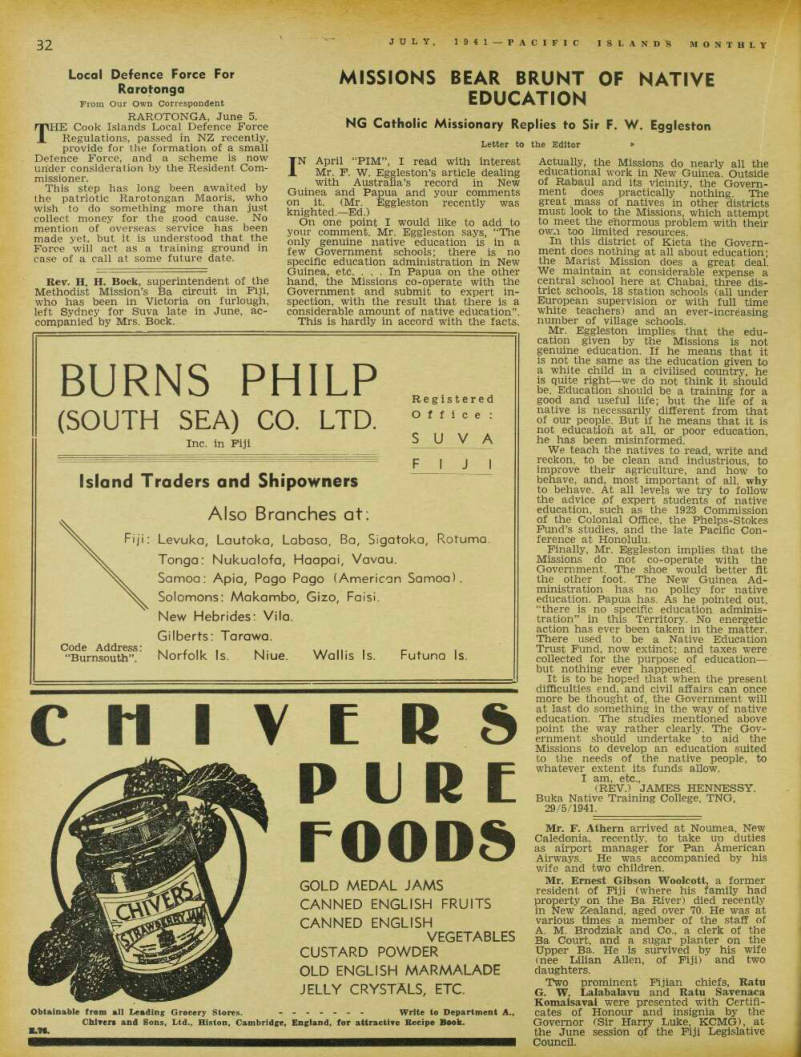
Missions Bear Brunt Of Native
NG Catholic Missionary Replies to Sir F. W. Eggleston
Letter to the Editor
IN April “PIM”, I read with interest Mr. F. W. Eggleston’s article dealing with Australia’s record in New Guinea and Papua and your comments on it. (Mr. Eggleston recently was knighted.—Ed.) On one point I would like to add to your comment. Mr. Eggleston says, “The only genuine native education is in a few Government schools; there is no specific education administration in New Guinea, etc. ... In Papua on the other hand, the Missions co-operate with the Government and submit to expert in spection, with the result that there is a considerable amount of native education”.
This is hardly in accord with the facts.
Actually, the Missions do nearly all the educational work in New Guinea. Outside of Rabaul and its vicinity, the Govern ment does practically nothing. The great mass of natives in other districts must look to the Missions, which attempt to meet the enormous problem with their own too limited resources.
In this district of Kieta the Govern ment does nothing at all about education; the Marist Mission does a great deal.
We maintain at considerable expense a central school here at Chabai, three dis trict schools, 18 station schools (all under European supervision or with full time white teachers) and an ever-increasing number of village schools.
Mr. Eggleston implies that the edu cation given by the Missions is not genuine education. If he means that it is not the same as the education given to a white child in a civilised country, he is quite right—we do not think it should be. Education should be a training for a good and useful life; but the life of a native is necessarily different from that of our people. But if he means that it is not education at all, or poor education, he has been misinformed.
We teach the natives to read, write and reckon, to be clean and industrious, to improve their agriculture, and how to behave, and, most important of all, why to behave. At all levels we try to follow the advice .of expert students of native education, such as the 1923 Commission of the Colonial Office, the Phelps-Stokes Fund’s studies, and the late Pacific Con ference at Honolulu.
Finally, Mr. Eggleston implies that the Missions do not co-operate with the Government. The shoe would better fit the other foot. The New Guinea Ad ministration has no policy for native education. Papua has. As he pointed out, “there is no specific education adminis tration” in this Territory. No energetic action has ever been taken in the matter.
There used to be a Native Education Trust Fund, now extinct; and taxes were collected for the purpose of education— but nothing ever happened.
It is to be hoped that when the present difficulties end, and civil affairs can once more be thought of, the Government will at last do something in the way of native education. The studies mentioned above point the way rather clearly. The Gov ernment should undertake to aid the Missions to develop an education suited to the needs of the native people, to whatever extent its funds allow.
I am, etc.,
(Rev.) James Hennessy.
Buka Native Training College, TNG, 29/5/1941.
Mr. F. Athern arrived at Noumea, New Caledonia, recently, to take up duties as airport manager for Pan American Airways. He was accompanied by his wife and two children.
Mr. Ernest Gibson Woolcott, a former resident of Fiji (where his family had property on the Ba River) died recently in New Zealand, aged over 70. He was at various times a member of the staff of A. M. Brodziak and Co., a clerk of the Ba Court, and a sugar planter on the Upper Ba. He is survived by his wife (nee Lilian Allen, of Fiji) and two daughters.
Two prominent Fijian chiefs, Ratu G. W. Lalabalavu and Ratu Savenaca Komaisavai were presented with Certifi cates of Honour and insignia by the Governor (Sir Harry Luke. KCMG), at the June session of the Fiji Legislative Council.