Captain George
pp. 41-42 · Read in the full issue
Vancouver
THE name and deeds of Captain George Vancouver, RN, are not so well known in the South Seas as they might be, though admittedly his place in the history of exploration was achieved in the northern rather than in the south ern waters of the Pacific Ocean.
He visited the islands of the Pacific as a subordinate in Captain Cook’s expedi tions of 1772-4 and 1776-9. With Cook, he was in Tahiti in 1777. Fourteen years later when, in command of HMS “Dis-
covery”, he dropped anchor in Matavai Bay, Tahiti, he found that the novelty of European advent had departed, and La Nouvelle Isle de Cythere of Bougain ville’s rhapsodies had become an un happy land tom by war and ravaged by strange diseases.
Dr. Corney, the historian, says, “Dur ing the five years that followed the ‘Lady Penrhyn’s’ arrival (1778) not fewer than a dozen ships came to an anchor in the bay of Matavai. It was during this time, too, that several of the mutineers of the ‘Bounty’, and the shipwrecked crew of the ‘Matilda’, lived for a while among the natives. The war with Mo’orea had intervened, and the struggle between Pare and Matavai, fomented by the pat ronage the latter district received from white men, through its bay becoming the resort of shipping, was going on at the time of Bligh’s second visit, shortly after the departure of Broughton and Van couver in 1792.”
Captain Vancouver contributed to this confusion by donating a quantity of gun powder to Pomare 1., although he de clined an invitation to join his ships and men with an expedition against Pomare’s enemies. Moreover, he refused an urgent request for muskets—alleging that he had none to spare.
Vancouver appears to have been the purveyor of a fatal disease hitherto un
known in Tahiti; for, according to the author already quoted, an epidemic out break of dysentery was attributed by the Tahitians to have arrived “by the medium of Vancouver’s ships”. (Note. —In this connection misty minded critics of South Seas missions are invited to remember that the LMS Mission ship “Duff” did not arrive in Tahiti until 1797.) The ship “Discovery” (Captain Van couver) and the brig “Chatham” (Lieu tenant Broughton) anchored at Matavai Bay in December, 1791, the former three days after the latter. On the voyage thither, Vancouver had discovered the Island of Rapa (Austral Group) which, as he himself later acknowledged, he erroneously named Oparo.
Dr. Corney gives details of Vancouver’s exploits in the north, as: “Sailing north from Tahiti. Vancouver made for Nootka, which was then considered to stand on the mainland of what is now British Columbia. Heading from Nootka south ward and passing into the Strait of San Juan de Fuca, he sailed into the Gulf of Georgia. Then turning northward he saw narrows ahead and, passing through with a rushing tide, found himself in the Pacific again. He had discovered that Nootka was an island; not part of the
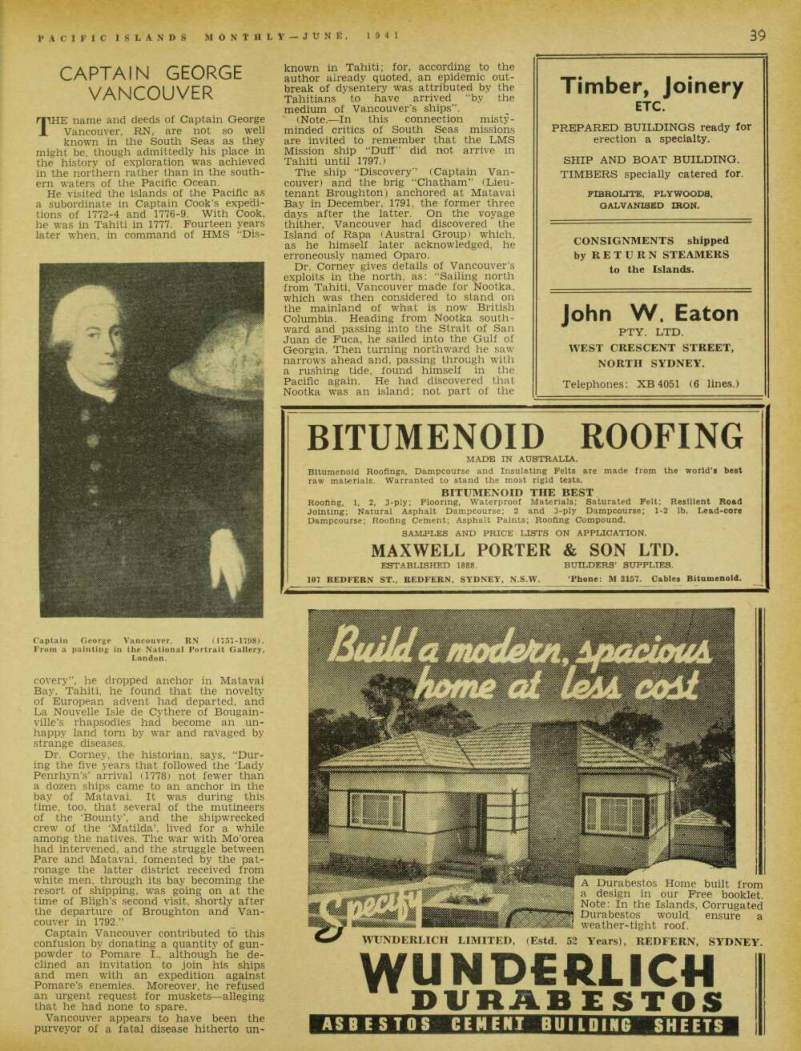
Captain George Vancouver, RN (1757-1798).
From a painting in the National Portrait Gallery, London.
mainland. Vancouver’s name was given to it by the Home authorities.”
A further reference says that the new and expanding city of Vancouver, on the adjacent mainland, was so named in spite of “loud and angry protests by the island’s inhabitants, who foresaw con fusion in the minds of many. The city takes great pride in caring for Captain Vancouver’s last resting place in Peter sham Churchyard, Surrey, England.”