A Tropical Household
p. 40 · Read in the full issue
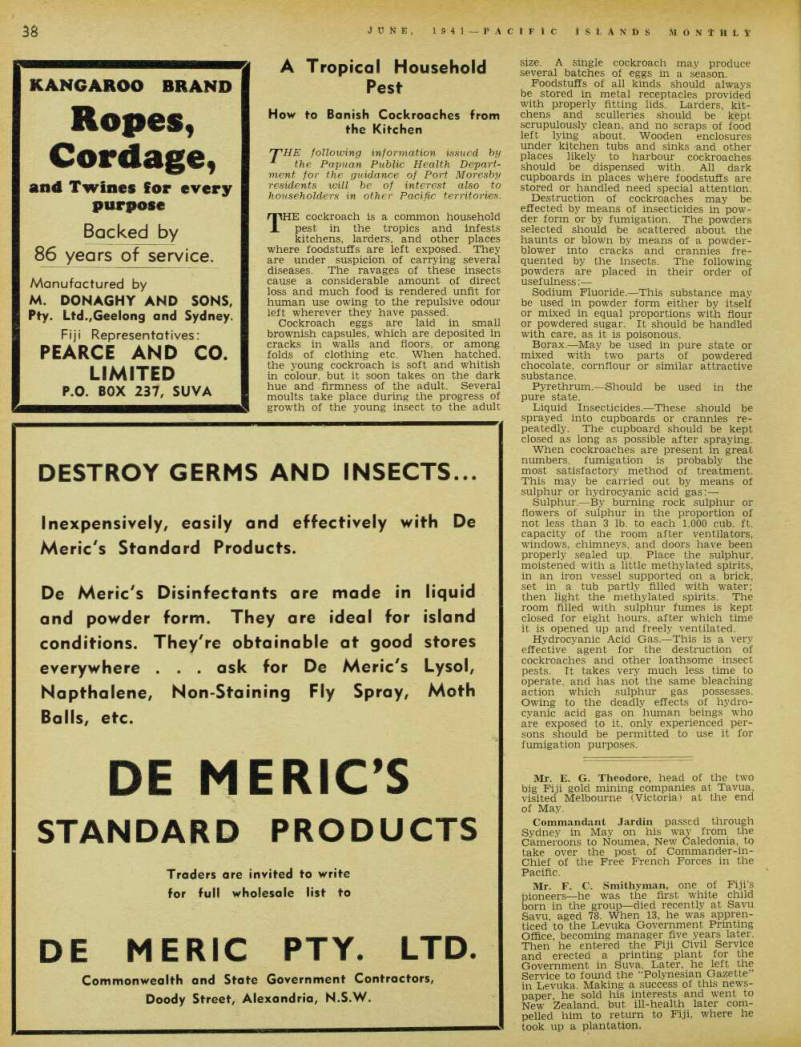
Pest How to Banish Cockroaches from the Kitchen
r VHE following information issued hy 1 tfie Pa V uan Public Health Depart ment for the guidance of Port Moresby residents will be of interest also to householders in other Pacific territories.
THE cockroach is a common household pest in the tropics and infests kitchens, larders, and other places where foodstuffs are left exposed. They are under suspicion of carrying several diseases. The ravages of these insects cause a considerable amount of direct loss and much food 15 rendere d unfit for human use owing to the repulsive odour left wherever they have passed. cockroach eggs are laid in small brownish capsules, which are deposited in cracks in walls and floors, or among folds of clothing etc. When hatched. the y° un S cockroach is soft and whitish in colour, but it soon takes on the dark hue and firmness of the adult. Several moults take place during the progress of growth of the young insect to the adult
size. A single cockroach may produce several batches of eggs in a season.
Foodstuffs of all kinds should always be stored in metal receptacles provided with properly fitting lids. Larders, kit chens and sculleries should be kept scrupulously clean, and no scraps of food left lying about. Wooden enclosures under kitchen tubs and sinks and other places likely to harbour cockroaches should be dispensed with. All dark cupboards in places where foodstuffs are stored or handled need special attention.
Destruction of cockroaches may be effected by means of insecticides in pow der form or by fumigation. The powders selected should be scattered about the haunts or blown by means of a powder blower into cracks and crannies fre quented by the insects. The following powders are placed in their order of usefulness: — Sodium Fluoride.—This substance may be used in powder form either by itself or mixed in equal proportions with flour or powdered sugar. It should be handled with care, as it is poisonous.
Borax. —May be used in pure state or mixed with two parts of powdered chocolate, cornflour or similar attractive substance.
Pyrethrum.—Should be used in the pure state.
Liquid Insecticides.—These should be sprayed into cupboards or crannies re peatedly. The cupboard should be kept closed as long as possible after spraying.
When cockroaches are present in great numbers, fumigation is probably the most satisfactory method of treatment.
This may be carried out by means of sulphur or hydrocyanic acid gas:— Sulphur.—By burning rock sulphur or flowers of sulphur in the proportion of not less than 3 lb. to each 1,000 cub. ft. capacity of the room after ventilators, windows, chimneys, and doors have been properly sealed up. Place the sulphur, moistened with a little methylated spirits, in an iron vessel supported on a brick, set in a tub partly filled with water; then light the methylated spirits. The room filled with sulphur fumes is kept closed for eight hours, after which time it is opened up and freely ventilated.
Hydrocyanic Acid Gas. —This is a very effective agent for the destruction of cockroaches and other loathsome insect pests. It takes very much less time to operate, and has not the same bleaching action which sulphur gas possesses.
Owing to the deadly effects of hydro cyanic acid gas on human beings who are exposed to it, only experienced per sons should be permitted to use it for fumigation purposes.
Mr. E. G. Theodore, head of the two big Fiji gold mining companies at Tavua, visited Melbourne (Victoria) at the end of May.
Commandant Jardin passed through Sydney in May on his way from the Cameroons to Noumea, New Caledonia, to take over the post of Commander-in- Chief of the Free French Forces in the Pacific.
Mr. F. C. Smithyman, one of Fiji’s pioneers—he was the first white child born in the group—died recently at Savu Savu, aged 78. When 13, he was appren ticed to the Levuka Government Printing Office, becoming manager five years later.
Then he entered the Fiji Civil Service and erected a printing plant for the Government in Suva. Later, he left the Service to found the “Polynesian Gazette” in Levuka. Making a success of this news paper, he sold his interests and went to New Zealand, but ill-health later com pelled him to return to Fiji, where he took up a plantation.