Guinea
p. 39 · Read in the full issue
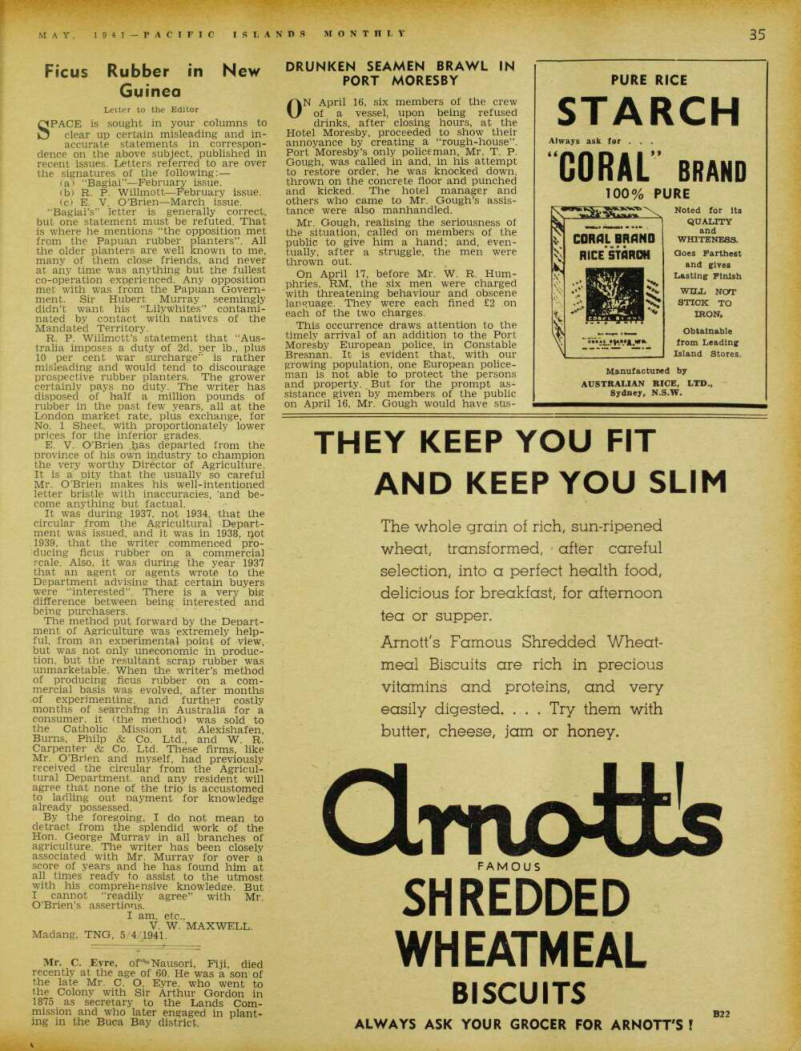
Ficus Rubber in New Guinea
Letter to the Editor SPACE is sought in your columns to clear up certain misleading and in accurate statements in correspon dence on the above subject, published in recent issues. Letters referred to are over the signatures of the following:— (a) “Bagiai”—February issue. (b) R. P. Willmott—February issue, (c) E. V. O’Brien —March issue.
“Bagiai’s” letter is generally correct, but one statement must be refuted. That is where he mentions “the opposition met from the Papuan rubber planters”. All the older planters are well known to me, many of them close friends, and never at any time was anything but the fullest co-operation experienced. Any opposition met with was from the Papuan Govern ment. Sir Hubert Murray seemingly didn’t want his “Lilywhites” contami nated by contact with natives of the Mandated Territory.
R. P. Willmott’s statement that “Aus tralia imposes a duty of 2d. per lb., plus 10 per cent war surcharge” is rather misleading and would tend to discourage prospective rubber planters. The grower certainly pays no duty. The writer has disposed of half a million pounds of rubber in the past few years, all at the London market rate, plus exchange, for No. 1 Sheet, with proportionately lower prices for the inferior grades.
E. V. O’Brien pas departed from the province of his own industry to champion the very worthy Director of Agriculture.
It is a pity that the usually so careful Mr. O’Brien makes his well-intentioned letter bristle with inaccuracies, 'and be come anything but factual.
It was during 1937, not 1934, that the circular from the Agricultural Depart ment was issued, and it was in 1938, pot 1939, that the writer commenced pro ducing ficus rubber on a commercial scale. Also, it was during the year 1937 that an agent or agents wrote to the Department advising that certain buyers were “interested”. There is a very big difference between being interested and being purchasers.
The method put forward by the Depart ment of Agriculture was extremely help ful, from an experimental point of view, but was not only uneconomic in produc tion, but the resultant scrap rubber was unmarketable. When the writer’s method of producing ficus rubber on a com mercial basis was evolved, after months of experimenting, and further costly months of searching in Australia for a consumer, it (the method) was sold to the Catholic Mission at Alexishafen, Burns, Philp & Co. Ltd., and W. R.
Carpenter & Co. Ltd. These firms, like Mr. O’Brien and myself, had previously received the circular from the Agricul tural Department, and any resident will agree that none of the trio is accustomed to ladling out payment for knowledge already possessed.
By the foregoing, I do not mean to detract from the splendid work of the Hon. George Murray in all branches of agriculture. The writer has been closely associated with Mr. Murray for over a score of years and he has found him at all times ready to assist to the utmost with his comprehensive knowledge. But I cannot “readily agree” with Mr.
O'Brien’s assertions.
I am. etc.,
V. W. Maxwell.
Madang, TNG, 5/4/^941.
Mr. C. Eyre, Fiji, died recently at the age of 60. He was a son of the late Mr. C. O. Eyre, who went to the Colony with Sir Arthur Gordon in 1875 as secretary to the Lands Com mission and who later engaged in plant ing in the Buca Bay district.