Survivors Tell Strange
p. 38 · Read in the full issue
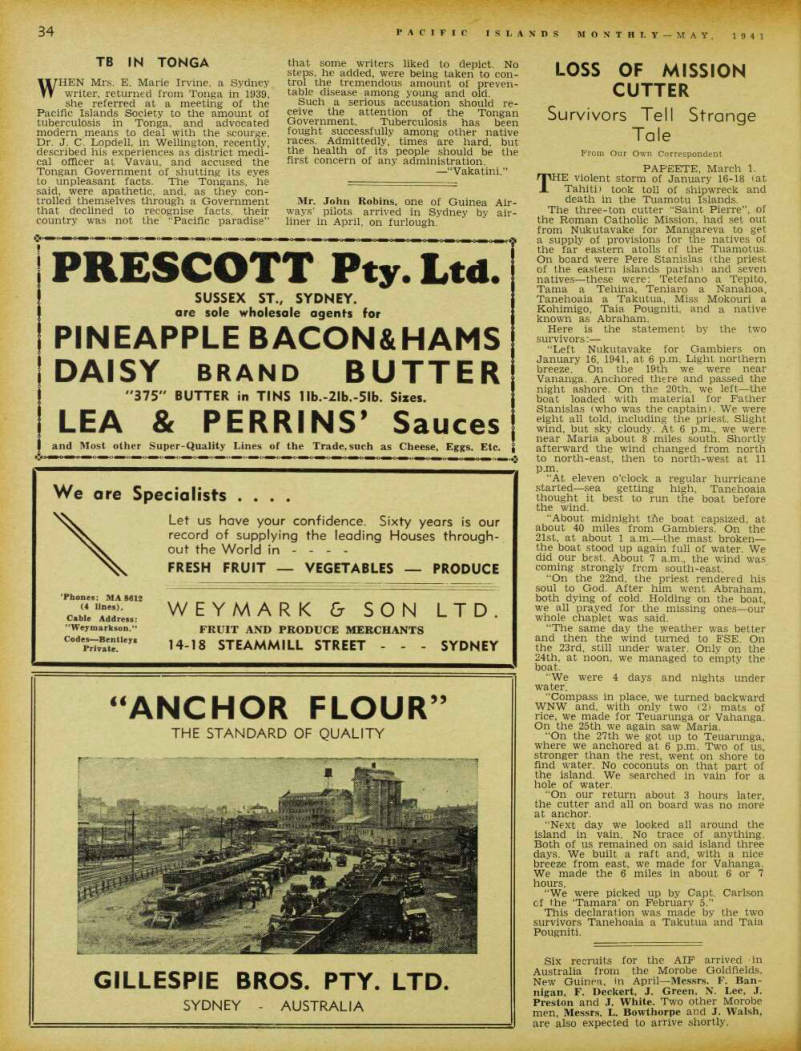
Loss Of Mission
Cutter
Survivors Tell Strange Tale
Prom Our Own Correspondent PAPEETE, March 1.
THE violent storm of January 16-18 (at Tahiti) took toll of shipwreck and death in the Tuamotu Islands.
The three-ton cutter “Saint Pierre”, of the Roman Catholic Mission, had set out from Nukutavake for Mangareva to get a supply of provisions for the natives of the far eastern atolls of the Tuamotus.
On board were Pere Stanislas (the priest of the eastern islands parish) and seven natives —these were; Tetefano a Tepito, Tama a Tehina, Teniaro a Nanahoa, Tanehoaia a Takutua, Miss Mokouri a Kohimigo, Taia Pougniti, and a native known as Abraham.
Here is the statement by the two survivors:— “Left Nukutavake for Gambiers on January 16, 1941, at 6 p.m. Light northern breeze. On the 19th we were near Vananga. Anchored there and passed the night ashore. On the 20th, we left—the boat loaded with material for Father Stanislas (who was the captain). We were eight all told, including the priest. Slight wind, but sky cloudy. At 6 p.m., we were near Maria about 8 miles south. Shortly afterward the wind changed from north to north-east, then to north-west at 11 p.m.
“At eleven o’clock a regular hurricane started—sea getting high, Tanehoaia thought it best to run the boat before the wind.
“About midnight the boat capsized, at about 40 miles from Gambiers. On the 21st, at about 1 a.m.—the mast broken— the boat stood up again full of water. We did our best. About 7 a.m., the wind was coming strongly from south-east.
“On the 22nd, the priest rendered his soul to God. After him went Abraham, both dying of cold. Holding on the boat, we all prayed for the missing ones—our whole chaplet was said.
“The same day the weather was better and then the wind turned to ESE. On the 23rd, still under water. Only on the 24th, at noon, we managed to empty the boat.
“We were 4 days and nights under water.
“Compass in place, we turned backward WNW and, with only two (2) mats of rice, we made for Teuarunga or Vahanga.
On the 25th we again saw Maria.
“On the 27th we got up to Teuarunga, where we anchored at 6 p.m. Two of us, stronger than the rest, went on shore to find water. No coconuts on that part of the island. We searched in vain for a hole of water.
“On our return about 3 hours later, the cutter and all on board was no more at anchor.
“Next day we looked all around the island in vain. No trace of anything.
Both of us remained on said island three days. We built a raft and, with a nice breeze from east, we made for Vahanga.
We made the 6 miles in about 6 or 7 hours.
“We were picked up by Capt. Carlson of the ‘Tamara’ on February 5.”
This declaration was made by the two survivors Tanehoaia a Takutua and Taia Pougniti.
Six recruits for the AIF arrived in Australia from the Morobe Goldfields, New Guinea, in April—Messrs. F. Ban nigan, F. Deckert, J. Green, N. Lee, J.
Preston and J. White. Two other Morobe men, Messrs. L. Bowthorpe and J. Walsh, are also expected to arrive shortly.