A Trader's Tale
pp. 54-55 · Read in the full issue
Lamps, Candlenuts, and the Oracle
By “Tukapa Koko”
BEFORE the Islands became so civilised that copra fell to one-third-of-a penny per pound, the humble huts of the darker brethren were illuminated by candle-nuts, after the sun set and the taro-weeder homeward plodded his weary way.
There were great advantages in the use of the “tui-tui” as an illuminant. It was cheap—in fact, it was free; there were no mantles to buy, no generators (surely an invention of the devil!) to replace, no pumps to re-valve, to re-washer. One applied a match to the string of nuts
threaded on a “kikau”-spike, and there one was.
How different to-day! If one has not a petrol-lamp operated by pressure, or that weird compound of the dear old Miller-type lamp with a wick, and the mantle of the gas school of thought—if one has not this, one is actually dead.
It was vastly different in the days when Plancus was consul.
That was the in-between stage, when the deficiencies of the candlenut were tolerantly recognised, and on such occasions as visitors called, the Lamp of Ceremony was lit, without any insult to the nut of economy.
They were in many houses then, those hanging lamps; and they weren’t cheap to buy! Ornamented with lustrous cry stal prisms, they were beautiful un-lit; but, performing their biological function of a guest-night—generally Saturdays— they made a reed-and-thatch shack into a Fairyland, with the golden glow from their circular wicks reflected by facets of crystal that dazzled the eye.
But they were tigers for kerosene!
The stores used to stock these hanging lamps at £5 or more a time. They were mostly imported from the land of the wooden nutmeg; but one or two of them, made of china wondrously be-flowered, came from the country that has given Adolf Hitler to a wondering world, and there was about them a subtle something, a Teutonic nordicism, that made them different.
In the case of the German lamps, there was a drawback; careless handling of the illuminative portion, belike a knock with the bottle from which it was filled, meant disaster. The “ue”, as the natives term the floral font that held the kerosene, would crack, the fuel flow dis mally away. A vainglorious, becrystalled hanging frame, ornamental but useless, was all that was left.
The knowledgeable Yankees must have known of this, for their product had a brass font, and the be-flowered ‘‘ue” was external to it, a mere camouflage as far as the act of filling was concerned. The first cost was the only outlay, not count ing occasional wicks.
We in Mangaia had —and have—one of these last. It is a goodly thing, even now, and the apple of Teremoana’s eye, in spite of the passing of time and the coming of Tilley-Lamps, Primus-Lamps, Coleman-Lamps, and all the rest of the modern equipment. And our old veteran is more than a lamp—it is an Oracle!
By some strange coincidence, the glass of this lamp always casts the shadow of future happenings, by breaking, even if not lit, without warning or cause, when any important event is on the eve of occurring. It came into our possession eleven years ago, being then over thirty years old. And it has prophesied for us the death of chiefs and native kings, the passing of Commissioners—and their return, after the new incumbent was found to be a dud —the sinking of ships (e.g., the “Tahiti”—we lost goods to the value of £6 in her abandoned parcel mail) and, latterly, the present war.
The bill for glass chimneys, at 2/6 each, has been no small item of our household expenditure; but, on the other hand, the fore-knowledge that is fore-arming is worth that sum.
We are waiting nojv for the glass to crack for the passing of Abominable Adolf, and the end of the war. That will be a half-crown’s worth that I won’t be grudge !
Mr. B. McArdel, formerly a member of the “Papuan Courier” staff in Port Moresby has enlisted with the A.I.F.
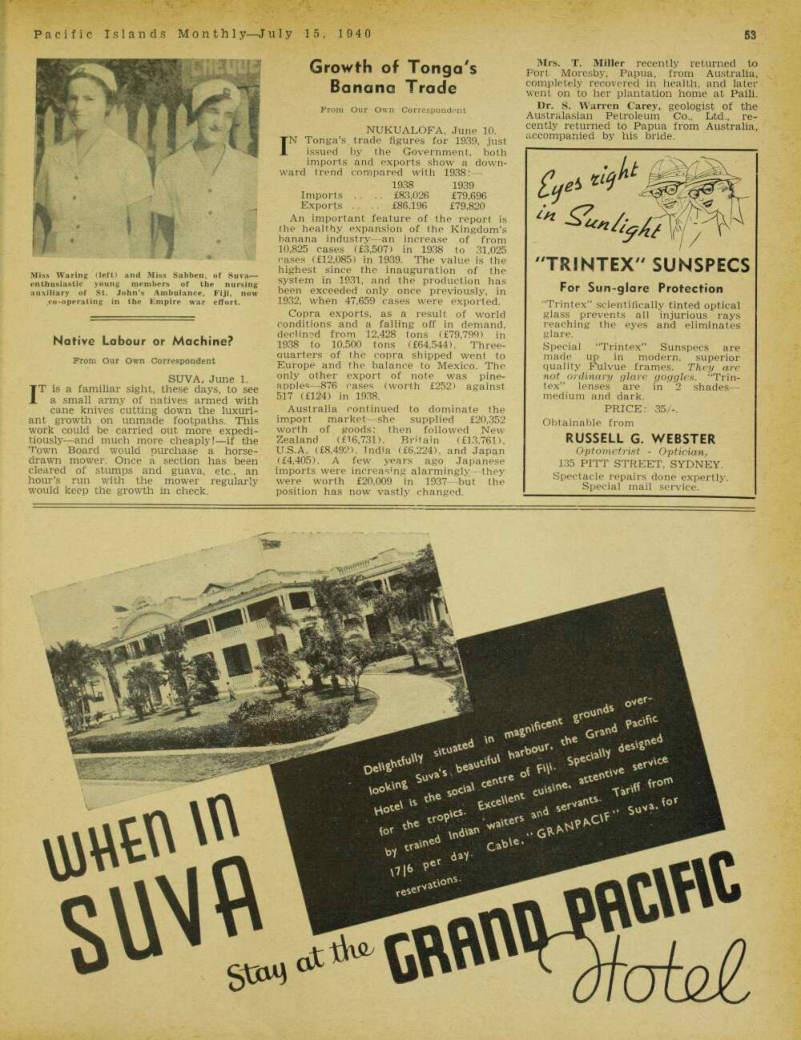
Miss Waring (left) and Miss Sabben, of Suva— enthusiastic young members of the nursing auxiliary of St. John’s Ambulance, Fiji, now co-operating in the Empire war effort.