France’S Collapse Destroys The
pp. 50-54 · Read in the full issue
World’S Balance Of Power
Probable Disintegration of French Empire :: U.S.A. and Japanese Moves and Pacific Status Quo
THE world’s second largest Empire —that of France—may fall to pieces before our eyes. Landless Powers, armed and hungry and wait ing, are planning already to carve up French territories and colonies, in the manner often predicted in this journal during the past ten years.
France’s defences failed; the wolves are at her throat.
We in the Pacific are closely af fected by the fate of France’s colonies in Asia and Oceania. mHE world does not realise, yet, the X vast dislocation of international relationships, and of “balance”, caused by the collapse of France. Here are some of its effects: — 1. Because the French armies in North Africa and Syria, and the French Medi terranean Fleet, can no longer be depended upon, and Britain is too far away, the Balkans nations find them selves unprotected, and jammed between the rival ambitions of the Dictators— Germany and Italy, on the one hand,
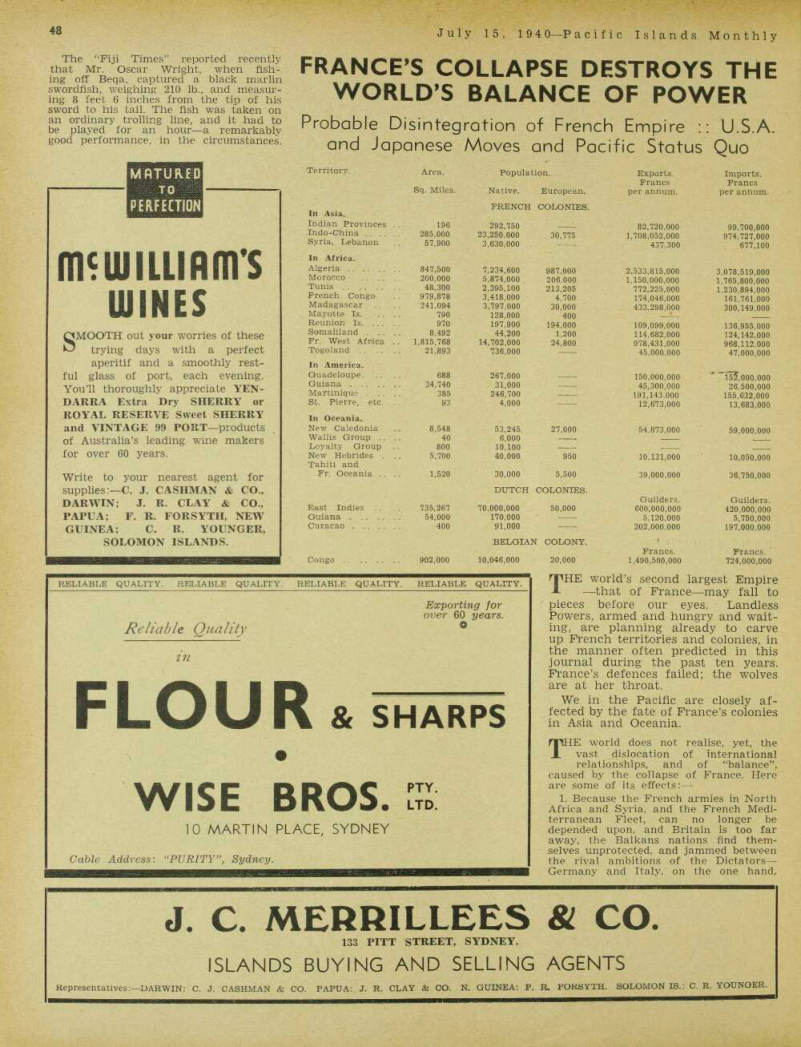
Territory.
Area.
Population.
Exports.
Imports.
Francs Francs Sq. Miles.
Native.
European. per annum. per annum.
French
Colonies.
In Asia.
Indian Provinces . . 196 292,750 82,720,000 99,700,000 Indo-China 285,000 23,250,000 30,775 1,708,052,000 974,727,000 Syria, Lebanon 57,900 3,630,000 437,300 677,100 In Africa.
Algeria 847,500 7,234.600 987,000 2,533,815,000 3,078,519,000 Morocco 200.000 5,874,000 206,000 1,150,000,000 1,765,800,000 Tunis 48,300 2,395,100 213,205 772,225,000 1,230,894,000 French Congo 979,878 3,418,000 4,700 174,046,000 161.761,000 Madagascar 241,094 3,797,000 30,000 433,298,000 300,149,000 Mayotte Is 790 128,000 400 Reunion Is 970 197,900 194,000 109,099,000 136,955,000 Somaliland 8,492 44,200 1,200 114.682,000 124,142,000 Fr. West Africa . . 1,815,768 14,702,000 24,800 978,431,000 968,112,000 Togoland 21,893 736,000 — 45,000,000 47,000,000 In America.
Guadeloupe 688 267,000 150,000,000 ' — 15?,000,000 Guiana 34.740 31,000 — 45,300,000 26,500,000 Martinique 385 246,700 -—.— 191,143.000 155,632,000 St. Pierre, etc. . . &3 4,000 — 12,673,000 13,683,000 In Oceania.
New Caledonia 8,548 53,245 27,000 54,873,000 59,000,000 Wallis Group .. 40 6,000 — Loyalty Group .. 800 10,100 — New Hebrides . .. 5,700 40,000 950 10,131,000 10,050,000 Tahiti and Fr. Oceania .. 1,520 30,000 5,500 39,000,000 36,750,000
Dutch
Colonies.
Guilders.
Guilders.
East Indies 735,267 70,000,000 50,000 600,000,000 420,000,000 Guiana 54,000 170,000 — 5,120,000 5,750,000 Curacao 400 91,000 — 202,000,000 197,000,000
Belgian Colony.
• f Francs.
Francs.
Congo 902,000 10,046,000 20,000 1,490,500,000 724,000,000
and Russia, on the other. Hence, the “non - belligerency” of Turkey, and the growing confusion, as between Rou mania, Hungary, Jugo - Slavia, Bul garia and Greece. 2. There is doubt whether Britain, lacking French help, can defend Egypt, Palestine and the Soudan against a large-scale Ger man-Italian attack, and there is uneasi ness, in consequence, in those countries. 3. Since there is uncertainty and confusion regarding the future of Indo- China (the ability of the French Pup pet Government at Bordeaux to protect and administer that great Territory be ing doubted), Japan deemed the time opportune to an nounce, on June 29,
a “Monroe Doctrine” over South-East Asia, and territories in the seas to the south thereof. This, obviously, was directed towards Britain and the United States, it being assumed that Indo- China is immediately affected by Brit ain’s determination that, sooner than French Colonies shall fall under enemy influence (through the Bordeaux pup pets), Britain herself will take control of them. On the face of it, Netherlands Indies are not so immediately affected
by the Japanese declaration, as they still are under independent Dutch ad ministration; but that administration is directed by the Dutch Government in England, and Japan apparently fears British control, and is presumed to be anxious to bring the East Indies under her new policy. Therefore, United States is vitally interested, in view of the American declaration of April 18, forthright and clear, that any alteration in the status quo in the Pacific would
be “prejudicial to the cause of stability, peace and security ... in the entire Pacific area ... a doctrine for which the United States unequivocally stands.”
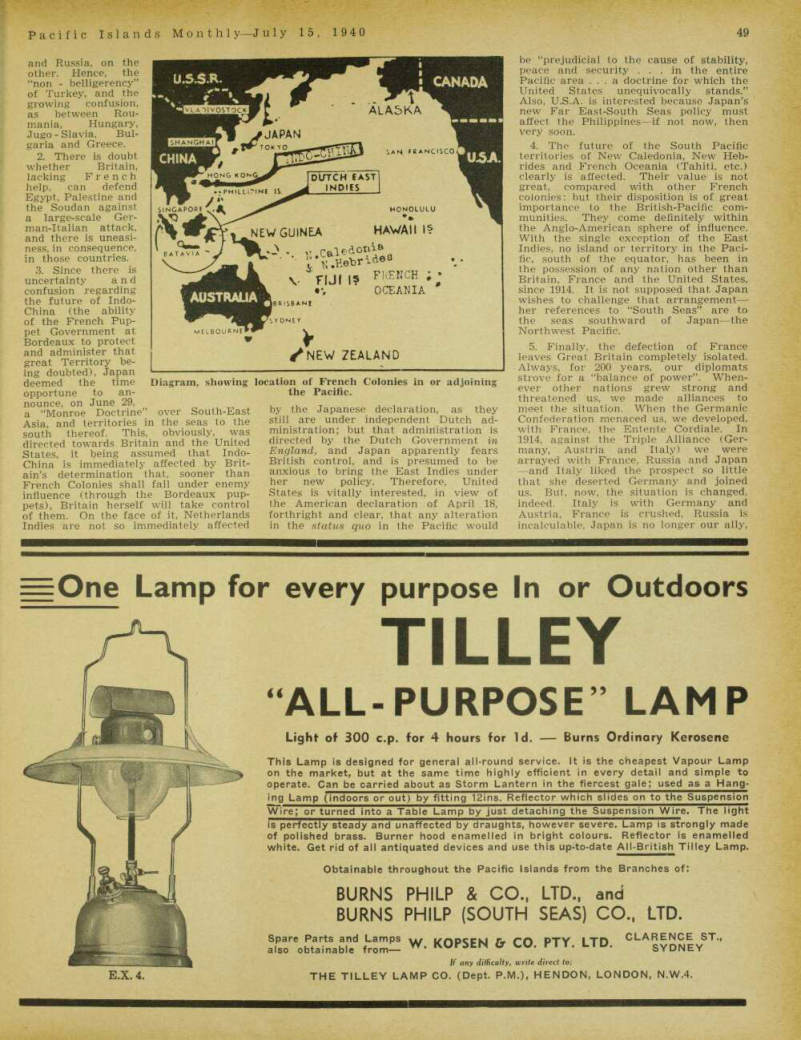
Also, U.S.A. is interested because Japan’s new Far East-South Seas policy must affect the Philippines—if not now, then very soon. 4. The future of the South Pacific territories of New Caledonia, New Heb rides and French Oceania (Tahiti, etc.) clearly is affected. Their value is not great, compared with other French colonies: but their disposition is of great importance to the British-Pacific com munities. They come definitely within the Anglo-American sphere of influence.
With the single exception of the East Indies, no island or territory in the Paci fic, south of the equator, has been in the possession of any nation other than Britain, France and the United States, since 1914. It is not supposed that Japan wishes to challenge that arrangement— her references to “South Seas” are to the seas southward of Japan—the Northwest Pacific. 5. Finally, the defection of France leaves Great Britain completely isolated.
Always, for 200 years, our diplomats strove for a “balance of power”. When ever other nations grew strong and threatened us, we made alliances to meet the situation. When the Germanic Confederation menaced us, we developed, with France, the Entente Cordiale. In 1914, against the Triple Alliance (Ger many, Austria and Italy) we were arrayed with France, Russia and Japan —and Italy liked the prospect so little that she deserted Germany and joined us. But, now, the situation is changed, indeed. Italy is with Germany and Austria, France is crushed, Russia is incalculable, Japan is no longer our ally,
Diagram, showing location of French Colonies in or adjoining the Pacific.
and the United States simply cannot believe that its security actually is challenged.
THE surrender of the French came to the British people as a terrible shock. We could not blame them for falling back, under the frightful blows of the German mechanical Colos sus; but we did expect them to fight on, in Southern France, or in French Northern Africa.
We know, now, that the French armies and the French people were not de feated, and did not surrender, but that they were betrayed by their national leaders. Official France was rotten at
the core. Paris, for 15 years, had reeked of political and commercial corruption.
Any Paris newspaper, and most politi cians, could be bought.
We had known that for many years; but what we did not know was that the rot had extended into the nation’s defence system. The greatest crime of the feeble, futile, fumbling old leaders was their cold-blooded and cynical desertion of Great Britain, in circum stances which placed our Empire at a terrible disadvantage. Nevertheless, our sympathies go out to all the Frenchmen we have known, high-spirited fighters and gallant gentlemen, to whom the
Bordeaux Submission must appear a thing of overwhelming shame. It is a terrible thing to see such men under the heel of Hitlers and Mussolinis.
Little of the French Empire may sur vive. We may as well face facts. Britain will fight on, until her aims are achieved; but the restoration of the France which so cruelly deserted her probably would . demand an effort that cannot be ex pected and could not be justified.
LOOK at the list of French colonies, etc., at the head of this article.
Consider the machinery necessary to permit the administration of those colonies by the so-called Government of France, from Bordeaux.
France, now, is disarmed and occu pied by Germans and Italians. The French masses, and most of the middle classes, we may be certain, are seething with resentment against their betrayers —against the Ministers now functioning at Bordeaux. The Bordeaux Government can carry on only while it is protected by Germany and Italy, and while the French masses are kept in subjection by enemy soldiery. France, to an increasing degree, will be policed by the enemy.
Is it conceivable that, in such circum stances, Great Britain, mistress of the seas, will allow Hitler’s puppet Govern ment, at Bordeaux, to administer colo nies all over the world, which in many cases adjoin British colonies?
It seems more likely that Britain, where practicable, vjyll take the Terri tories under her own protection, to be administered for the duration of the war by the French National Committee established in London. That arrange ment would be similar to what has hap pened in the case of the Dutch, Belgian and Danish colonies.
When Holland and Belgium were over-run, the Dutch and Belgian Govern ments moved to Britain; and, from there, the Dutch officially administered the Dutch territories (previously, when Holland was threatened, they had re moved huge gold reserves from The Hague to New York), and the Belgian officials took charge ot Belgian Congo.
Denmark had surrendered; and Britain thereupon took over her only colony, Iceland, to be held for her until the end of the war.
France, now, is in the same position as Denmark; and Britain, therefore, may be expected to take certain of France’s colonies under her protection, in the same way—subject, however, to the United States “Monroe Doctrine” in the Western Hemisphere (affecting all French colonies in the Americas) and perhaps subject also to Japan’s “Monroe Doctrine of the Far East”.
LATER: It is now July 4. Since the above was written, the position, in rela tion to France, has become worse.
Traitors and Fascists are in control of the Bordeaux Government, and are re acting to the Nazis’ whispered urge, that Britain should not be permitted to “interfere” with the administration of the French colonies. The French people are being held in subjection by German police and German propaganda, France is being “Nazified”, Spain is being lined up with the Nazi-Fascist bloc; and it is not impossible that, very soon, Britain will be officially at war with her late ally, France, as well as with Spain.
That is part of the Dictators’ plan to invade and control Northern Africa, via Morocco.
Dr. Frederick Bowie, of Aberdeen, Scot land, whose name was brought promin ently before the last meeting of the British Medical Association in connection with his discovery of a cure for pneumonia, is a native of the New Hebrides, being the elder son of the late Rev. F. G. and Mrs. Bowie, of Tangoa, Santo.