How Archbold Party Flew To New Guinea
pp. 54-55 · Read in the full issue
By John Williams
Honolulu, June 15.
THE crackerjack trans-Pacific flight of the Richard Archbold party from San Diego, California, to Hollandia, Dutch New Guinea, 8,000 land miles in three hops and 54 hours’ flying time, showed how an ocean should be flown.
There are some facts about it that must go into the record: They used a three-years-old type of airboat, named the “Guba”. The U.S. navy has more than 200 of them as pa trol bombers in use to-day. Archbold used his head in picking what probably was the finest all-round crew ever to take to the air together. All the men, with the exception of Raymond Booth, the radio-man, are pilots.
Russell Rogers, the pilot, probably is at the top of commercial pilots in Ame rica to-day. He doesn’t say so he dodges publicity—but his flying comrades are unstinted in their praise.
Captain Lewis A. Yancey was chosen as navigator because he is the dean of navigators in America. In 1929, with Roger Williams, he flew from New York to Rome, auite a flight for those days.
Then he flew from New York to Ber muda, the first to do so. Long before this, though, he had won pioneering fame in navigating several long non-stop trans-Continental flights. Year by year, he built up his navigation fame. He has
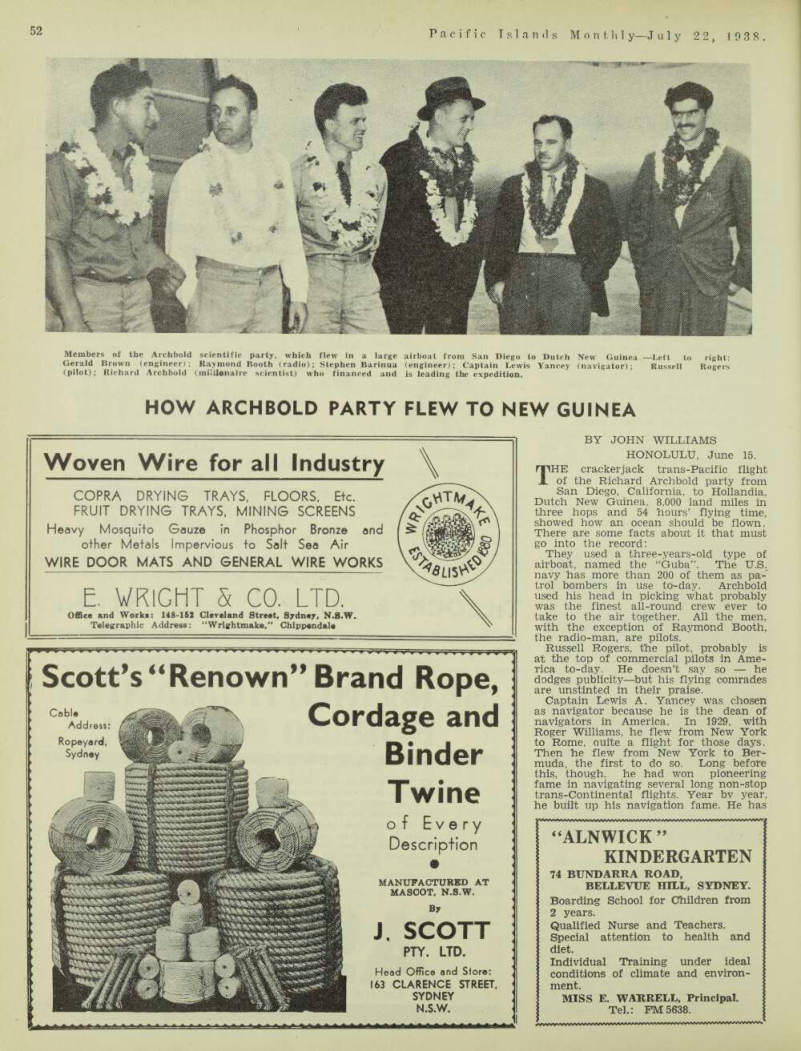
Members of the Archbold scientific party, which flew in a large Gerald Brown (engineer); Raymond Booth (radio); Stephen Barinua (pilot); Richard Archbold (millionaire scientist) who financed and
airboat from San Diego to Dutch New Guinea.—Left to right: (engineer): Captain Lewis Yancey (navigator); Russell Rogers is leading the expedition.
more hours in the air on major flights than any other navigator.
Captain Yancey heartily debunks, as does Captain P. G. Taylor, the Austra lian pilot-navigator, the “mystery”, the “glamour”, with which some attempt to cloak aerial navigation (avigation is the U.S. word for it). Captain Yancey claims any sailor worth his salt could take a ’plane across any ocean.
They flew from San Diego to Hono lulu in 18 hours flat, and without bene fit of publicity ballyhoo, radio aids and surface station ships. Yancey plotted the course, Rogers obeyed orders. Only once did they take a radio bearing and that was to keep a certain company quiet: the company, like the navy, thinks radio aids are imperative. The bearing was taken when the airboat was a little more than an hour out of San Diego.
On the way, the crew had a lot of fun. Russ Rogers made the “iron mike” fly the airboat for hours on end. He sat, hands folded in lap, dozed, read, yarned. The others liked him best when he was cooking over the two-ring elec tric stove back in a fireproof compart ment. He threw together chicken, ham and eggs, spinach, carrots. As he said later; “The boys couldn’t do much about it. They had to eat the grub I tossed them, or else! Mine was the only re staurant in sight!”
No ’plane before had flown non-stop from Honolulu to Wake Island, or from Wake direct to New Guinea. Yancey and Rogers spent some hours at famed Bishop Museum, poring over old charts of the Caroline Islands area. The U.S. press tried to beat up a sensational angle, that the Japanese were peeved about the party flying across their mandated is lands; but the Japanese said they were
sure that if Mr. Archbold planned to use mandated islands facilities he nat urally would make that known through the customary diplomatic channels.
The ’plane actually flew over the is lands at night, so even if they did ac tually go over any island they couldn’t see much of it. That kind of pricked the sensational stories.
While in Honolulu, Mr. Rogers gave me details of the round-the-world con tinuation of the party’s plans, which, of course, depends entirely upon how the notoriously fickle New Guinea weather conditions treat them. Here’s the plan in a nutshell.
Ostensibly, the expedition is to hunt things, from butterflies and marsupials to phythons and rare seeds and climatic data, in New Guinea’s hinterland. There will be some 35 white men employed, many of them scientists from American museums, 75 Dutch soldiers, and hun dreds of native carriers.
Pilot Rogers is to transport them as far up the mountain ranges as possible, then fly food and other supplies in to them, dropping the stuff by parachute above each camp. Then he will have to fly them out, a long and painstaking task that will call upon all the skill he possesses which is something, because he has been flying since he was 13.
They may get the work done in one year: maybe, it will take two. It all de pends upon the weather. If all goes well, then, instead of heading back home across the Pacific, the same party will go down to Java or Darwin, and con nect with the British Imperial Airways route to London, and skip along it.
Then they will fly the North Atlantic
and swoop down into New York —right around the world, back to where they started.
This will be the first time a privately owned ’plane has made the round-the world flight: that is, down across the equator and back over again. The “Guba”, incidentally, is the world’s largest private “air yacht”. Cost, fully equipped; £50,000 sterling.
Mr. Rogers said that there is little likelihood of the “Guba” going down to Brisbane and Sydney.
There is much speculation in the U.S. press about the real purpose of the Archbold expedition into Dutch New Guinea. Highlights of the discussion; Archbold’s last expedition used Papua.
In 1936 Dutch-Shell interests, smiled upon the Dutch Government, made an aerial and ground survey of little-known in ner Dutch New Guinea (as reported in various issues of the P.1.M.).
Archbold is a Standard Oil heir.
Among the scientists accompanying him are geologists skilled in detecting “oil country”. The Dutch Government, again, is showing the utmost friendship.
Don’t forget the Japanese southward thrust. Already, Japanese interests have concessions in Dutch New Guinea.
If there are oil and minerals to be found in Dutch New Guinea, looks like the Dutch-American-British groups are determined to get in first. Archbold has chosen a good all-round crew for his part in it, anyhow.
Mr. C. VV. G. Fox, of the N.G. Admin istration staff, passed through Sydney in June en route to Melbourne, where he will join Mrs. Fox, and spend three months’ furlough.