Training Of
pp. 52-53 · Read in the full issue
Primitive Minds
Methods Of Primory Education In Papua
By Mollie Lett
fJTHIS year, the Papuan Government xt c as L i ssue d Papuan Junior Reader . °- 5 ; a further and more advanced stage m continuance of the series, Nos. 1, 2, 3, and 4, which made their appearance in 1932 and 1934, and which, owing to their comprehensive character, have been in great demand by other Administra tions concerned with the primary edu cation of native people.
These Readers which have been com piled by the London Missionary Society in collaboration with Colonel Hooper, (Inspector of the Queensland Depart ment of Public Instruction), range from the most elementary lessons in reading and writing, on illustrated objects of daily use in the village, to those on in cidents of village life, such as hunting and fishing.
Reader No. 4 was constructed on the same progressive plane, and included illustrated lessons adapted from Papuan folk-lore and fairy tales of other coun tries.
The new Reader, No. 5, deals with a large variety of subjects—historical, poetical and agricultural. The histori cal subjects include such incidents as
the discovery of Australia and America, Drake’s voyage round the world, Vasco de Gama’s voyage round the Cape, and the discovery of Port Moresby by Capt.
Moresby in “H.M.S. Basilisk” in 1872.
Among the poems one recognises simple and popular poems of one’s childhood, such as “Casabianca”, and “Inchcape Rock”.
The design of the lessons enables the natives to increase their knowledge of the English language by enlarging their vocabulary, giving them an outline of the history of important explorations and discoveries; and thus expanding? their knowledge of countries, climates, and food production.
The elementary lessons on the prin ciples of agriculture, and on particular crops—the soil and its requirements, the rotation of crops, etc., and the cultivation of products such as maize, rice, millet,
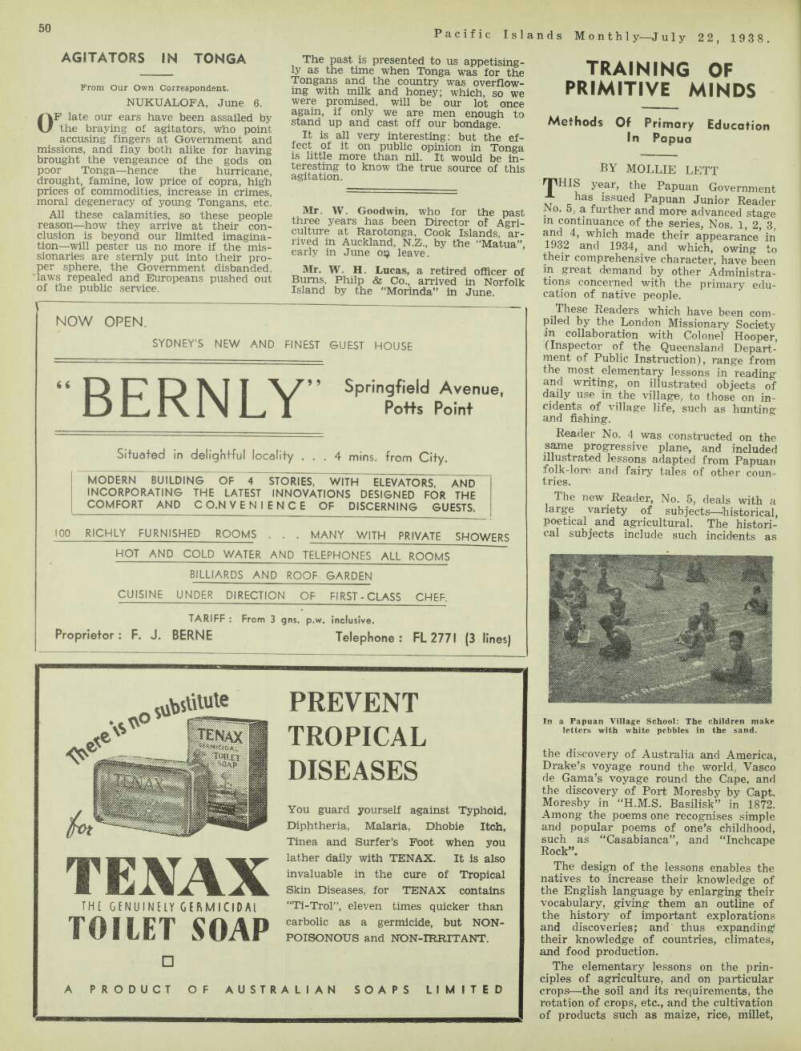
In a Papuan Village School; The children make letters with white pebbles in the sand.
and others—give the essential condi tions for the production of vegetable foods.
These lessons are conducted with practical demonstrations, and it is hoped they will increase both the interest in agriculture and the variety and quality of the natives’ food supply in the Territory.
Apart from the issue of Reader No. 5, Mr. Percy Chatterton, (of the Educa tional Department of the London Mis sionary Society in Papua), has recently prepared and published a Syllabus for village schools in the Territory. It is for the use of trained native teachers and is published in both English and Motuan, and has been kept as simple as possible in order that it may be applicable to the smallest one-teacher schools.
Lessons are conducted in the vernacu lar, and in three classes,A, B, and C.
In the lowest class C, the small child ren are taught the most elementary lessons in simple addition and subtrac tion by means of shells, stones and small sticks. With reading and writing, a few letters are taken at a time, from which they make words, which they eventually write on a black-board.
In the highest class, A, the children are taught multiplication tables, the values of English currency, and reading
and writing and general knowledge.
After completing class A, pupils are ready to commence lessons in English from the Government Readers, 1,2, 3, and 4, and eventually, No. 5.
The education of natives is built on a foundation of village life from the early beginnings. Vernacular teaching is carried on through the lower and up to the middle classes from the ages of five to ten years, in progressive stages, in lessons dealing with incidents in daily village life and customs. The natives
are trained to think in their own langu age; and it is upon this foundation that the L.M.S. have been able to bring edu cation in English up to its present stan dard.
There is one universal civilisation to which the world still is moving, and of which Europe is the leader at the pres sent time; so that the educational system which the Papuan Government is in troducing into the Territory is designed according to European models.
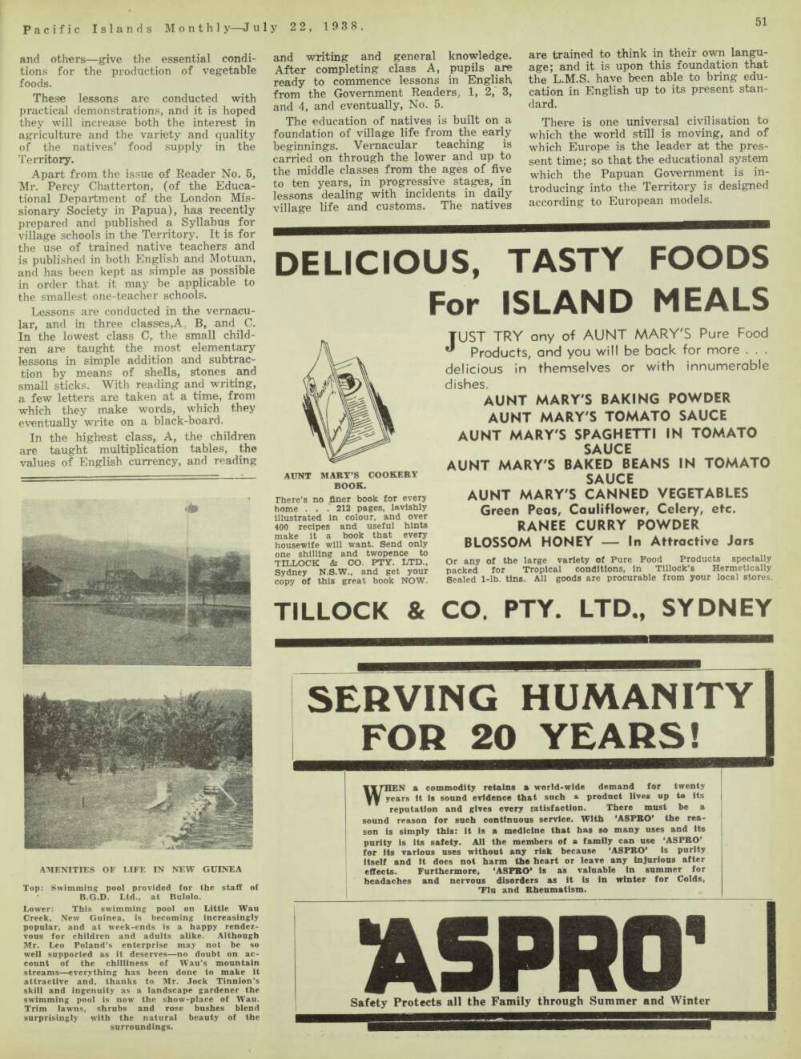
Amenities Of Life In New Guinea
Top: Swimming pool provided for the staff of B.G.D. Ltd., at Bulolo.
Lower: This swimming pool on Little Wan Creek, New Guinea, is becoming increasingly popular, and at week-ends is a happy rendez vous for children and adults alike. Although Mr. Leo Poland’s enterprise may not be so well supported as it deserves—no doubt on ac count of the chilliness of Wau’s mountain streams—everything has been done to make it attractive and, thanks to Mr. Jock Tinnion’s skill and ingenuity as a landscape gardener the swimming pool is now the show-place of Wau.
Trim lawns, shrubs and rose bushes blend surprisingly with the natural beauty of the surroundings.