Monocle”
p. 56 · Read in the full issue
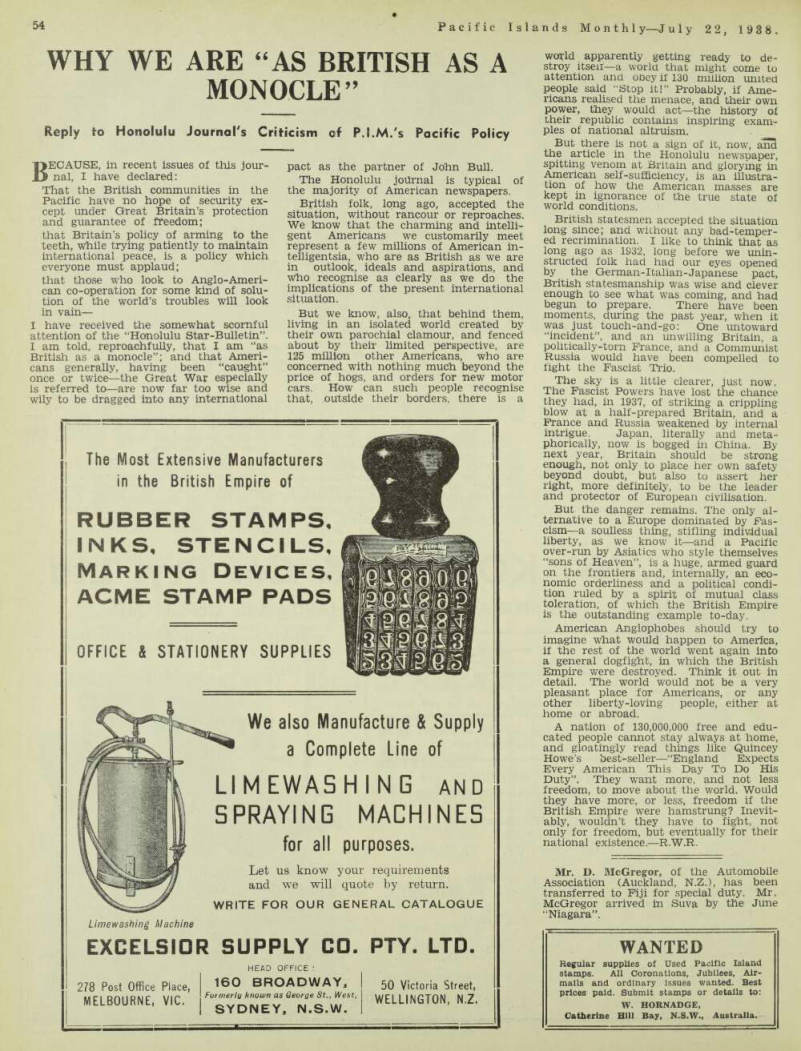
WHY WE ARE “AS BRITISH AS A
Reply to Honolulu Journal's Criticism of P.I.M.'s Pacific Policy
BECAUSE, in recent issues of this jour nal, I have declared: That the British communities in the Pacific have no hope of security ex cept under Great Britain’s protection and guarantee of freedom; that Britain’s policy of arming to the teeth, while trying patiently to maintain international peace, is a policy which everyone must applaud; that those who look to Anglo-Ameri can co-operation for some kind of solu tion of the world’s troubles will look in vain— I have received the somewhat scornful attention of the “Honolulu Star-Bulletin”.
I am told, reproachfully, that I am “as British as a monocle”; and that Ameri cans generally, having been “caught” once or twice —the Great Way especially is referred to—are now far too wise and wily to be dragged into any international
pact as the partner of John Bull.
The Honolulu journal is typical of the majority of American newspapers.
British folk, long ago, accepted the situation, without rancour or reproaches.
We know that the charming and intelli gent Americans we customarily meet represent a few millions of American in telligentsia, who are as British as we are in outlook, ideals and aspirations, and who recognise as clearly as we do the implications of the present international situation.
But we know, also, that behind them, living in an isolated world created by their own parochial clamour, and fenced about by their limited perspective, are 125 million other Americans, who are concerned with nothing much beyond the price of hogs, and orders for new motor cars. How can such people recognise that, outside their borders, there is a
world apparently getting ready to de stroy itsen—a world that might come to attention and obey if 130 million united people said “Stop it!” Probably, if Ame ricans realised the menace, and their own power, they would act—the history of their republic contains inspiring exam ples of national altruism.
But there is not a sign of it, now, and the article in the Honolulu newspaper, spitting venom at Britain and glorying in American self-sufficiency, is an illustra tion of how the American masses are kept in ignorance of the true state of world conditions.
British statesmen accepted the situation long since; and without any bad-temper ed recrimination. I like to think that as long ago as 1932, long before we unin structed folk had had our eyes opened by the German-Italian-Japanese pact, British statesmanship was wise and clever enough to see what was coming, and had begun to prepare. There have been moments, during the past year, when it was just touch-and-go: One untoward “incident”, and an unwilling Britain, a politically-torn France, and a Communist Russia would have been compelled to fight the Fascist Trio.
The sky is a little clearer, just now.
The Fascist Powers have lost the chance they had, in 1937, of striking a crippling blow at a half-prepared Britain, and a Prance and Russia weakened by internal intrigue. Japan, literally and meta phorically, now is bogged in China. By next year, Britain should be strong enough, not only to place her own safety beyond doubt, but also to assert her right, more definitely, to be the leader and protector of European civilisation.
But the danger remains. The only al ternative to a Europe dominated by Fas cism—a soulless thing, stifling individual liberty, as we know it —and a Pacific over-run by Asiatics who style themselves “sons of Heaven”, is a huge, armed guard on the frontiers and, internally, an eco nomic orderliness and a political condi tion ruled by a spirit of mutual class toleration, of which the British Empire is the outstanding example to-day.
American Anglophobes should try to imagine what would happen to America, if the rest of the world went again into a general dogfight, in which the British Empire were destroyed. Think it out in detail. The world would not be a very pleasant place for Americans, or any other liberty-loving people, either at home or abroad.
A nation of 130,000,000 free and edu cated people cannot stay always at home, and gloatingly read things like Quincey Howes best-seller —“England Expects Every American This Day To Do His Duty”. They want more, and not less freedom, to move about the world. Would they have more, or less, freedom if the British Empire were hamstrung? Inevit ably, wouldn’t they have to fight, not only for freedom, but eventually for their
national existence.-
R.W.R.
Mr. D. McGregor, of the Automobile Association (Auckland, N.Z.), has been transferred to Fiji for special duty. Mr.
McGregor arrived in Suva by the June “Niagara”.