Romantic History
pp. 22-24 · Read in the full issue
Of Papeete's Palaces.
How The Town Got Its Nome.
By W. W. Bolton, M.A.
T*HE First Pomare (Ariirahi, or High Chief of Pare-Arue) was not con tent with a single residence in the dis trict over which he ruled. The records show that he raised native homes for himself and family, one at Matavai, one in Papaoa and yet another in Pare.
And there was no mistaking where he lived. They were known by two lofty posts opposite the home, which was always nigh the beach, with the head of a man (a Tiki) carved atop on them, placed on the trail some 70 to 80 yards apart. Wherever he had a home it was so dignified, and the etiquette so strict, and the punishment for non-observance so severe, that all must bare themselves to the waist, both men and women, as they walked past, from the one post to the other.
But the Second Pomare, as he drew near his end, discarded the lot—and not without good reason.
When he returned from exile on Moorea, in 1812, where he had been since 1808, great changes had taken place in his district. Matavai was no longer the rendezvous of shipping. An other and an infinitely better harbour had been found. Matavai was but an open roadstead, yet had had to suffice; for the Papeete of to-day, with its spacious barrier-reefed lagoon, had far too dangerous a Pass for the white pioneers, such as Wallis, Cook and Bligh.
Whalers, however, had come upon the scene from the Sous-le-Vent Group, which was on the whale track from the North to the Antarctic; and whalers dared anything. They were not con tent with the unsheltered Matavai; they tried the Pass, and made it. They were quickly followed by the traders, who set up storehouses on the unnamed beach, and all vessels, even to men-of war, sailed in and cast anchor where wind and sea could be contemned.
The old homes therefore were no place for Pomare, nor the old etiquette attending them. He had passed that stage. Where white men gathered he would be; the place where the vast Nanu once had stood would claim him as a resident. Here, for untold years, had stood the “Long House”, the “Nannoo” of the earliest maps, the social centre of the district, the outstanding feature of the entire waterfront, and the name on every tongue when mentioning the harbour. What went on within, besides debate (as first seen by white men in 1798), is best left to the imagination.
Pomare had property hard by, a fine, broad strip of land, family property from long years past, running down from the hills at the back (where a spring of purest water gushed up) to the placid lagoon. His strip was known as Vai-ete.
He owned also the little islet in the lagoon, directly opposite, which was “Motootoo” to the white men chroniclers, but Motu-uta to him and his, and to us, to-day.
On Vai-ete, at the back thereof, Pomare II raised a native home, his “Palace”, for himself, his two wives and his then only child, a daughter (later ~,,, D „„.' 1 1.. ’ n ,- , '. .
Queen Pomare IV). On his island, hraised a sort of summer-house, where he could retire, away from the crowd; for, unlike his father, he was very far from social and very partial to the rum flask. But Vai-ete as a name could no longer serve In those'days, there were words which were Tapu to the common folk; there was a language for the Chiefs and another for the rest. Chiefs and their kin would say “Good-day” to each other with “Maeva”; but ordinary Tahitians must use “la-ora-na”. So with much else. As “Vai” was the Chiefs’ word for “water”, it could not be used in the daily converse of the common herd. There was nothing for it but to
use the general word for water—“Pape”, The last portion of the name was not Tapu: “Ete” meant “basket” for all (the contrivance to hold the gourds con taining water). h vai ete became p a p e .ete; and, , . p nmo J __j b 5 ir J5, . e uiL,JL , . shortly to become right royal property, when kingship was at long last won (1815), it absorbed all other names of (V '’ . , , ■ ... .. th « vanous fa ™l y p „ r ° p< extensive quarter-moon waterfronh- J re ' u , e ’ ... P , , . .. . < tb ? ug V? U used freely by residents both whlte and natlve )> these leading only to confusion in trade. A town was ln makmg l. °" e name " eeds su f ffi £ e -. the **oyal one naturally the . most Thus arose a tow "
T. d T a A a . me arose ’ wholly unknown to old la nitians.
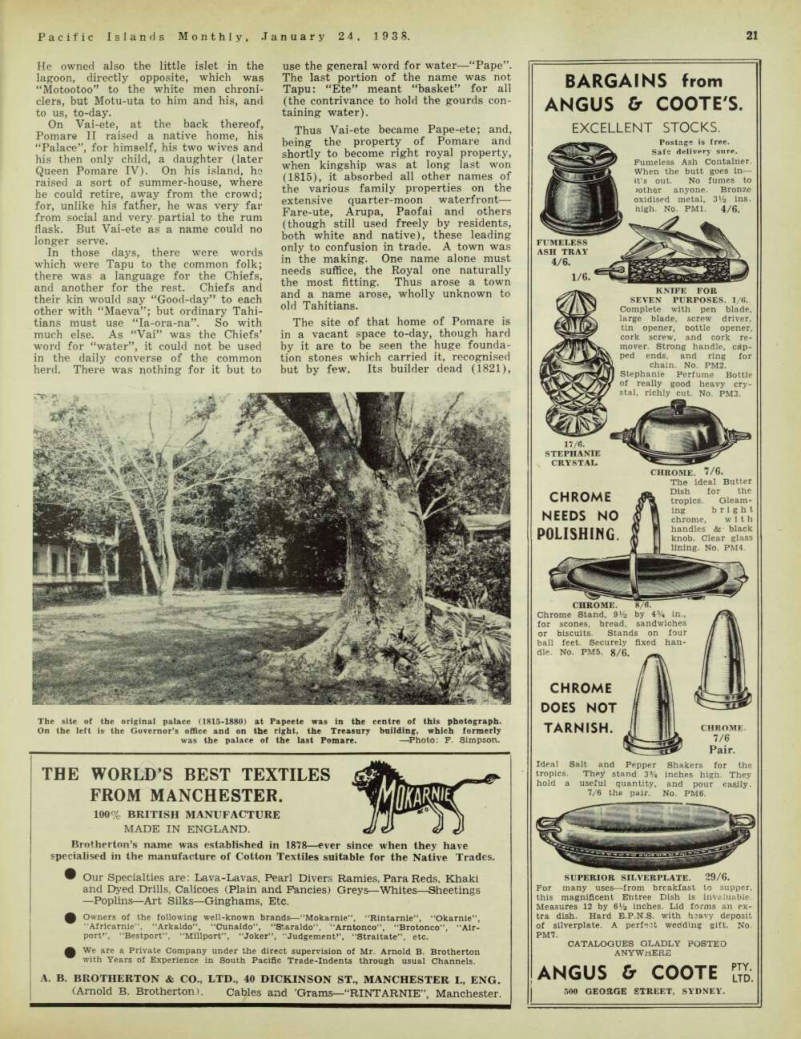
The site of that home of Pomare is in a vacant space to-day, though hard by it are to be seen the huge founda tion stones which carried it, recognised but by few. Its builder dead (1821),
The site of the original palace (1815-1880) at Papeete was in the centre of this photograph.
On the left is the Governor’s office and on the right, the Treasury building, which formerly was the palace of the last Pomare. Photo: F. Simpson.
his baby son (born 1820), dwelt there on and off till he was borne off to school on Moorea, to be brought back in 1827, there to die.
Now a Queen inhabited it, though but a girl of 13 years, and it was to be her home for 50 years—though forced to flee from it for a while when her sovereignty was seized ruthlessly from her by Dupetit-Thouars, and she fled for protection first to the British Con sulate, hard by along the waterfront, thence to the ketch, “H.M.S. Basilisk”, and thence to “H.M.S. Carysfoot”, which bore her off to Raiatea till her sovereignty was returned to her. Then
she lived once more under its roof, though the Protectorate held sway.
When the Queen fled from her home in November, 1843, the French Com mandant (Bruat) ealmly appropriated her residence for himself, and remained there till a ready-made house was shipped out to him from France, which he erected at one side of the Queen’s nigh where now the Governor’s Office stands. When the Queen returned, Bruat offered her, as one of the terms of submission to the Protectorate, a new “Palace”, to be reared for her as a re sidence, but this she refused—she much preferred to dwell under the old roof.
It was falling into disrepair, and al ready. in 1838 she had renovated it, but nothing could wean her away from her girlhood home. There she lived and there she died in 1877.
Her son, Pomare V, succeeding, re mained on until in 1880 he decided for various reasons (needless of mention here) to sell his sovereignty and his people to France. Besides an annuity of 60,000 gold francs, he stipulated that the “Palace”, which—despite the Queen —the French authorities had started erecting in 1860 on the other side of her home from Bruat’s dwelling (but had ceased work upon when but half done) should be completed and furnished for his use.
Here, he dwelt alone, but for his en tourage of kindred spirits. A large, roomy, two-storied building of wood, a cupola atop, and wide verandahs on all sides, gave him what he sought, space for dinners and entertainments, and all the wild accompaniments of a dissipated life. Here, in 1891, a physical wreck, he died, and the last Royal home changed its character; there were no longer kings and queens on Tahiti. It is to-day the French Treasury building.
So fell the final curtain upon Papeete’s Palaces. Only their memory abides.