Choung Chong.
pp. 21-22 · Read in the full issue
Tragedy Of
Sidelight On The Anti-Chinese Policy of N.Z. Labourites.
Prom a Special Correspondent.
Apia, Dec. 6.
CHOUNG CHONG, a respected Chinese resident, was buried yesterday. His tragic death may be laid directly at the door of certain political fools and faddists who direct the Samoan policy of the New Zealand Labour Government.
I do not know the early history of Choung Chong, except that he was born in South China, and came under British influence at an early age. When the war broke out, he was a young man, with a natural aptitude for mechanics. He went with the British forces to India and Meso potamia, and his genius with engines was such that he was always employed on aeroplanes and submarines. He served with bravery and distinction, and the British awarded him v/ith four war decor ations, and a meritorious discharge.
After the war, Chong somehow found
his way to Western Samoa, and was em ployed as a mechanic by the public works branch of the Administration. In later years, he was on the staff of the Gold Star Motor Transport Co., Ltd., where his work was considered valuable and his services irreplaceable. As a workman and citizen, he had an exemplary record in Samoa.
Many years ago, Chong married a Sa moan wife, and he had three children.
His domestic condition was quite happy.
Then came the New Zealand Labour Government, ahd the neVer-to-be-for gotten “Goodwill Mission”. The two mis sioners—two very well-meaning but prac tically uneducated labour members of Parliament, with no prior knowledge of Samoan conditions—regarded with horror the presence of indentured Chinese la bourers in Samoa. They said this was a shocking arrangement, socially, economi cally, ethnologically—only they did not use those words —probably they would not have been able to pronounce them, anyway. But that was what they meant.
They were particularly upset about the appearance in the Samoan community of Chinese half-castes. They need only have asked the then Director of Education in Samoa, Mr. Rutherford, a New Zealander, and they would have been told that
Chinese-Samoan half-castes are usually the cleverest, brightest, prettiest, and strongest children in Polynesia. If they doubted Mr. Rutherford, they could have had the opinion of the Bishop Museum experts, to the same effect.
The missioners were also told, by a deputation of pleading planters, that Chinese labourers were absolutely neces sary for the proper working of Samoan plantations—that Samoans will not work —they have no need to. “Tut, tut!” said the “Goodwill Mission”. “You must learn to do without Chinese. They are most undesirable people—they work far too hard, and they do not demand enough wages. You say you cannot carry on if you have no Chinese? Well, isn’t that just too bad!”
The two futile old gentlemen took a leading part in a fantastic “Welcome Home” to Mr, O. F. Nelson; and then
they paddled back to New Zealand, and the ukase went forth that all Chinese were to be repatriated within twelve or eighteen months. Entreaties and argu ments and curses have not moved the Labour Government —except that it was decided that Chinese coolies employed on cocoa plantations might remain a little longer. All others were to go.
For Choung Chong this was sheer, black calamity. In Apia, he had an im portant job, European and Chinese friends, and a happy little home. In China, he knew no one, and he had no job, and he was now past middle age.
Chong begged to be allowed to remain in Samoa, if not as a mechanic, then as a cocoa-plantation labourer. His plea was supported by various Europeans. The Chamber of Commerce included him among several Chinese artisans and cooks whom they considered necessary in Sa
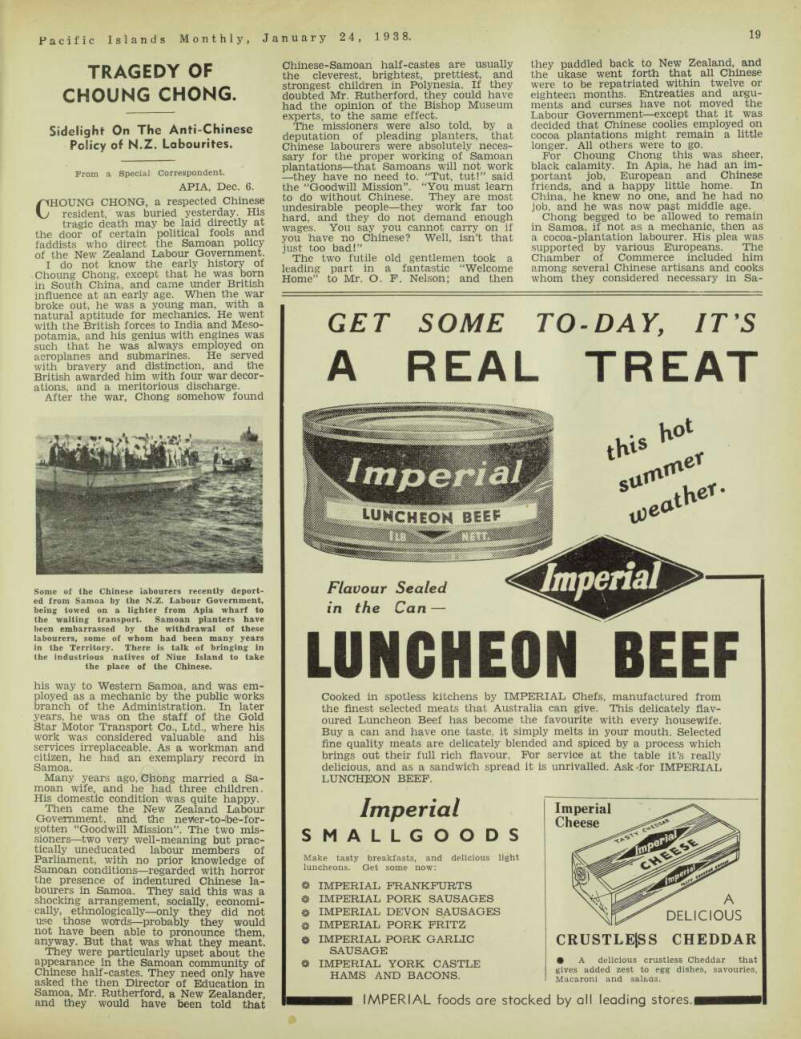
Some of the Chinese labourers recently deport ed from Samoa by the N.Z. Labour Government, being towed on a lighter from Apia wharf to the waiting transport. Samoan planters have been embarrassed by the withdrawal of these labourers, some of whom had been many years in the Territory. There is talk of bringing in the industrious natives of Niue Island to take the place of the Chinese.
moa, and who would suffer cruel hard ship under repatriation.
But the gentlemen who rule in Welling ton were adamant. They said the Chinese must go. Choung Chong was ordered to embark on the “Sagres” for China on December 1.
Chong was in despair. A few days be fore the arrival of the boat, he fled into the bush, and he remained hidden in the hills until the departure of the transport.
Then he crept back to his little home, and his wife and children. But he knew that the evil moment was only postponed—that already Authority was reaching out for him.
Next day, his distracted Samoan wife reported that he was dead. At first, it was thought he had taken poison, but an autopsy revealed no cause of death what
ever Chong, literally, died of a broken heart. * * * A party of 168 Chinese coolies, gathered m from various plantations, were em barked on the “Sagres” on December 2 There were many pathetic scenes as some of the older Chinese said a final Goodbye to their Samoan wives and child ren. Six children accompanied their fathers to China.
The “Sagres” had a large British flag painted on each side—a sign of vtfhat she expected to meet in Par Eastern waters She ran on the reef when leaving Apia Bay, but eventually was hauled off un damaged; but, in being hauled off, a wire rope broke and fouled the propel ler, and divers worked for two days be fore the trouble was remedied. She final ly got away on December 4.